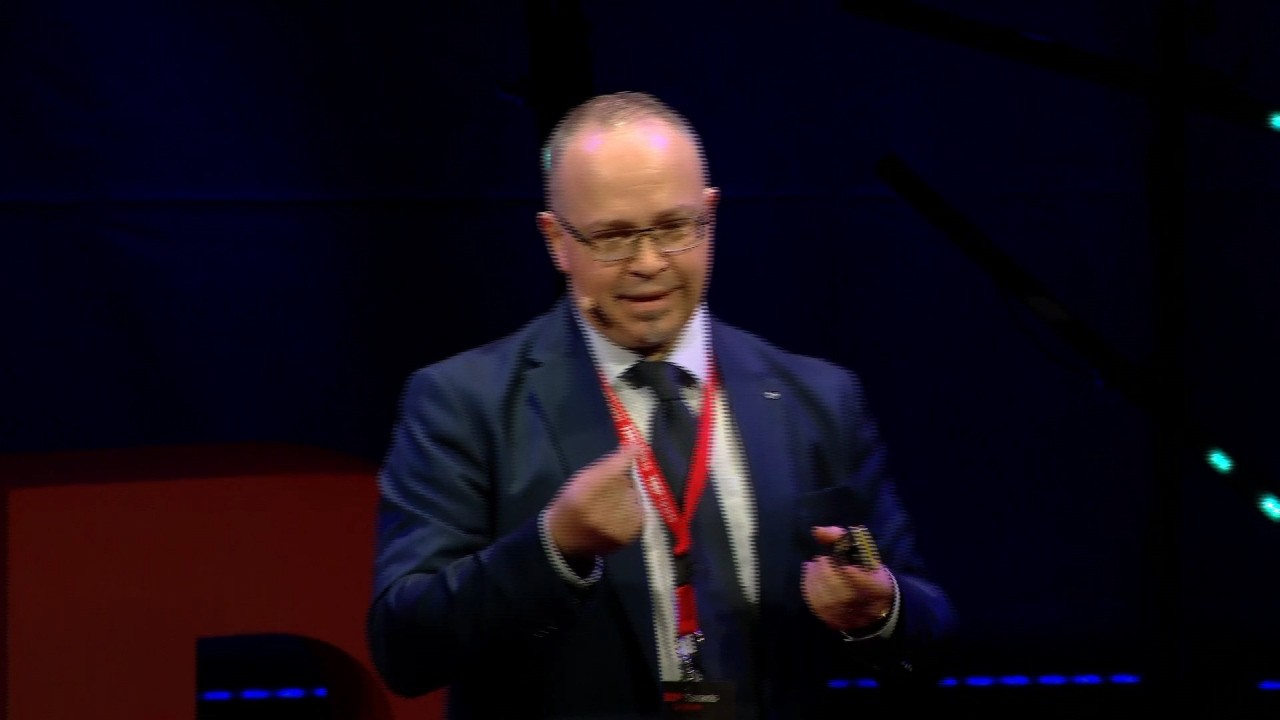
Frontiere invisibili. Guida alla disobbedienza da te stesso | Nicola Gianluca Raimondi | TEDxTaranto
Invisible Frontiers: A Guide to Self-Disobedience | Nicola Gianluca Raimondi | TEDxTaranto
Keywords
Summary
265 words
Critical Evaluation
Value of the Information & Strength of the Argument
The informational value lies less in facts than in a reusable introspective protocol. The ‘invisible passport’ sequence is a compact, transferable exercise: successive questions progressively strip identity layers (given name, inherited surname, family role, occupation, nationality, gender, personal history) and end with a counterfactual self-description. That ordering is the real content, and it is well constructed: each step lowers the level of social definition, and the final question is genuinely open. The observation drawn from the opening visualisation — that a sizeable share of an audience struggles to produce a wish when asked quickly — is used effectively as experiential evidence for the speaker’s claim about restricted aspiration, though it is anecdotal and uncontrolled. Argumentatively, the talk is coherent but circular in places: irritation is pre-framed as confirmation (’the more you get angry, the more the exercise is working’), which makes the thesis effectively unfalsifiable. The ‘bird test’ is presented as a diagnostic but has no scoring, no baseline and no validation; it functions as rhetoric. Several causal claims are asserted with confidence and no hedging — that repeated adult injunctions compress a child’s field of desire, that roles, when performed well, make one forget oneself, that a past narrative ’eats’ the future. These are intuitively plausible and consistent with familiar psychological framings, but they are delivered as certainties rather than hypotheses, and important distinctions (between healthy constraint and pathological inhibition, between desire and impulsive change) are not made. The historical and anthropological asides are the weakest link: the account of a matriarchy destroyed by patriarchal violence, and the attribution of gender norms to the Romans and Greeks, are compressed into a single assertive sentence without qualification. The closing flourish — that the safest life is to stop desiring — is a deliberate reductio, effective as rhetoric, but it leaves the audience with a binary (automaton or desirer) rather than with any account of how one distinguishes a genuine desire from a reactive one, which is precisely the difficult question the exercise raises.
Scientific Rigor, Source Quality, Title Accuracy
No source is cited at any point: no author, no study, no book, no figure. The scientific vocabulary invoked (conditioning, identity, patriarchy, roles) is used in its everyday sense, and the one external name dropped — the astronaut Cristoforetti — serves as an illustration, not as a reference. The historical claim about a matriarchy overthrown by violence, and the attribution of current gender norms to Roman and Greek antiquity, are the passages where the absence of sourcing matters most, since they are stated as settled fact. The talk also relies heavily on anecdote (a doctor who answered the final question in an unexpected way) and on a live, uncontrolled ’experiment’ with the audience, whose results are reported without any count or method. This is acceptable within the register of a stage talk, but it means nothing here can be checked or reproduced by a listener. On the title/content relation, the framing is honest: ‘invisible frontiers’ and ‘disobedience to yourself’ describe exactly what the exercise does, and the talk does not claim to deliver data it does not have. The main rigour deficit is therefore not overreach relative to the title, but the absence of any epistemic marking between metaphor, personal observation and empirical claim.
552 words
Title / Content Match
The title's promise of a 'guide to disobeying yourself' is broadly honoured: the talk is a guided, interactive sequence of exercises designed to make the audience question self-imposed limits. The 'guide' is metaphorical and experiential rather than a structured method, but there is no misleading gap between title and content.
Quality & Reliability
3/10
The talk is a motivational coaching exercise built on a single metaphor (the 'invisible passport') rather than on data, experiments or cited literature. Its claims about identity, childhood conditioning and desire are plausible and echo known psychological concepts (self-concept, self-fulfilling expectations, social roles), but they are asserted rather than demonstrated, and a few historical/anthropological claims (a matriarchy overthrown by patriarchal violence, the Roman origin of gender roles) are stated loosely and without support. No numbers, no methodology, no references: the epistemic status is that of an informed personal-development testimony, not of validated science.
Key Moments
Markers derived by PSI from the transcript: the creator did not define chapters.
- Provocative opening warning: the audience may feel anger or want to change their life; irritation is presented as proof the exercise is working.
- Guided visualisation (a house at dusk, a shooting star) and the instruction to make a wish; only a few hands go up.
- The shrinking sky: the list of childhood injunctions ('don't ask questions', 'you're not good at this', 'be realistic') and the claim that they usually come from people who love you.
- The 'bird test': emotional response to a one-legged bird is offered as a measure of how narrow one's inner world has become.
- Introduction of the 'invisible passport' and first question written on it: 'Who are you?' in five seconds.
- Dismantling of the first labels: given name and surname are received, not chosen.
- Family role, profession and nationality examined as costumes rather than identity ('that is what you do, not what you are').
- Gender norms and the patriarchy/matriarchy claim: identities inherited from decisions one never made.
- Second exercise: introduce yourself in the future tense rather than the past or present.
- Final frontier and closing: 'if you weren't you, who would you be?', followed by the ironic injunction to stop desiring — and the call to dare to wish again.
Cited Sources
- TEDx programme (official TED page) — Only reference given in the description, pointing to the TEDx format under which the talk was independently organised; no scientific source is cited in the talk or the description.
Concurring Sources
- Pygmalion effect — Documents experimentally that expectations communicated by others influence actual outcomes, supporting the talk's core claim that repeated adult injunctions shape what a person believes is possible.
- Self-fulfilling prophecy — General mechanism consistent with the speaker's argument that labels internalised in childhood constrain later behaviour and aspiration.
- Self-concept — Provides the conceptual vocabulary (social roles, identities, self-narrative) that the 'invisible passport' exercise operationalises in lay terms.
Dissenting Sources
- Matriarchy — The talk states that the patriarchy destroyed the matriarchy through violence, presented as historical fact. The anthropological literature is far more cautious: claims of a universal, once-dominant matriarchy are contested and largely unsupported, and the concept itself is defined in several incompatible ways.
Contribution & Novelties
The talk’s originality is procedural rather than factual. Instead of arguing that people are constrained by self-limiting beliefs — a very familiar thesis — it makes the audience perform the constraint live: the wish that is hard to formulate, the five seconds to answer ‘who are you’ (which almost always produces a name given by someone else), the future-tense self-presentation, and finally the counterfactual self stripped of every label. The sequencing is the contribution: it moves from an emotionally accessible entry point (a wish on a shooting star) to an increasingly destabilising question, and it uses the audience’s own discomfort as the demonstration. The ‘invisible passport’ is a lightweight, reproducible device that a listener can reapply, which is more than most motivational talks offer. What it does not offer is a way to distinguish between a liberating desire and a reactive one, nor any criterion for deciding which labels are worth keeping — the very question the exercise opens.
Further reading:
- Self-concept — Background on how self-descriptions are assembled and maintained; useful counterpoint to the talk’s ’labels’ framing.
- Pygmalion effect — Empirical literature on how others’ expectations shape performance, the closest research analogue to the ‘phrases that shrink the sky’ passage.
- Mindset (Carol Dweck) — The fixed-versus-growth framing that underlies the talk’s claim that ‘you can’t’ injunctions become self-fulfilling.
- Matriarchy — Anthropological overview; relevant because the talk asserts a historical matriarchy overthrown by violence, a claim this literature treats far more cautiously.
- Samantha Cristoforetti — The example invoked on stage; verifiable biography of the astronaut used as an illustration of a sky that was not shrunk.
266 words
Radar Profile
The profile is sharply asymmetric: very low technical level and modest information density, paired with a moderate score on quality because the exercise itself is well designed and internally coherent. Reliability sits low, driven by the total absence of cited sources and by unhedged historical claims, while the rhetorical effectiveness of the delivery is high. This is a content profile typical of a stage talk whose value is experiential rather than evidential.