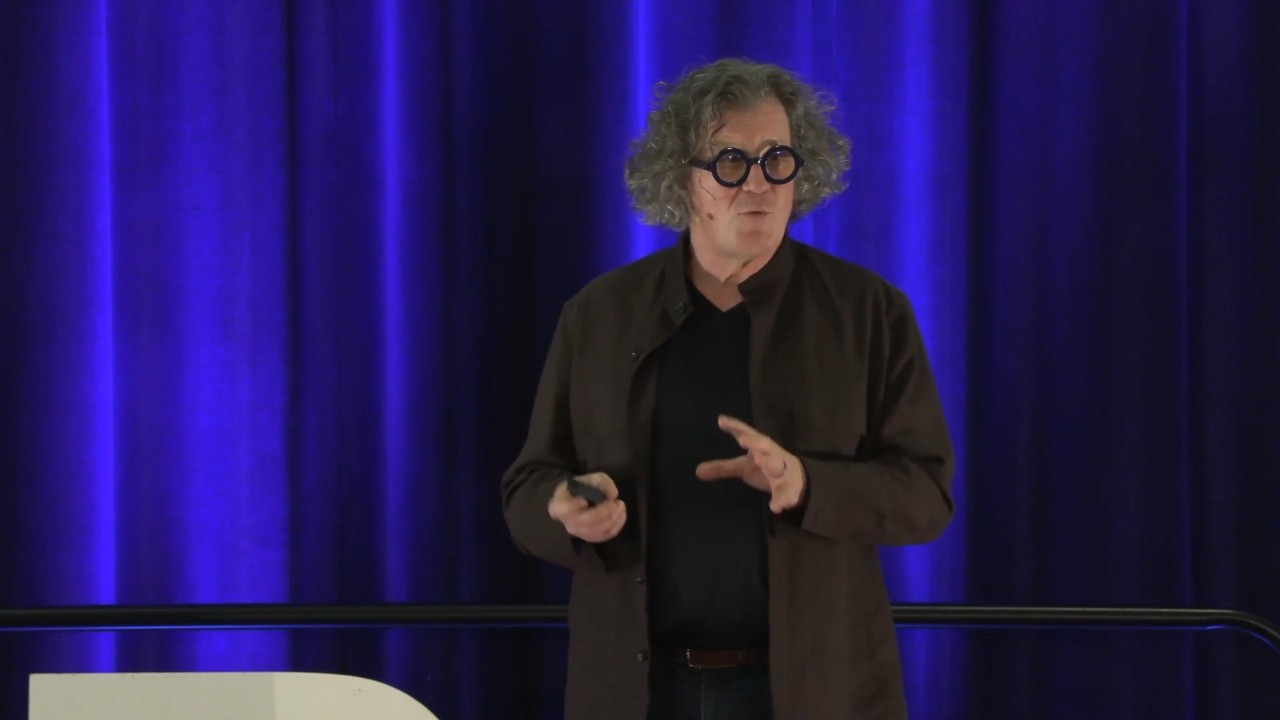
Xperiment - Jon McCormack | Jon McCormack | TEDxBerkeley
Title history
- Xperiment - Jon McCormack | Jon McCormack | TEDxBerkeley — observed on 20261114-0306 UTC (YouTube)
Keywords
Summary
193 words
Critical Evaluation
Value of the Information & Strength of the Argument
The value of the information lies in the original bridge built between artistic photography and cognitive neuroscience. McCormack uses compelling visual demonstrations and cross-scale analogies to make the case that natural patterns have a measurable effect on human physiology. However, the argumentation rests on heavily simplified summaries of scientific studies. While the references to IL-6 and alpha waves point to real phenomena, the talk does not provide the critical context (sample sizes, statistical significance, specific research designs), making the evidence appear more deterministic than it is. The progression from photographic observation to clinical claims feels emotionally driven rather than methodologically rigorous, though it is effective as a motivational call to action.
Scientific Rigor, Source Quality, Title Accuracy
The scientific rigor is limited by the absence of precise citations within the talk. The speaker refers to ‘UC Berkeley researchers’ and ’neuroscience shows’ without naming specific papers or studies, which reduces the capacity for independent verification. The only sources provided in the description are the TEDx guidelines and the general TEDx website, which do not corroborate the scientific claims. The title ‘Xperiment’ is perfectly aligned with the content, framing the talk as an invitation to conduct a personal observational experiment. No comments were provided for analysis, so public reception trends cannot be assessed.
220 words
Title / Content Match
The title 'Xperiment' elegantly captures the speaker's proposition to treat daily observation of nature as a personal experiment. It is highly relevant and accurately reflects the core message.
Quality & Reliability
7/10
The talk blends personal artistic observations with generally plausible scientific claims. It mentions specific research (e.g., UC Berkeley on awe and cytokines) but lacks precise citations within the speech itself (no authors, dates, or specific study titles), which hampers direct verification. The overall direction aligns with established research on nature and wellbeing, though simplified for a broad audience.
Key Moments
Markers derived by PSI from the transcript: the creator did not define chapters.
- Citation of Georgia O'Keeffe on taking time to see a flower, linking her philosophy to the speaker's COVID-era discovery of everyday patterns.
- Illustration of recurring patterns across different scales: a dry riverbed, septarian rock from Utah, and a Masai giraffe's coat.
- Exploration of ice caves, described as 'nature's cathedrals', and mention of black ice caves formed after volcanic eruptions.
- Discovery of microscopic beauty in agate rocks and introduction of diatoms, noting they provide a significant share of the Earth's oxygen.
- Revelation of the speaker's color blindness and how it forced him to perceive the world through patterns, rhythm, and structure.
- Neuroscientific argument: natural patterns increase alpha waves, activate dopamine, and the UC Berkeley study linking awe to lower IL-6 levels.
- Final invitation to the audience: 'What if I slow down enough to wonder?' Concluding call to action for daily attention to nature.
Cited Sources
- TEDx Content Guidelines — Mentioned in the video description's note from TED regarding speaker's personal views and event organization guidelines.
- TEDx Official Page — Referenced in the video description to explain the independently organized TEDx event format.
Concurring Sources
- TEDx Official Page — The talk is hosted under the TEDx platform, and the description directs viewers to this page for event context, supporting the format and speaker's credentials.
Contribution & Novelties
The talk’s primary novelty is the artistic documentation of natural patterns as a gateway to discuss neurophysiological responses to awe. It effectively translates complex neuroscientific concepts into relatable visual analogies, such as comparing ice caves to Fabergé eggs and stained glass windows. This provides a fresh observational framing of ’eco-attention’ as a health-promoting practice.
Pour aller plus loin :
- Biophilia hypothesis — Directly relevant to the claim that humans have an innate tendency to connect with nature, underpinning the health benefits discussed.
- Attention Restoration Theory — Explains the cognitive mechanisms behind why natural patterns and environments replenish directed attention, aligning with the speaker’s call to slow down.
- Research on awe and inflammation (e.g., studies by Stellar et al., 2015) — Pertinent to the specific claim about IL-6 reduction; cited without a specific URL due to uncertainty about exact source addresses, but the concept is central to the talk’s scientific foundation.
150 words
Radar Profile
The radar profile reveals a classic popular science talk: high quantity of information and decent quality of examples, but moderate technical depth and a lower overall reliability score due to the absence of precise citations. The talk is strong on inspiration and visual richness but weaker on standalone scientific verifiability.