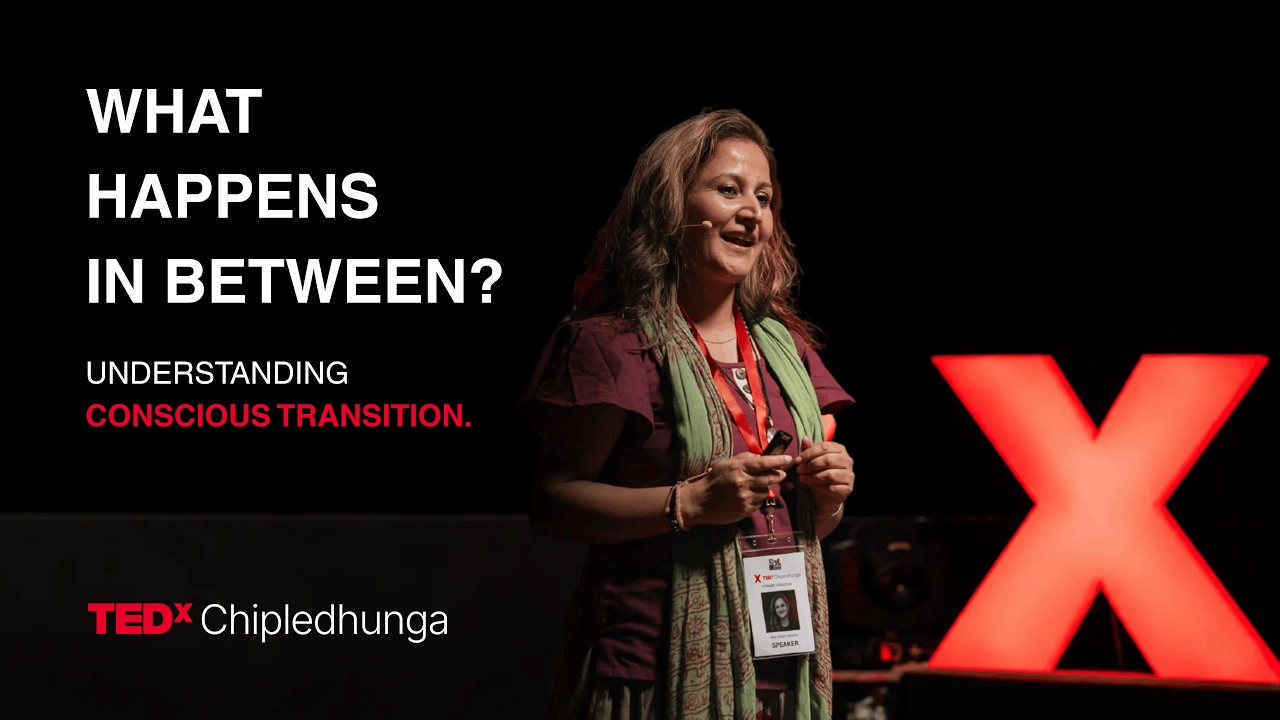
What Happens In Between? Understanding Conscious Transition | Indrani Sharma | TEDxChipledhunga
Keywords
Summary
329 words
Critical Evaluation
Value of the Information & Strength of the Argument
The informational value of the talk lies almost entirely in its framing rather than in its content. The reframing of ‘who am I?’ into ‘who am I becoming?’, and the locating of change in the interval rather than in the endpoints, are efficient rhetorical moves that give the audience a portable lens: attention to the passage between states rather than to arrival. The posture analogy used to introduce ‘conscious transition fitness’ is a genuinely useful didactic image, because it makes the idea of alternating stretch, contraction and recovery concrete. The guided breathing sequence is the only moment where the talk moves from description to experience, and it works as a demonstration of the claim that a minimal shift in attention changes bodily and mental state. Beyond this, the argumentative load is carried by metaphor rather than by reasoning: the river, the bridge and physical fitness each illustrate the thesis without ever testing it.
The core weaknesses are structural. ‘Conscious transition’ is never given an operational definition that would allow anyone to recognise success or failure, and ‘conscious transition fitness’ is named but not specified - no components, no progression, no assessment, no boundaries. The empirical support offered is anecdotal and unquantified: ’thousands of people across different countries’ and a recurring sentence reported from coaching practice, with no indication of how clients were sampled, what was measured, or what proportion expressed that sentiment. The invocation of modern science and neuroscience is gestural; adaptability, attention and recovery are named without any mechanism being described or any finding being stated, so the scientific register adds authority without adding content. Several claims are constructed as unfalsifiable affirmations (’every conversation changes us’, ’the greatest intelligence is inside us’), and no counter-argument is considered - notably that some transitions fail, that stability can be adaptive, or that attention to process can become avoidance of decision. There is also conceptual slippage between yogic awareness, NLP-influenced coaching vocabulary and psychological notions such as resilience and emotional flexibility, which are treated as interchangeable when they belong to distinct traditions with different truth claims. The result is a coherent and well-paced inspirational address whose propositions are persuasive at the level of sentiment but not at the level of evidence, and which offers orientation rather than actionable method.
Scientific Rigor, Source Quality, Title Accuracy
No source is cited anywhere in the talk. The scientific register is invoked twice, once as ’the modern science speaks about adaptability’ and once as ’the neuroscience studies about attention and recovery’, with no author, laboratory, publication, year or figure attached to either statement; the yogic tradition is referenced with the same level of generality (’the yoga has spoken for thousands of years’). The speaker’s authority is established biographically - Himalayan upbringing, PhD scholarship, international coaching practice, NLP certification - rather than evidentially, and the audience is asked to accept the framework on the strength of lived experience. The description adds only the generic TEDx programme link, which documents the event format and not the content. Nothing in the talk is presented as a measurement, a trial or a review, and nothing is claimed to be replicated, so the absence of citations is consistent with the genre; it nonetheless means no statement can be checked, and the borrowing of scientific vocabulary without scientific referents is the principal rigour problem. On the title-content relation, the talk delivers on its promise: ‘What Happens In Between?’ is answered directly by the notion of conscious transition as the space between states, and the bridge and river images serve that theme throughout. The subtitle’s ‘understanding’ is the one overstatement, since the talk explores and evokes the interval rather than analysing it.
618 words
Title / Content Match
The title asks what happens 'in between', and the talk's central thesis is precisely that neglected interval between states, so the match is strong; only the word 'understanding' overpromises, since the talk offers reflection rather than analysis.
Quality & Reliability
3/10
The talk is internally coherent and clearly structured, but its evidentiary basis is personal experience, metaphor and appeal to the speaker's credentials rather than data, cited studies or a described method. References to 'modern science', 'neuroscience' and yogic tradition are made generically, with no authors, publications, figures or experimental results. The only external link is the generic TEDx programme page. Claims about adaptability, attention and recovery, and about the benefits of 'conscious transition fitness', are stated rather than demonstrated and are framed in ways that make them difficult to falsify. The content is honest about being a reflective, experiential account, which keeps it above the lowest band, but it does not meet the standards of verifiable scientific communication.
Key Moments
Markers derived by PSI from the transcript: the creator did not define chapters.
- Opening provocation: who are you beneath name, profession and social roles, and how many versions of you have already existed today.
- Reframing of the central question from 'who am I?' to 'who am I becoming?', with the claim that every conversation, disappointment and breath changes us.
- Presentation of the speaker's Himalayan background and of nature as her first teacher: silence from the mountains, patience from the forest, transformation from the rivers.
- River metaphor developed: the same river reflects the sky or carves rock, and never resists its own changing; the question of why nature transitions gracefully while humans suffer.
- Report from coaching practice across countries: the recurring sentence 'I know where I want to be but I do not know how to be there'.
- Definition of conscious transition as the middle between point A and point B, and the claim that this interval is where life is actually created.
- Loose appeals to modern science on adaptability and to neuroscience on attention and recovery, placed alongside yogic attention to breath, thought and action; the imagined school that teaches transition instead of achievement.
- Introduction of 'conscious transition fitness' via the posture analogy: a healthy body stretches, contracts, recovers and balances rather than holding one position.
- Guided breathing exercise: inhale, notice the body, exhale, notice the shift in body, attention and mindset as an instance of transition.
- Bridge image and closing question: we celebrate and measure beginnings and endings but not what happens in between; the final question becomes how you move ahead.
Cited Sources
- TEDx programme page (ted.com/tedx) — The only link in the description; it documents the TEDx format and the fact that the event was independently organised by a local community. It is not a source for any of the substantive claims made in the talk.
Concurring Sources
- Mindfulness (Wikipedia) — Supports the general claim that deliberate attention to breath and present experience is a documented practice with a research literature, which is the direction the talk gestures towards without citing.
- Flow (psychology) (Wikipedia) — Concordant with the idea that the quality of engagement during an activity, rather than its endpoint, carries much of the experienced value.
- Neuroplasticity (Wikipedia) — Concordant with the broad claim that repeated experience modifies us; the talk asserts this without describing mechanism or limits.
Dissenting Sources
Contribution & Novelties
The originality of the talk is terminological and metaphorical rather than substantive. The coinage ‘conscious transition fitness’ - the capacity to recognise and move wisely into the next state - recombines three familiar ingredients: yogic attention to breath and thought, coaching vocabulary around resilience and emotional flexibility, and a fitness analogy borrowed from physical training. Framing the capacity to change as something trainable, with alternation between effort and recovery rather than a permanent posture, is a serviceable mnemonic and gives the audience a handle on an otherwise abstract injunction to ‘be present’. The bridge image carries a real conceptual point: the interval deserves as much attention as the endpoints, and both banks must be held equally. What is not new is the underlying content, which restates longstanding contemplative and self-help themes - awareness of the present moment, the gap between stimulus and response, change as process rather than event - without adding a model, a measurement, a protocol or a testable hypothesis. The talk therefore contributes a memorable vocabulary and two durable images rather than a framework anyone could apply or evaluate. It would need defined components, observable indicators and some form of outcome evidence before ‘conscious transition fitness’ could function as more than a slogan.
Pour aller plus loin :
- Flow (psychology) — Directly relevant to the talk’s claim about full absorption in the interval between states; provides the research vocabulary the talk alludes to without naming.
- Mindfulness — Background on the attentional practices the speaker associates with yogic tradition, including how they are operationalised and measured in contemporary research.
- Neuroplasticity — The actual scientific referent behind the talk’s vague appeal to ‘adaptability’ and to what experience does to the brain.
- Cognitive reappraisal — The emotion-regulation construct closest to the talk’s ‘from anger into awareness, from failure into learning’, and one that is empirically studied.
- Viktor Frankl — Frequently associated with the idea of a space between stimulus and response, a formulation often quoted in this genre and worth checking against its actual source.
- Executive functions and response inhibition — the cognitive-control constructs that would need to be specified if ‘conscious transition fitness’ were to be turned into a measurable capacity; cited by name only, as no single stable reference page is asserted here.
375 words
Radar Profile
The profile is sharply asymmetric: technical level and reliability sit near the floor while the talk's appeal rests on rhetorical and experiential force, which the radar does not capture. High thematic ambition combined with near-zero specification produces the characteristic signature of inspirational content - strong on framing, empty on method. Information quantity is moderate only because the talk is long and repetitive rather than because it delivers many distinct points.