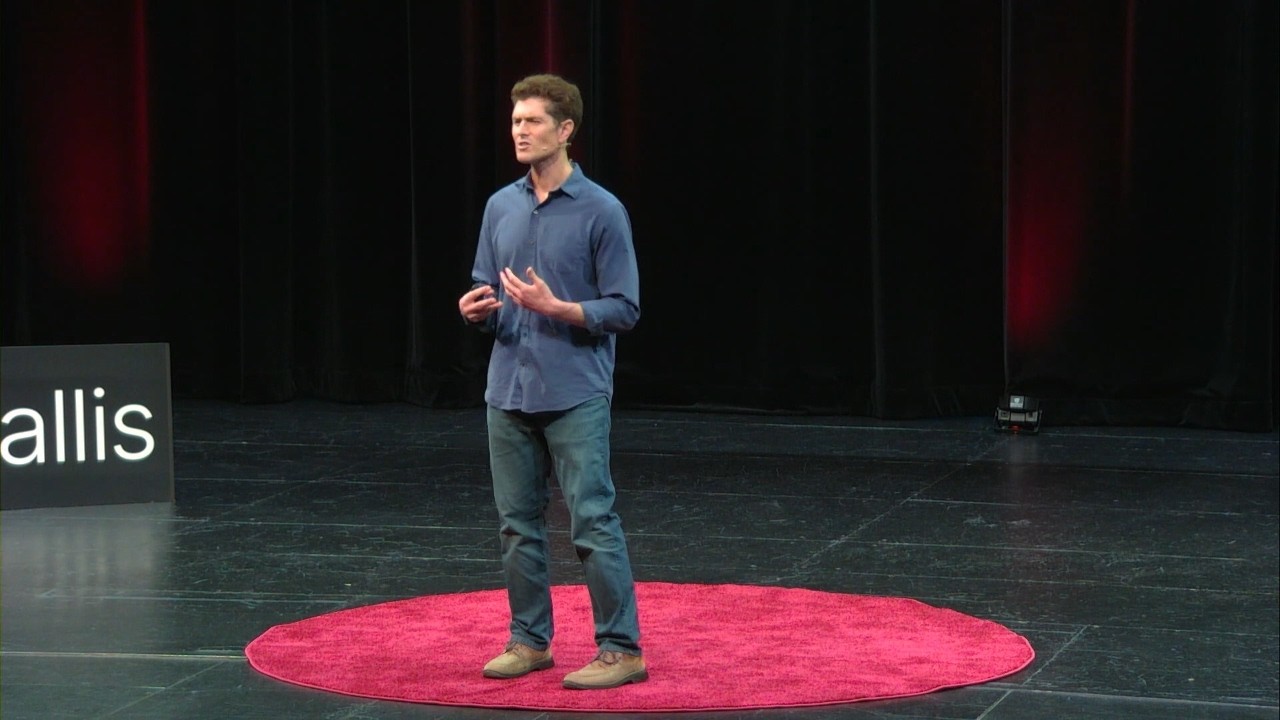
Why Schools Should Create More Opportunities for Disagreement | Mark Urista | TEDxCorvallis
Title history
- Why Schools Should Create More Opportunities for Disagreement | Mark Urista | TEDxCorvallis — observed on 20261110-1737 UTC (YouTube)
Keywords
Summary
168 words
Critical Evaluation
Value of the Information & Strength of the Argument
The value lies in its practical illustration of how structured disagreement can transform students’ understanding, supported by a concrete anecdote that moves from conflict to collaborative learning. The argumentation is coherent: Urista builds on three key concepts—perspective-taking, critical thinking, and self-efficacy—each linked to a relevant psychologist (Ross, Bandura) and illustrated with real examples. However, the reasoning relies heavily on a single case study and personal testimony, lacking empirical data or broader research support. The bridge analogy and family story are persuasive but not systematically rigorous. Overall, the talk presents a compelling vision but its evidence is primarily anecdotal.
Scientific Rigor, Source Quality, Title Accuracy
The talk references scientific concepts accurately but does not cite specific studies or external sources during the presentation. The only provided link is the general TEDx page, indicating no additional references. The title precisely matches the content, focusing on the need for more disagreement opportunities in schools. The speaker’s credibility is enhanced by his background in communication and civil discourse programs, though the lack of citations limits the scientific rigor. The argumentation is internally consistent but not backed by a literature review or data.
197 words
Title / Content Match
The title accurately reflects the talk's central argument that schools should provide structured opportunities for disagreement.
Quality & Reliability
7/10
The talk draws on established psychological concepts (naive realism, self-efficacy) and personal teaching experience, but relies on anecdotal evidence rather than systematic research.
Key Moments
Markers derived by PSI from the transcript: the creator did not define chapters.
- Introduction: Urista expresses his love for productive disagreement.
- Story: Campus controversy over an artwork display; students visit his office.
- Students prepare for debate and realize legitimate arguments on the other side.
- Discussion of naive realism and its role in the artwork conflict.
- Critical thinking as testing ideas; engineering bridge analogy.
- Managing discomfort; family background and self-efficacy.
- Conclusion: Schools should provide structured disagreement experiences.
Cited Sources
- TEDx Official Website — The talk was given at a TEDx event; this link provides general information about the TEDx program.
Contribution & Novelties
The talk’s original contribution is its proposal to integrate structured disagreement into educational curricula as a deliberate pedagogical tool, bridging established concepts (naive realism, self-efficacy) with a real-world case study. It emphasizes that disagreement, when properly facilitated, can foster intellectual humility and resilience. The novelty lies in the practical model of a campus debate that transforms adversarial stances into collaborative inquiry.
Pour aller plus loin :
- Naïve realism (psychology) — Directly relevant to the speaker’s discussion of cognitive bias in disagreement.
- Self-efficacy — Bandura’s concept applied to handling discomfort in dialogue.
- Civil discourse — The broader framework for constructive disagreement in public life.
103 words
Radar Profile
The profile shows moderate-to-high scores in quality, reliability, and technical level, with lower quantity due to a single case study. The balanced scores reflect an engaging but anecdotal argument, strongest in conceptual grounding and weakest in empirical depth.