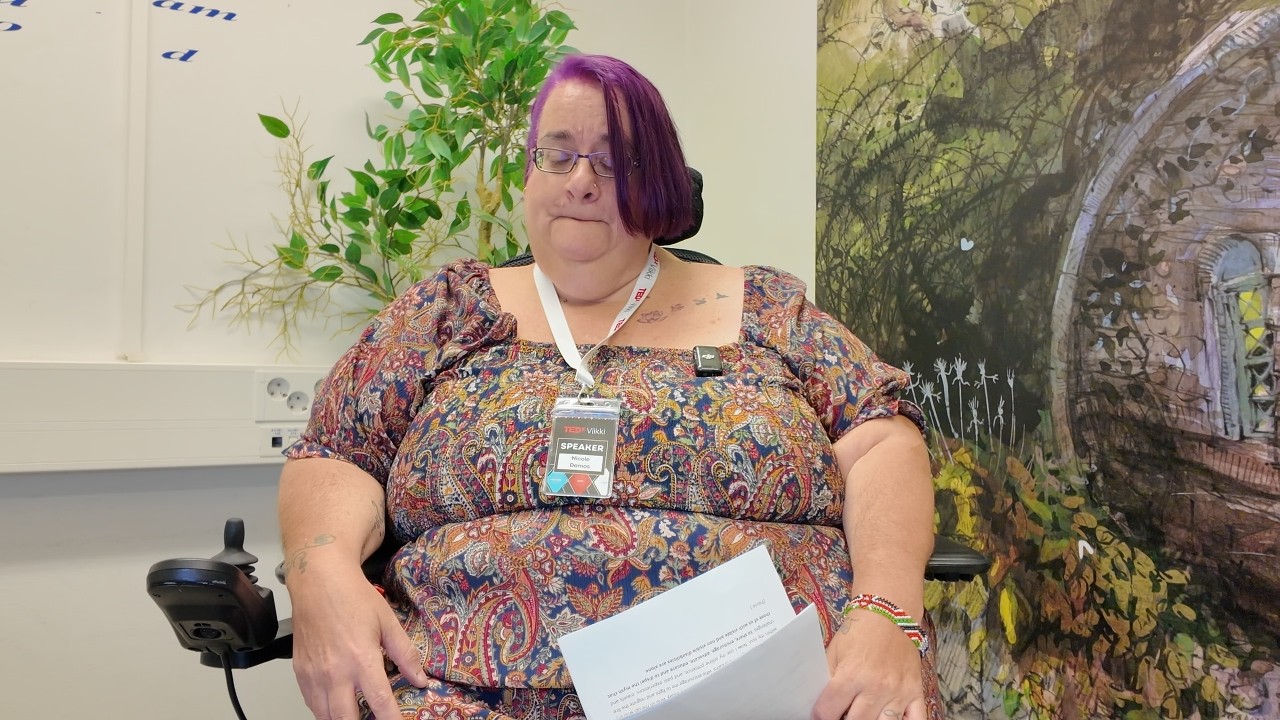
Why Are Disable Voices Still Silent in Finland? | Nicole Demos | TEDxViikki
Title history
- Why Are Disable Voices Still Silent in Finland? | Nicole Demos | TEDxViikki — observed on 20261026-1551 UTC (YouTube)
Keywords
Summary
177 words
Critical Evaluation
Value of the Information & Strength of the Argument
The value of this talk lies in its authentic personal testimony, which humanizes the statistics about disability in Finland and gives voice to a marginalized group. The argumentation is grounded in lived experience rather than empirical data, making it emotionally compelling but less robust in terms of scientific evidence. The speaker draws on her 32 years as an inclusive educator to advocate for systemic change, but the reasoning relies more on anecdote and moral appeal than on systematic analysis. While the statistics mentioned (WHO, Statistics Finland) are relevant, they are cited without precise sources, and the link between personal suffering and broader systemic failure is asserted rather than demonstrated. The talk effectively argues for the importance of allyship and collective action, but its persuasive power comes from emotion and storytelling rather than rigorous reasoning.
Scientific Rigor, Source Quality, Title Accuracy
Scientific rigor is limited: the talk references WHO and Statistics Finland without providing specific reports or citations, and the speaker’s claims are primarily anecdotal. The sources are not academic but rather self-published articles and her professional network links, which she lists in the description. These do not constitute verifiable scientific evidence. The title ‘Why Are Disable Voices Still Silent in Finland?’ is well-aligned with the content, as the talk directly addresses this question through personal narrative and a call to action. The speaker’s expertise as an inclusive educator and advocate lends some credibility, but the absence of rigorous sourcing and the reliance on personal opinion prevent the talk from being a strong scientific contribution. There is no evidence of contradictory sources or peer review.
273 words
Title / Content Match
The title accurately reflects the content, as the talk addresses the silence of disabled voices in Finland through personal testimony and calls for systemic change.
Quality & Reliability
6/10
The talk presents a personal narrative and advocacy, with some statistics cited but without thorough sourcing or verification. The speaker is an inclusive educator with 32 years of experience, but the content is primarily anecdotal rather than research-based.
Key Moments
Markers derived by PSI from the transcript: the creator did not define chapters.
Cited Sources
- Building Diversity — Speaker's publication related to diversity and inclusion
- Crip Life — Website where the speaker has published articles on disability
- LinkedIn article — Link to a LinkedIn article by the speaker
- Women Emerging - Poem — Speech about a poem she wrote on disability, empathy, and strength
- Harness Magazine — Magazine where the speaker has published work
- TEDx official page — Information about TEDx events and format
- TIE Online newsletter — Newsletter with the speaker's contribution
Contribution & Novelties
The talk offers a unique firsthand perspective on disability in Finland, highlighting the gap between official commitments to inclusion and lived reality. It contributes to disability advocacy by emphasizing the power of storytelling and the need for allies. The speaker’s personal journey, including her late acceptance of her disability, provides an original narrative that may inspire others. To go further, one could explore the United Nations Convention on the Rights of Persons with Disabilities (UNCRPD), the social model of disability, and the work of Judith Heumann, all of which are central to the talk’s themes.
Pour aller plus loin :
- Convention on the Rights of Persons with Disabilities (Wikipedia) — The international treaty referenced in the talk, outlining legal rights for disabled persons.
- Social model of disability (Wikipedia) — The theoretical framework that views disability as resulting from societal barriers, not individual impairments, which underpins the talk’s call for systemic change.
- Judith Heumann (Wikipedia) — The disability rights activist who inspired the speaker, known for her advocacy and ‘Speak up for justice’ message.
173 words
Radar Profile
The radar profile shows a talk with moderate informational quantity and quality, low technical depth, and moderate reliability. This indicates a persuasive, emotionally engaging presentation rather than a rigorous scientific analysis, with strength in personal credibility and relevance but weaknesses in empirical grounding and technical detail.