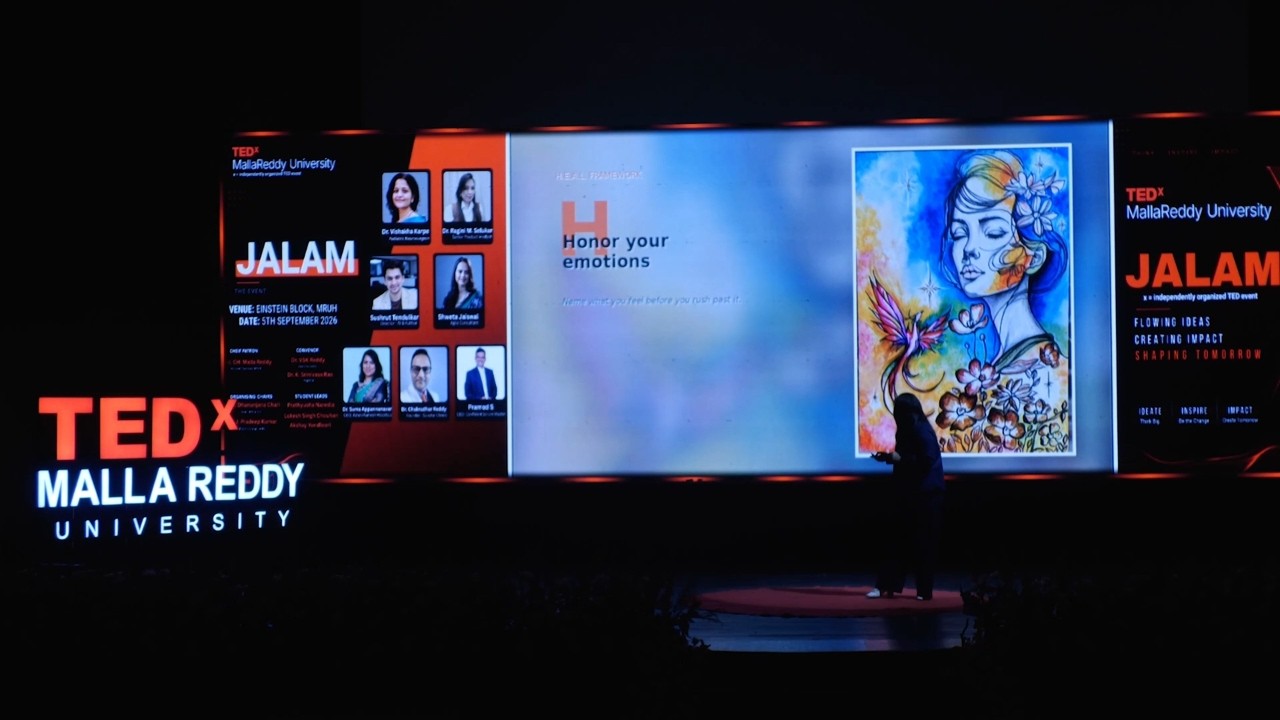
"Jalam: The Story We Paint" | Dr. Ragini M. Selukar | TEDxMalla Reddy University
Keywords
Summary
200 words
Critical Evaluation
Value of the Information & Strength of the Argument
The talk provides a meaningful, accessible framework for emotional self-care, grounded in the speaker’s personal journey and professional insight. The water metaphor is compelling and well-elaborated, making abstract emotional concepts tangible. The H.E.A.L. acronym is memorable, and the stages—honoring, embracing forgiveness, anchoring, and living—are presented with practical suggestions, such as choosing colors before words or painting over old layers without erasing them. The argumentation is largely anecdotal and rhetorical, relying on emotional resonance rather than systematic evidence. The speaker does not reference studies on art therapy or psychology, which limits the scientific depth. However, her dual identity as a physician and artist lends credibility to the practical claims, and the talk effectively communicates the importance of giving emotions a safe outlet.
Scientific Rigor, Source Quality, Title Accuracy
The talk demonstrates moderate scientific rigor. While the speaker references her clinical experience and personal observations, she does not cite scientific literature or systematic studies. The only source provided is the general TEDx link, which does not offer specific references. The content is more motivational than empirical, and claims such as ‘suppressed emotions reappear as irritability, anxiety, or outbursts’ are asserted without supporting data. The title accurately reflects the content, using ‘Jalam’ (water) to frame the emotional metaphor. The presentation is coherent, but a lack of verifiable sources and controlled evidence weakens its scientific credibility. No comments were provided for analysis.
237 words
Title / Content Match
The title 'Jalam: The Story We Paint' aligns well with the central metaphor of emotions as water and the act of painting as a healing process, accurately reflecting the talk's theme.
Quality & Reliability
5/10
The talk is based on personal experience and anecdotal evidence rather than empirical research. While it offers a coherent framework (H.E.A.L.) and references general psychological principles, it lacks citations to scientific studies or clinical data. The speaker's background as a physician adds credibility, but the content is largely subjective and rhetorical.
Key Moments
Markers derived by PSI from the transcript: the creator did not define chapters.
- Introduction: Personal story of aunt's cancer diagnosis and death, questioning where unspoken emotions go.
- Water metaphor introduced: Emotions behave like water, blocked emotions build pressure and find destructive outlets.
- Three myths about healing: healing for strong people, strong people don't feel, time heals everything.
- Personal crisis and rediscovery of painting as an emotional outlet; first abstract painting session.
- Introduction of H.E.A.L. practice: Honour, Embrace, Anchor, Live; detailed explanation of each step.
- Conclusion: Water metaphor extended, encouraging audience to choose their own story and pick up the brush.
Cited Sources
- TEDx Program — The talk was given at a TEDx event, independently organized by a local community under the TEDx license.
Contribution & Novelties
The talk introduces an original practice (H.E.A.L.) that synthesizes common psychological concepts into a practical framework for emotional healing through abstract art. Its novelty lies in the integration of a physician’s clinical perspective with an artist’s experiential approach, offering a non-clinical, self-directed method. The water metaphor provides a vivid visualization of emotional suppression and release.
Pour aller plus loin :
- Art therapy — Overview of the therapeutic use of art-making, relevant to the core practice described.
- Emotional intelligence — The concept of recognizing and managing one’s own emotions, which underpins the H.E.A.L. framework.
- Expressive suppression — Psychological research on how suppressing emotions can have negative consequences, supporting the talk’s premise.
110 words
Radar Profile
The radar profile shows moderate scores across all dimensions, with slightly higher quality and quantity of information but lower technical level and reliability. This reflects a talk that is emotionally engaging and conceptually coherent yet lacks empirical rigor and deep technical detail, making it more suitable for a general audience than for specialists.