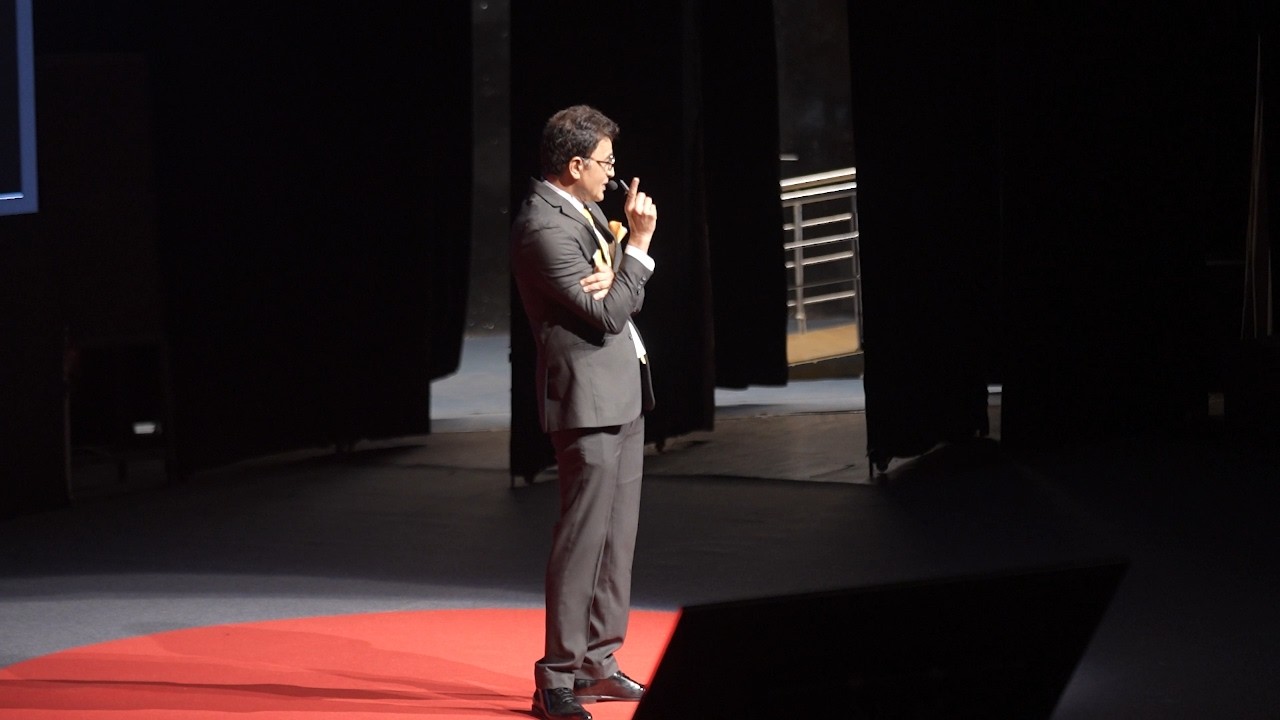
The Lessons We Miss When We Think We Know Enough | Dr. Ajoy Kumar, IPS | TEDxSukhna Lake
Keywords
Summary
300 words
Critical Evaluation
Value of the Information & Strength of the Argument
The informational value here is practical and illustrative rather than empirical. What the talk actually delivers is a compact set of decision-making heuristics, each attached to a concrete episode: consult the people who hold field knowledge before designing an operation; treat small execution details as load-bearing rather than clerical; and keep a service-oriented criterion in view when weighing institutional rules against human consequences. Because each heuristic arrives wrapped in a specific scene — the briefing where two junior officers are told to shut up, the 2 a.m. telephone call, the single sari withheld from evidence — the material is memorable and easy to transfer to organisational settings. That is genuine value, but it is value of the case-study and parable kind, not of the evidential kind: the talk offers no measurement, no counterfactual and no way to test whether the lessons generalise beyond the speaker’s own career. The argumentation is inductive and rhetorical. Its structure is a chain of narratives, each terminating in an explicit moral, reinforced by borrowed authority: Tolstoy on families, Jim Collins on how the mighty fall, John Wooden on shoelaces, Longfellow’s footprints, Michelangelo’s ‘Ancora imparo’. The reasoning moves from a single vivid instance to a general prescription, which is the classic weakness of the genre — one successful raid does not establish that surprise approaches are wrong, and one badly-targeted warrant does not establish a rule about delegation. There is also an unexamined tension in the talk: the speaker credits his best outcome to bending evidentiary rules in a defendant’s favour, while elsewhere insisting on rigorous execution of procedure, and he does not address how a subordinate should distinguish the two. The closing pivot to service as the ultimate purpose is asserted rather than argued. The result is coherent, well-paced and morally serious testimony from someone who clearly held real responsibility, but it functions as persuasion through lived example, not as analysis that a sceptical reader could verify or falsify.
Scientific Rigor, Source Quality, Title Accuracy
Scientific rigour is essentially absent, and the talk does not claim otherwise. The only external reference supplied anywhere in the material is a generic link to the TEDx programme page; no document, record, report or dataset is invoked. The anecdotes are undated in any checkable way and involve people who are either unnamed or named without any means of verification, so none of the factual claims — the raid, the warrant, the recovery of the stolen items — can be checked by a reader. The quotations are handled loosely: the Tolstoy line is accurate in substance, the Longfellow-derived ‘footprints in the sands of time’ is quoted without attribution and slightly reshaped, the basketball player’s name is garbled in delivery, and Michelangelo’s ‘Ancora imparo’ is a widely repeated but poorly documented attribution that the speaker presents as a deathbed utterance. Jim Collins and John Wooden are cited by name but their works are not identified precisely. On the positive side, there is no misrepresentation of the talk as research, no fabricated statistics, and no claim that the personal experience constitutes proof. On source quality, then, this is oral testimony with literary ornament, and it should be weighed accordingly. Regarding title and content, the correspondence is close: a talk announced as being about what we miss when we believe we already know enough does devote itself to overconfidence, inattention and the discipline of continued learning, and the three stories map onto those themes without padding.
582 words
Title / Content Match
The title promises a talk about the cost of overconfidence and the value of continued learning, and the content delivers exactly that through three stories on hubris, attention to detail and service. The fit is strong, with only the marketing-style framing of 'the lessons we miss' being broader than the fairly classic leadership-moral content.
Quality & Reliability
3/10
The talk is built entirely on the speaker's personal career anecdotes (police raids, a warrant execution, a dacoity investigation) plus loosely attributed quotations. There are no data, no documented cases, no dates or verifiable records, and no external references beyond the generic TEDx link. The lessons drawn (listen to those with field experience, attend to small details, service as purpose) are reasonable and internally consistent, but they rest on single-operator testimony and retrospective interpretation, so they can be taken as illustrative experience rather than as evidence.
Key Moments
Markers derived by PSI from the transcript: the creator did not define chapters.
- Opening: successful people have little to teach us; we should seek out those who made the mistakes. Tolstoy's Anna Karenina used to argue that all successes resemble each other while failures are specific.
- Jamshedpur raid: as a decorated 27-year-old Superintendent of Police, he silences the inspector and sub-inspector who try to advise him on how to conduct the operation.
- The plan collapses — the wrong, windowless house, the difficult approach route — and he finds himself in hand-to-hand combat with the suspect; reflection on what surfaces at the edge of death.
- Debrief with his officers: the simple road, the locked door, the arrest that could have been made at dawn. Lesson one named explicitly as hubris and the failure to listen.
- Coach John Wooden teaching shoelaces to a legendary UCLA team; the argument that small details — a blister, a shoelace — decide whether the big things happen at all.
- The 2 a.m. phone call from a prominent citizen about to be arrested on a two-year-old traffic warrant; he warns the officer against starting with easy, lucrative warrants.
- The same officer later calls back, weeping and holding the citizen's ankle — illustrating the gap between a leader's intention and how a directive is executed downstream.
- Rajpur dacoity: a family that lost an entire wedding trousseau offers tea to the arriving officer, a moment he contrasts with how he himself would have reacted.
- The tracking dog Rani follows the scent for eight hours across farmland and leads the team to the hideout; every stolen item is recovered.
- Bending evidentiary practice to return all but one sari so the wedding can proceed; closing reflections on service as the only durable reward, and on Michelangelo's 'Ancora imparo'.
Cited Sources
- Leo Tolstoy — Anna Karenina — Quoted at the opening for the observation that happy families are all alike while each unhappy family is unhappy in its own way, extended here to success and failure narratives.
- Jim Collins — How the Mighty Fall — Invoked by the speaker as the body of work explaining how great organisations decline through hubris and inattention; cited by author rather than by title or edition.
- John Wooden — UCLA basketball coach — Cited for teaching his players to tie their shoelaces at every session, used as the illustration of how small details determine larger outcomes.
- Henry Wadsworth Longfellow — A Psalm of Life — The closing quotation about making our lives sublime and leaving footprints in the sands of time is quoted without attribution; this is the poem from which it derives.
- TEDx programme (official site) — The only external link provided in the video description; it identifies the independent TED-format event framework and provides no supporting documentation for the talk's claims.
Concurring Sources
- Jim Collins — research on organisational decline (author overview) — The literature the speaker gestures at does independently identify hubris and the refusal to confront unwelcome information as recurrent drivers of institutional failure, which supports the talk's central thesis even though the talk itself supplies no data.
- Psychological safety — Wikipedia — Organisational research on speaking up converges with the talk's claim that suppressing junior colleagues' input carries operational cost, lending external support to a point the speaker establishes only anecdotally.
Contribution & Novelties
The originality of this talk lies less in its conclusions than in the entry point it chooses: the speaker deliberately inverts the standard conference format by drawing his material from his own failures rather than his successes, and he makes the inversion explicit with the Tolstoy analogy. The most distinctive element is the operational texture of the police anecdotes — the difference between the approach road that is tactically elegant and the one that is actually walkable, the windowless room that should have suggested waiting until morning, the warrant that a subordinate selects because it is profitable rather than because it is serious. That second strand, the gap between a leader’s stated intention and the incentives that shape how a directive is carried out at street level, is the genuinely useful contribution and is rarely articulated in personal-development formats with such specificity. The third strand — bending evidentiary convention to return stolen goods before a wedding — is the most contestable and, for that reason, the most interesting, since it sets the value of a concrete human outcome against procedural regularity without resolving the conflict.
Further reading:
- Anna Karenina — Wikipedia — Source of the opening Tolstoy formulation on similarity among successes and singularity among failures.
- Psychological safety — Wikipedia — Conceptual frame for the talk’s central claim that junior people with field knowledge must be able to speak without being silenced.
- Humility — Wikipedia — Broader philosophical and psychological treatment of the trait the speaker identifies as the missing ingredient in his early career.
- Dunning–Kruger effect — cognitive bias whereby limited competence yields inflated self-assessment; directly parallels the young officer’s confidence in the briefing scene (cited by name only, no URL given here).
- “Ancora imparo” (“I am still learning”) — the phrase attributed to Michelangelo in old age, widely circulated but poorly documented; worth checking its provenance before citing it as a deathbed utterance.
315 words
Radar Profile
The profile is dominated by narrative rather than analytical content: technical depth and reliability sit low, while the quantity and quality of information occupy the middle band, reflecting a talk that conveys several usable heuristics without evidence behind them. The wide gap between information quantity and reliability is characteristic of experience-based testimony — dense in concrete detail, thin in verification.