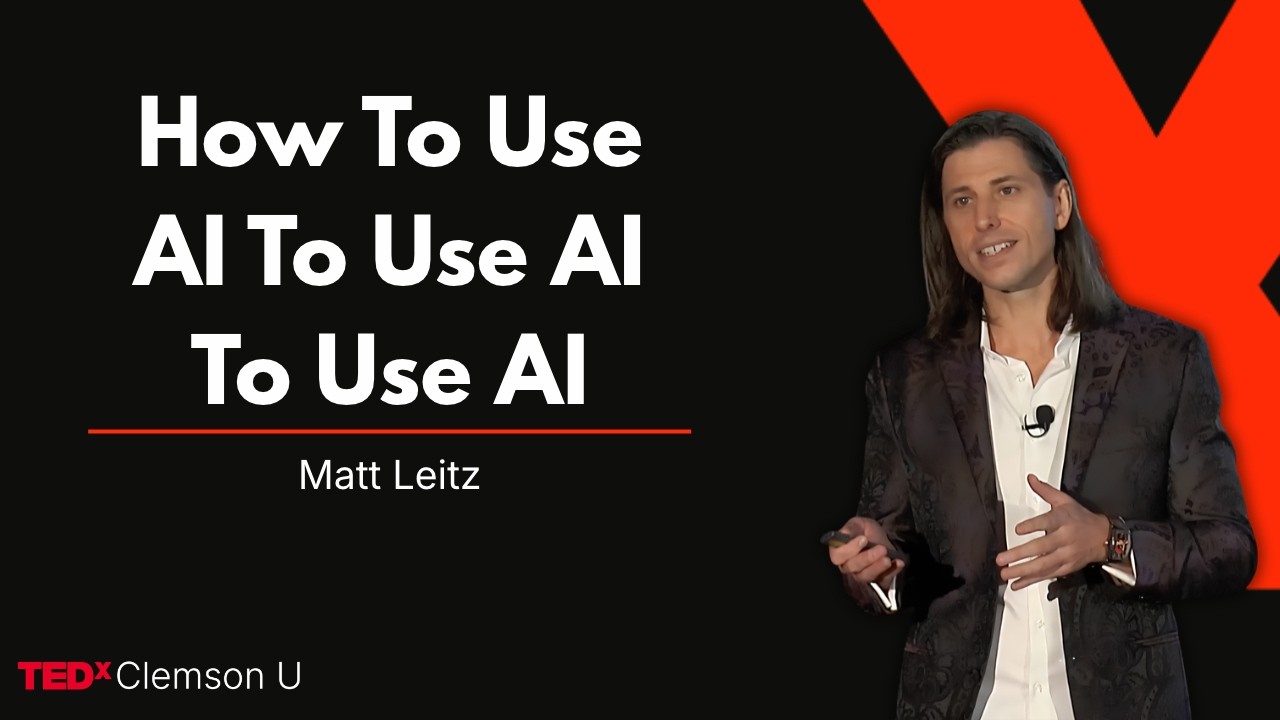
How To Use AI To Use AI To Use AI | Matt Leitz | TEDxClemson U
Title history
- How To Use AI To Use AI To Use AI | Matt Leitz | TEDxClemson U — observed on 20261114-0309 UTC (YouTube)
Keywords
Summary
147 words
Critical Evaluation
Value of the Information & Strength of the Argument
VALUE: The talk offers a compelling reframing of AI interaction, shifting from manual prompting to strategic delegation. It introduces the practical concept of ‘prompt pong’ and provides a clear framework for autonomous AI workflows. The personal anecdote about a board game failure adds authenticity and illustrates the importance of aligning AI with personal purpose. ARGUMENTATION: The reasoning is logically structured, moving from problem (prompt pong) to solution (AI self-prompting) to implementation (four Es, standing instructions). The example of waking up to an email draft and logo demonstrates the concept concretely. However, the argumentation relies heavily on anecdotal evidence and does not engage with potential risks or limitations of autonomous AI, such as errors or safety concerns.
Scientific Rigor, Source Quality, Title Accuracy
RIGUEUR SCIENTIFIQUE: The talk makes a broad claim about a UC Berkeley study but provides no details or citation. The speaker’s references to Claude and ChatGPT are anecdotal. No scientific publications or external sources are explicitly cited. QUALITÉ DES SOURCES: Only the TEDx organizational link is provided in the description; no specific research or third-party references are mentioned. ADÉQUATION TITRE/CONTENU: The title aptly captures the theme of using AI to manage AI, which is the core of the talk. The content directly supports this concept, though the delivery is more inspirational than technical.
224 words
Title / Content Match
The title is a clever play on recursive AI usage, and the talk indeed focuses on empowering AI to work autonomously, matching the title well.
Quality & Reliability
6/10
The talk presents practical advice grounded in personal experience and entrepreneurial insight. It references a UC Berkeley study without providing specifics or citation. The content is conceptually sound and aligns with current AI trends, but lacks rigorous empirical backing.
Key Moments
Markers derived by PSI from the transcript: the creator did not define chapters.
- Introduction: The speaker promises to teach how to stop using AI directly.
- First AI experience and the emergence of the 'prompt pong' pattern.
- Key idea: ask AI to improve its own prompts, moving beyond manual iteration.
- Personal story about board game company failure and discovering true outcome.
- Introducing the four Es of excellence and setting standards for AI.
- Example: autonomous AI drafts email and logo, demonstrating autonomous workflow.
- Conclusion: Be the boss, use AI to use AI to use AI.
Cited Sources
- TEDx Program — Mentioned as the organizing body for the talk.
Contribution & Novelties
The talk contributes a fresh perspective on AI adoption by encouraging users to shift from active prompting to strategic delegation. It introduces the memorable concept of ‘prompt pong’ and offers a concrete method (the four Es) for setting quality standards for AI output. The idea of having AI write its own prompts is timely and actionable for non-technical users.
Pour aller plus loin :
- Software agent — Relevant to the concept of AI agents that work autonomously.
- Prompt engineering — Discusses techniques for crafting effective AI prompts, contrasting with the speaker’s advocacy for AI-generated prompts.
- Automation — Contextualizes the broader shift toward automated workflows.
104 words
Radar Profile
The radar profile shows moderate scores in information quantity and quality, with a lower technical level. This reflects a talk that is accessible and practical rather than deeply technical. The reliability score is modest, consistent with an opinion-driven presentation.