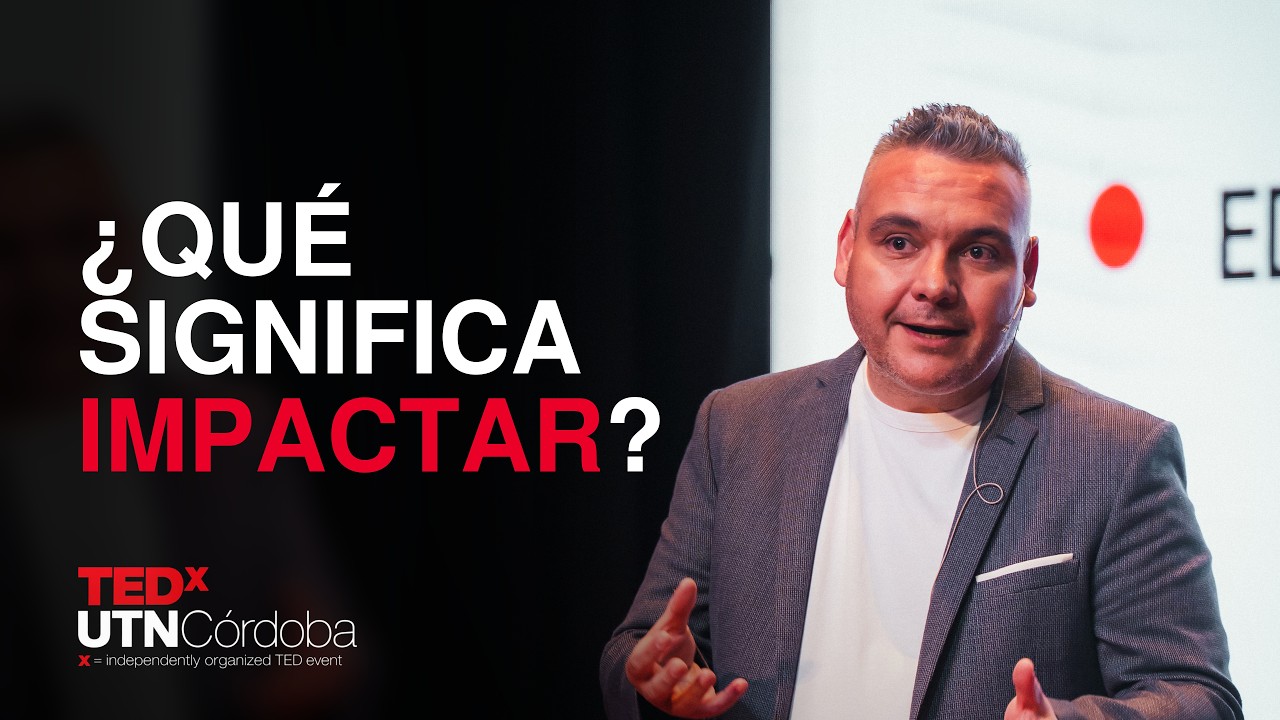
Elegí tu metro cuadrado | Daniel Caudana | TEDxUTN Córdoba
I chose your square meter | Daniel Caudana | TEDxUTN Córdoba
Keywords
Summary
362 words
Critical Evaluation
Value of the Information & Strength of the Argument
The informational value lies less in generalisable knowledge than in a set of concrete, replicable organisational practices presented with unusual specificity: pricing land in bags of cement as an inflation-proof unit of account, structuring a payment plan for low-wage workers, reverse-engineering a training curriculum from a list of desired competencies and then having it formally certified, and adapting a job to a candidate (GPS plus accompanied first routes) rather than screening the candidate against the job. Each of these is a transferable managerial move, and the talk gives enough detail — subject count, hour count, monthly payment, headcount, timeline — for a listener to reconstruct the reasoning. The argumentation itself is inductive and anecdotal: causality is asserted rather than tested. The claim that hiring Guillermo ‘improved absenteeism indicators’ is presented as validation of the decision, but there is no baseline, no comparison, and the speaker is both decision-maker and narrator. The same holds for the claim that the lot programme ‘impacted the lottery of Matorrales’ — a vivid phrase with no measurement behind it. The strongest argumentative move is rhetorical rather than empirical: the contrast between the 66% of engineering students who wanted to emigrate and the operators who had never imagined reaching a university diploma reframes ambition from geographic scale to relational proximity. That reframing is coherent and well supported by the narrative, but it rests on a single survey of 216 students reported from memory, with no methodology. The closing self-criticism — that he measured the firm by headcount and delayed dismissals because of his father’s 1998 layoff — is the most intellectually honest passage, since it identifies a bias in his own judgement rather than celebrating an outcome. Overall the talk offers practical value and a defensible moral argument, but its evidentiary weight is testimonial and its generalisations about impact remain untested hypotheses.
Scientific Rigor, Source Quality, Title Accuracy
No source of any kind is cited: no study, no dataset, no institutional report, no reference work. The only external authority invoked is the speaker’s own institution and his own firm, and the numbers given (37 lots, 70 employees, 192 teaching hours, 216 students, 66% intending to leave) are recalled from memory without documents, methodology or dates verifiable from the talk itself. The 66% figure in particular is presented as the result of a classroom poll with no stated sampling, question wording or margin of error, and it carries the argumentative weight of the central pivot. The UTN certification of the training programme is the one claim with a plausible paper trail, but no reference is given to it. The talk therefore functions as testimony, not as evidence-based communication, and should be read as such. On the title: ‘Choose your square meter’ is faithful to the thesis and to the closing exhortation, even if the metaphor only crystallises in the final minutes after a long sequence of company stories; the promise of the title is honoured, though late.
499 words
Title / Content Match
The title matches the closing call to action — the 'square meter' metaphor is the talk's organising idea and its punchline — although the content spends most of its time on business anecdotes before reaching it.
Quality & Reliability
4/10
This is a personal-narrative TEDx talk built almost entirely on the speaker's own experience as co-founder of a small manufacturing firm. The anecdotes are specific and internally consistent (dates, headcounts, training hours, graduation ceremony), but every claim is self-reported and unverifiable: no data, no external study, no document, no independent evaluation is cited. There is no factual error or misleading assertion in the scientific sense, but the evidentiary basis is testimonial rather than documented, which caps the reliability score.
Key Moments
Markers derived by PSI from the transcript: the creator did not define chapters.
- Opening questions to the audience on who and what has shaped them; entrepreneurship defined as creating, transforming, linking, designing — and failing and restarting.
- Presentation of Indoors: made-to-measure exterior and interior doors and fittings, national installation; the founding partnership with Mariano and the logic of seeking in a partner the skills one lacks.
- The 2019 land purchase: a plot divided into 37 lots of 10 by 25 metres, priced in bags of cement to neutralise inflation, with a five-bag monthly payment plan for employees.
- 2021: sales doubled as spending shifted to construction; the new bottleneck is middle management — 'not machines, not capital, but heads' — prompting a search for training that the market did not offer.
- Building the programme: ten subjects drawn from the backbone of industrial engineering, 192 teaching hours, Saturday classes delivered by university professors in Matorrales.
- UTN homologates the training as 'from operators to middle managers'; in May 2022 the dean hands diplomas on the same stage to operators who had never finished secondary school.
- Teaching in the entrepreneurship course; a survey of 216 students finds 66% willing to leave the country within a year, and a student's answer — 'I want to leave to change the world' — triggers the talk's pivot.
- The Guillermo story: five rejections on the assumption that a 1.50 m applicant could not handle three-metre doors, then hiring, and a marked improvement in absenteeism.
- Guillermo becomes the delivery driver after a trial drive, a GPS loaded with all client addresses and three accompanied routes; four years of service, then he leaves to drive a larger truck, his dream.
- The professional defect: measuring the firm by headcount rather than turnover, traced to his father's 1998 layoff, and the closing call to identify and care for one's own square meter.
Cited Sources
- TEDx — official programme page — The only external reference in the video description; it documents the TEDx format under which this independently organised local event took place.
Contribution & Novelties
The original contribution is not conceptual but practical: it documents, from the inside, a set of small-firm interventions that are rarely described with this level of operational detail — indexing a land price in bags of cement to escape inflation, converting a hiring bottleneck into an in-house certified training programme, and adapting a job to a worker’s actual constraints instead of screening the worker out. The reframing of ‘changing the world’ as ‘impacting one particular person within your square meter’ is a familiar motivational trope, but here it is anchored in named cases rather than abstraction, and the closing self-criticism about measuring a company by headcount gives the talk an unusual note of introspection for the genre.
Further reading:
- Employee ownership — Useful background for the lot-allocation and employee-access schemes described, and for the wider family of arrangements in which firms transfer assets or stakes to their workforce.
- Brain drain — Directly relevant to the reported 66% of engineering students intending to emigrate, a phenomenon extensively documented in the economics literature.
- Small and medium-sized enterprises — Context for the structural constraints (middle-management shortage, financing, labour retention) that the speaker describes from a single firm’s vantage point.
- Dignity of work / dignity of labour — a long-standing theme in social thought and Catholic social teaching that frames the speaker’s insistence on protecting jobs over maximising revenue; cited by name only, as the exact reference is uncertain.
- Middle-management capability development as a growth bottleneck — an established topic in operations and human-resource management literature; cited by concept, without a specific reference.
259 words
Radar Profile
The profile is strongly asymmetric: high on practical, experience-derived content and low on technical depth, formal sourcing and verifiable rigour. Quantity and quality of information sit at a middling level because the talk is dense in concrete detail yet almost entirely anecdotal. Reliability is limited by the absence of any external corroboration, not by any identifiable error.