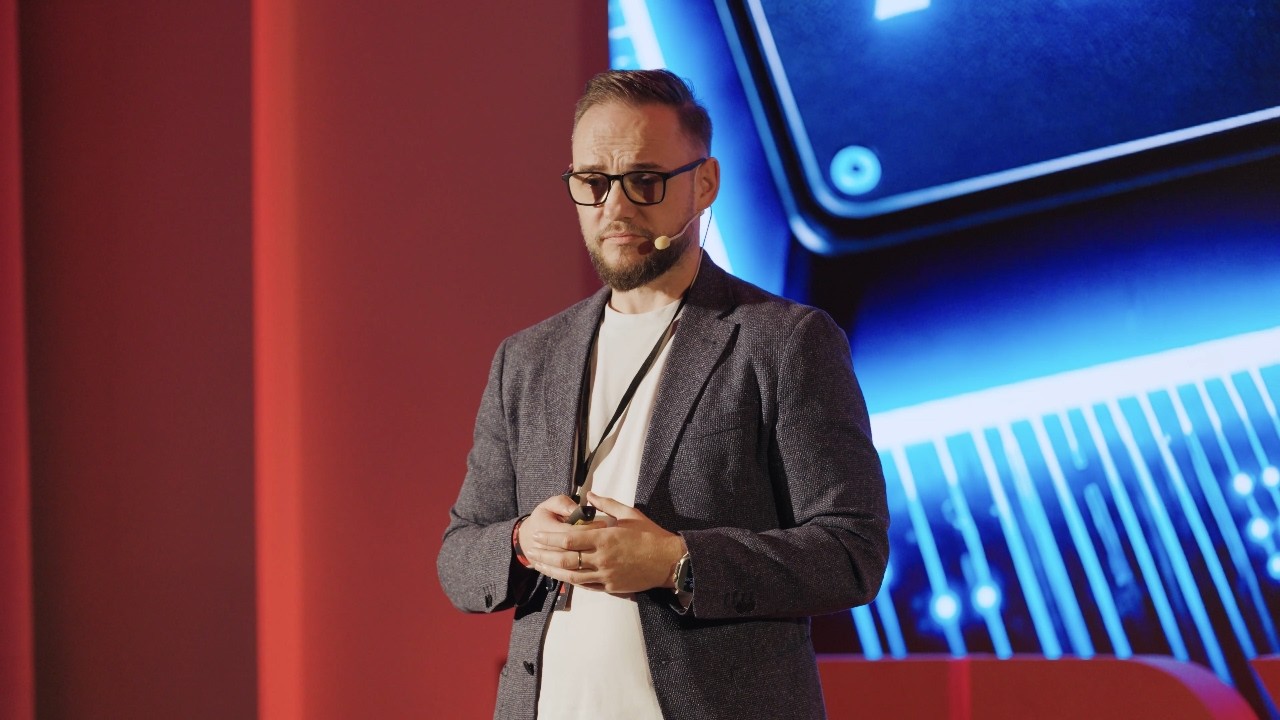
Tehnologiile care vor rescrie lumea | Sergiu Biriș | TEDxBistrita
The technologies that will rewrite the world | Sergiu Biriș | TEDxBistrita
Keywords
Summary
257 words
Critical Evaluation
Value of the Information & Strength of the Argument
The informational value of the talk lies less in facts than in a transferable frame of thought. Its strongest contribution is the electrification analogy: the observation that early factory owners replaced a large steam engine with a large electric motor while keeping the same shaft-and-belt architecture, and that the productivity revolution only came when small motors were distributed to individual workstations and the factory was physically reorganised. Applied to AI, this yields a genuinely useful diagnostic question: if I rebuilt my company or my job today, with current technology available from the start, would these processes still exist? The argument is coherent, well paced and supported by a concrete case from the speaker’s own practice (automated collection and reconciliation of accounting documents across email, messaging, a national e-invoicing feed and bank statements), which makes the abstraction tangible. The three-step method he offers at the end (spot a process problem, delegate a bounded part of it, apply domain expertise as a check on the output) is simple but operational. The argumentation is nonetheless thin in several respects. The historical material is deployed anecdotally: the Luddite episode and the ATM episode are told without figures, dates beyond approximate decades, or reference to the empirical literature that has actually examined the ATM case, so the reader cannot verify the causal story being told. The claim that ‘we do not have 30 years’ this time is asserted, never argued, and no reason is given for why the diffusion of a general-purpose technology should now be faster. The analogy itself is under-interrogated: AI, unlike an electric motor, is cheap to copy, has near-zero marginal deployment cost and its bottleneck is organisational and managerial rather than capital investment, which weakens the parallel and would deserve explicit treatment. The thought experiment of rebuilding the company from scratch is rhetorically powerful but empirically untested, and the two case studies are presented without a single metric (hours saved, error rates, headcount effects), which is precisely what would have turned the personal experience into evidence. Finally, the speaker is an entrepreneur who builds and sells AI automation, so the framing naturally privileges an optimistic, opportunity-driven reading of the technology; this is disclosed implicitly rather than addressed as a possible bias.
Scientific Rigor, Source Quality, Title Accuracy
Scientific rigour is low by design: this is a motivational and strategic talk, not an analysis. No study, statistic, report or expert is cited anywhere in the transcript, and no numerical claim is sourced. The description contains a single link, the generic TEDx page, which carries no topical reference, so the audience is given no route to verification. The historical claims are broadly correct in outline but imprecise in detail: the Luddite disturbances and the capital statute against machine-breaking in England, with executions at York, are consistent with the historical record, but the ATM example is told as a schematic story with no mention of the empirical work that has examined the relationship between ATMs and bank-teller employment, and the electrification narrative is a compressed version of a well-known argument about delayed productivity gains, presented without attribution. The factory examples from the present are presented as things the speaker has seen (‘factories have started to…’) without naming sites, vendors or metrics. On adequacy between title and content: the title announces a panorama of technologies that will rewrite the world, whereas the body is a focused argument about AI adoption and process redesign, with no treatment of other candidate technologies (energy, biotech, robotics, space). The mismatch is one of scope rather than of substance: the talk delivers something narrower and more coherent than what the title advertises.
611 words
Title / Content Match
The title promises a survey of several world-rewriting technologies, but the talk is almost entirely about AI adoption and organisational change, with historical detours. Coverage is partial rather than misleading.
Quality & Reliability
5/10
A well-structured and rhetorically effective TEDx talk built on personal entrepreneurial experience and historical analogies rather than on data, studies or citations. No figure, source or study is quoted in the transcript; the only link in the description is the generic TEDx page. The historical examples (Luddites, ATMs, factory electrification) are broadly accurate in outline but used illustratively, and the central claim that AI adoption cannot afford the 30-year electrification lag is asserted rather than demonstrated. Useful as a framework for thinking about organisational change, weak as an evidence-based analysis.
Key Moments
Markers derived by PSI from the transcript: the creator did not define chapters.
- Opening frame: the question 'will AI take my job?' is presented as the wrong question, and the talk promises to explain why.
- First historical case: textile mechanisation around 1800, the Luddite movement, machine-breaking and the capital statute adopted in England.
- Second case: the ATM and the fear of teller unemployment, followed by an expansion of branch networks and of bank employment.
- Third case, the pivotal one: the factory organised around a single steam engine, replaced at first by a single large electric motor, with no productivity breakthrough.
- The real revolution: many small distributed motors and a complete redesign of the factory layout; the 30-year diffusion lag from 5% adoption.
- Application to today's office work: emails, spreadsheets, meetings and reports, all accelerated by AI but left structurally unchanged.
- Concrete case study: automated collection and reconciliation of accounting documents from email, messaging, the e-invoicing feed and bank statements.
- Factory predictive maintenance: AI agents monitoring equipment, checking supplier stock and coordinating procurement and departments in near real time.
- Individual level: two attitudes towards AI, then the three-step method (identify the problem, delegate, apply critical judgement) and a suggested exercise.
Cited Sources
- TEDx programme page (TED) — The only link provided in the video description; it is the generic TEDx information page and gives no reference to the historical or technical claims made in the talk. No specific study, report or data source is cited in the transcript.
Concurring Sources
- Productivity paradox — Wikipedia — Background on the delay between the introduction of a general-purpose technology and the productivity gains it eventually delivers, echoing the talk's electrification argument and its '30 years' figure.
- Luddite — Wikipedia — Documents the early nineteenth-century machine-breaking movement and the legal response in England referred to in the talk's first historical example.
- Technological unemployment — Wikipedia — Summarises the long-running debate, including historical episodes where automation coincided with employment growth rather than decline, which supports the talk's general line of argument.
Dissenting Sources
- Daron Acemoglu — Wikipedia — The task-based literature on automation and labour markets argues that displacement effects can dominate when technology substitutes for labour without a strong productivity effect, which qualifies the talk's reassuring historical analogy and its claim that new tasks will reliably absorb displaced workers.
Radar Profile
The profile is unbalanced towards accessibility and volume of ideas rather than technical depth or verifiability: information quantity and quality sit mid-range, technical level is deliberately low, and overall reliability is limited by the total absence of cited evidence. The talk scores best on rhetorical structuring and on the transferability of its central metaphor, and weakest on empirical grounding.