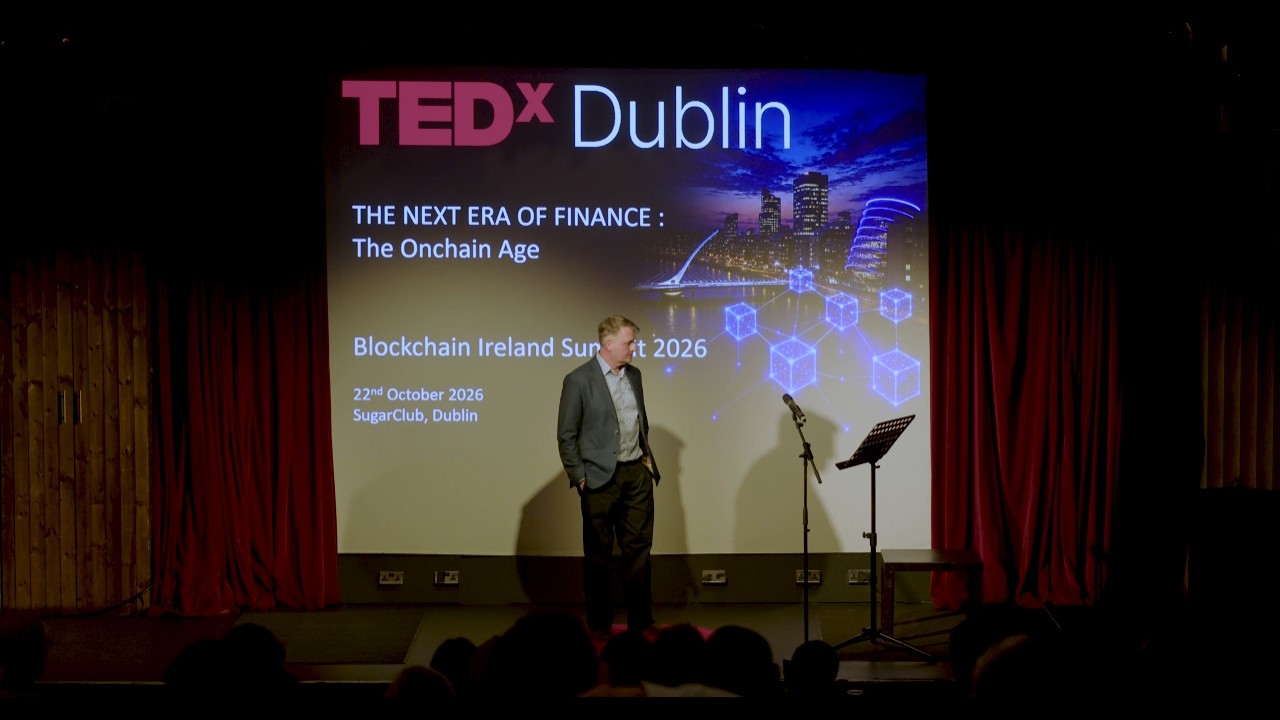
Why Europe Can't Sit This One Out | Jan Sell | TEDxDublin Salon
Keywords
Summary
298 words
Critical Evaluation
Value of the Information & Strength of the Argument
The informational value lies mainly in the diagnostic framing rather than in new data. The speaker assembles a coherent picture of two facts that are rarely put side by side: the euro’s weight in conventional international finance and its near-absence on public blockchains. His practitioner’s account of correspondent banking — value dating, chains of intermediaries, cut-off times, back-office re-keying, weekend immobility — is concrete and rings true to anyone who has worked in payments operations, and it explains better than any abstract definition why settlement finality on a shared ledger is attractive to treasurers. The Ethereum social-impact-bond anecdote works as an efficient illustration of atomic delivery-versus-payment. The argument that stablecoin reserves are invested in the jurisdiction of the issuing currency is the strongest analytical point of the talk and connects monetary infrastructure to bank funding capacity in a way that is not merely rhetorical. The weaknesses are symmetrical. Many of the load-bearing numbers are unattributed and undated, which matters in a fast-moving market where the euro-stablecoin share has been volatile. The argument is essentially one-directional: it establishes the strategic cost of dollar dominance but does not examine why euro stablecoins have struggled — limited offshore demand for euro liquidity, the absence of a large euro-denominated stablecoin float in emerging-market remittance corridors, reserve-management and yield constraints, and the network effects that make the dollar the path of least resistance. The dependency analogy with frontier AI models and satellite broadband is evocative but never substantiated as a comparable case. Finally, the conclusion slips from a public-policy recommendation to a description of the speaker’s own product, without examining whether a bank-consortium issuer solves the liquidity problem or merely relocates it. The talk is therefore valuable as a well-argued statement of a strategic problem and weaker as a demonstration that the proposed remedy follows.
Scientific Rigor, Source Quality, Title Accuracy
No source is cited anywhere in the talk: the 98% and sub-1% figures, the 20-25% range for euro-denominated cross-border payments and bond issuance, and the claim that stablecoins settle more volume in a week than the major card networks are all presented bare, with no dataset, institution, report or date. The regulatory references are real and identifiable — MiCA and its single rulebook for 27 countries, BaFin’s crypto-custody licensing regime — but they are invoked from memory by an actor who participated in the licensing process, which is a form of testimony rather than documentation. The narrative is internally consistent and the autobiographical material is verifiable in principle through the speaker’s public professional record, yet the argument never engages with contradicting evidence, such as data on actual euro-stablecoin issuance, redemption behaviour, or the share of stablecoin transfers that correspond to genuine payments rather than trading collateral. Regarding the title-to-content match, the talk delivers exactly what it announces: a case for European participation in on-chain financial infrastructure, with the rhetorical framing supported throughout. There is no advertising break in the recording.
495 words
Title / Content Match
The title is faithful to the content: the whole talk is an argument that Europe cannot remain a spectator while dollar-denominated stablecoins become the base layer of on-chain finance. The framing is deliberately broad and rhetorical, but no promise made by the title goes unaddressed.
Quality & Reliability
5/10
The talk is delivered by a recognised industry practitioner (former Coinbase Germany lead, CEO of a euro-stablecoin venture) whose operational experience lends credibility to the descriptive parts on banking friction and licensing. However, the quantitative claims that carry the argument — 98% of stablecoins in dollars, euro stablecoins under 1%, euro at 20-25% of cross-border payments and bond issuance, stablecoin volume exceeding card networks within a week — are asserted without any cited source, dataset or date. The reasoning is persuasive rather than demonstrative, mixes a genuine public-policy question with the speaker's commercial positioning, and offers no counter-argument on why euro-stablecoin demand has remained low (limited non-resident euro demand, reserve/asset-management constraints, dollar network effects).
Key Moments
Markers derived by PSI from the transcript: the creator did not define chapters.
- Opening claim: over 98% of the world's stablecoins are dollar-denominated, euro stablecoins under 1%, against 20-25% for the euro in fiat cross-border flows and bond issuance.
- Plain-language definition of a stablecoin as a blockchain token holding the value of an underlying currency, and the framing of on-chain euro as 'a rounding error'.
- Autobiographical detour: childhood in Algeria, Botswana, India and Pakistan, and the realisation that what is normal in Europe is not normal elsewhere.
- The Berlin anecdote of eight-to-ten-year-olds riding the U-Bahn unsupervised, used to define European values as dignity, solidarity and rule of law — 'we look out for one another and play by the same rules'.
- Twenty years in London finance and the observation that cross-border settlement has not changed: sending money from Europe to Peru still means days of opacity across a chain of intermediaries.
- The 2016 conversation about a social-impact bond on Ethereum, illustrating atomic delivery-versus-payment and code that 'doesn't go to sleep on a Friday'.
- Coinbase Germany's successful BaFin crypto-custody licence application and the lesson drawn: whoever builds the rails decides what runs on them.
- The policy critique: Europe studied and regulated the technology, then let others build it, becoming a 'comfortable bystander' while stablecoin volume now exceeds card-network volume.
- Why it matters: dollar-based rails push billions in reserves outside the European banking system, and growing stablecoin use in Asia, Latin America and Africa shows demand for an alternative.
- Closing argument: MiCA provides the rulebook and banks are engaged, but liquidity is missing — 'we have the safety, but not the utility' — and a brief mention of his own euro-stablecoin venture.
Cited Sources
- TEDx — official programme page (event format and organising principles) — The only link provided in the video description; it documents the TEDx format under which the talk was given, not the factual claims made in the talk.
- Markets in Crypto-Assets Regulation (MiCA) — Named in the talk as the single EU rulebook covering 27 member states and credited with providing 'the rules' for on-chain euro issuance; no document, article or date is referenced by the speaker.
- BaFin crypto-custody licence — Invoked as the first licence of its kind granted by the German financial supervisor, obtained during the speaker's tenure at Coinbase Germany; no public register entry or press release is cited.
- Ethereum — Referenced as the blockchain on which a social-impact bond was being built in 2016, used to illustrate settlement finality and delivery-versus-payment.
Concurring Sources
- Stablecoin — overview of issuance, reserves and market composition — General reference corroborating the structural picture of a stablecoin market overwhelmingly denominated in US dollars with a marginal euro segment.
- Digital euro — ECB project documentation — Confirms that European public institutions have themselves identified the dependence on non-European payment and currency infrastructure as a policy concern.
Contribution & Novelties
The talk’s original contribution is not technical novelty but the coupling of two debates that are usually kept apart: the euro’s role as a reserve and invoicing currency on one side, and the denomination of on-chain settlement infrastructure on the other. Framing stablecoin reserves as a bank-funding question — dollars backing euro-area transactions sit on the other side of the Atlantic rather than in European bank balance sheets — is a sharper way to state the sovereignty argument than the usual appeal to ‘digital sovereignty’. The practitioner’s angle on licensing as the entry ticket for institutional capital, and the formulation ‘regulation without liquidity gives safety without utility’, is a useful corrective to the assumption that MiCA alone settles the question. The talk is weakest where it is most novel commercially: the claim that a bank-backed issuer resolves the liquidity gap is asserted rather than argued, and the reasons euro stablecoins have remained marginal are left unexplored.
Pour aller plus loin :
- Stablecoin — Background on stablecoin designs, reserve models and the dollar dominance the talk is built around.
- Digital euro — The ECB’s retail CBDC project, the public-sector counterpart to the private euro-stablecoin route advocated here.
- Ethereum — Technical context for the settlement-finality and smart-contract mechanics the speaker discovered in 2016.
- Markets in Crypto-Assets Regulation (MiCA) — cited in the talk as the EU’s single rulebook; worth consulting the official EU texts directly rather than relying on the speaker’s summary.
- Correspondent banking and the SWIFT messaging network — the legacy settlement chain the speaker describes, useful for judging how much of the friction is technical versus commercial.
267 words
Radar Profile
The profile is that of a persuasive policy talk by a practitioner: information density and technical depth sit at a middle level, sustained by concrete operational anecdotes rather than by figures or mechanisms. Reliability is constrained less by the speaker's competence than by the absence of any cited dataset for the load-bearing statistics and by the proximity of the conclusion to his own commercial activity. The overall shape is balanced but flat, with no dimension strongly exceeding the others.