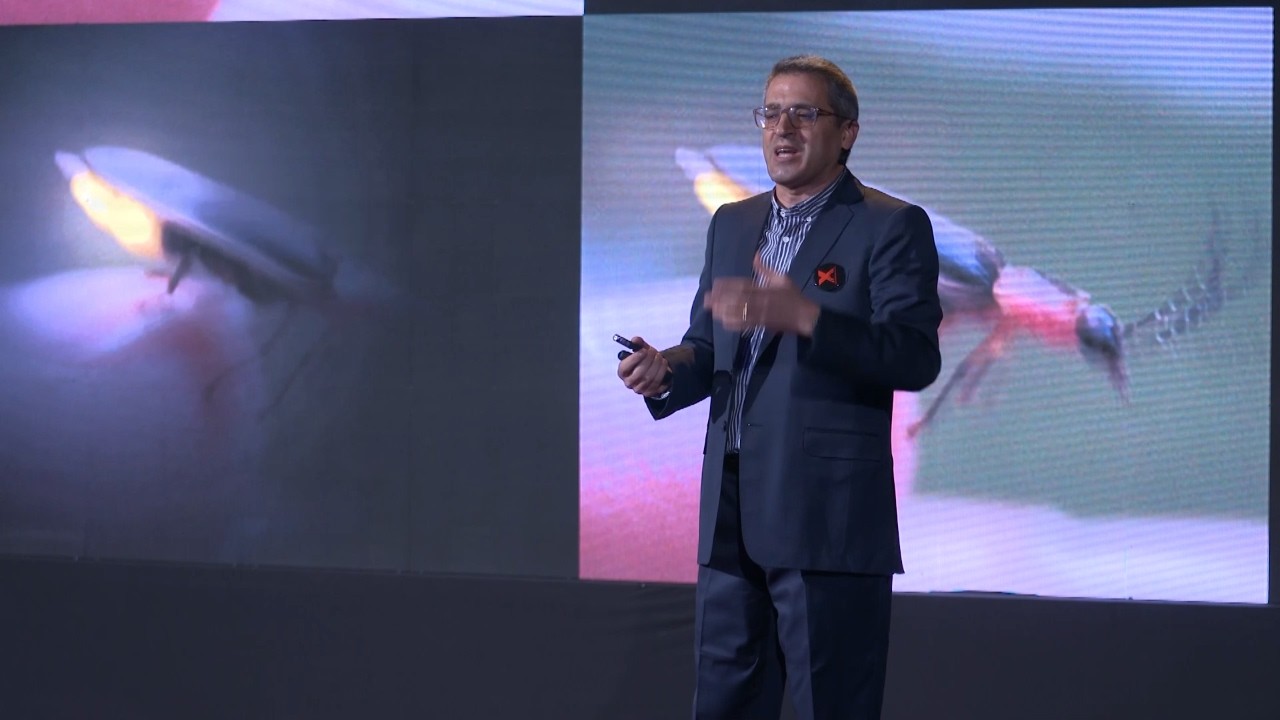
Borrowing light from nature | Saman Hosseinkhani | TEDxTarbiat Modares University
Keywords
Summary
379 words
Critical Evaluation
Value of the Information & Strength of the Argument
The informational value is high in density but uneven in depth. The strongest material is the concrete account of a research trajectory: the enzymatic reaction is stated correctly (luciferin + ATP → oxyluciferin + light), the cloning of a firefly gene into bacteria is described as an application of the genetic-engineering techniques that emerged in the mid-1970s, and the downstream uses (reporter assays for programmed-cell-death complexes, split-luciferase complementation, red-shifted mutants for in vivo imaging) are recognisable, real research lines in bioluminescence-based biosensing. The commercial translation into a rapid contamination swab illustrates the basic-research-to-product pathway, and the description of a foreign partner screening a chemical library against the inflammasome reporter to identify inhibitors is a plausible and instructive example of how an assay becomes a drug-discovery tool. The argumentative structure, however, is that of a motivational narrative rather than a demonstration: claims are supported by anecdote (one surviving firefly out of twenty, a kindly professor at McGill, a ministry that refused the product for five years) rather than by data, and success is asserted rather than shown. Several quantitative statements are shaky or self-contradictory: the brain’s neuronal ‘wiring’ is given as 180,000 km and then later as 1,800 km for a single tissue, and the figure of 10 trillion protein molecules per cell sits two to three orders of magnitude above the commonly used estimates of a few billion per mammalian cell. The genetic example is also mishandled: a single amino-acid change in haemoglobin is correctly tied to sickle-cell disease, but the same sentence attributes haemoglobin defects to haemophilia, which is a coagulation-factor deficiency. These slips do not invalidate the overall thrust, but they show that numbers are being used rhetorically. The talk’s persuasive force comes from the coherence of a single career narrative, from the personal stakes (collecting insects, convincing a ministry, training olympiad teams) and from a clear normative message about the social responsibility of basic scientists; it does not come from evidence presented for scrutiny.
Scientific Rigor, Source Quality, Title Accuracy
Scientific rigour is that of an expert speaking from inside his own field: the vocabulary, the enzymatic mechanism and the experimental logic are correct and are used with the fluency of someone who has done the work. Rigour weakens wherever the talk leaves the laboratory. No publication, dataset, patent or institutional document is cited at any point, so the consortium grants, the ~200 reporter assays, the Spanish screening result, the Google Scholar ranking and the claim that all national import needs are now met by the domestic kit remain unverified self-report. The numerical framework used to impress the audience is the least controlled part of the talk, with inconsistent orders of magnitude for neural wiring and for protein abundance per cell. Source quality is therefore high on disciplinary competence and low on traceability. The title promises a talk about borrowing a design from nature, and that promise is honoured for roughly the first two thirds, where biomimicry of the firefly lantern genuinely structures the argument; the closing segment on olympiad organisation and educational policy is a separate subject that the title does not cover, and the explicit self-presentation of awards and positions sits awkwardly with the framing.
539 words
Title / Content Match
The title fits roughly the first two thirds, which are genuinely about borrowing a natural light-producing system to build assays and diagnostic tools; the final third shifts to biology-olympiad organisation and science education, which the title does not announce.
Quality & Reliability
6/10
The talk is delivered by a practising professor of biochemistry and its core technical content (luciferase/luciferin chemistry, ATP-dependent light emission, apoptosome/inflammasome/necrosome reporter assays, cloning a firefly gene into bacteria) is standard, accurate molecular biology. However, no reference, citation or publication is given anywhere in the talk or the description, several quantitative claims are approximate or internally inconsistent (brain 'wiring' figures, protein copy number per cell), and one genetic example is misattributed. The commercial and institutional achievements described are self-reported and unverifiable from the video itself. The only link supplied is the generic TEDx page.
Key Moments
Markers derived by PSI from the transcript: the creator did not define chapters.
- The cell described as a walled city: nucleus as command centre, gates controlling entry and exit, mitochondria as power plants producing ATP, lysosomes and peroxisomes handling recycling and toxic waste.
- Scale figures for the human body: 30 trillion cells, 330 billion replaced daily, around 200 specialised cell types, roughly 70 percent water, and the claimed total of neuronal wiring.
- Proteins as the dominant dry component of the cell, with 10 trillion protein molecules and about 1,300 distinct enzymes per cell, and how a single amino-acid change can cause disease.
- The pivot of the career: seeing the firefly lantern and its photocytes, and deciding to work on luciferase when no one in Iran was doing so.
- Correspondence with Edward Meighen at McGill University, leading to a stay abroad to learn how luciferase works and how to move a gene between hosts.
- Collecting fireflies in the forests of northern Iran with his first master's student and his wife; nineteen of twenty die before reaching the lab and the last is used for mRNA extraction.
- The luciferin-luciferase reaction explained, and the cloning of the firefly gene into bacteria so that colonies visibly emit green light.
- Random mutagenesis to obtain red-shifted luciferases for in vivo imaging, and the move from single molecules to protein signalling networks and molecular machines.
- Luciferase reporters for programmed cell death: apoptosome, inflammasome and necrosome complexes, EU consortium funding, roughly 200 reporter assays, and high-throughput screening by a Spanish company yielding two new inhibitors.
- Translation into a commercial 15-second swab test for microbial contamination, five years of negotiation with the Ministry of Health, and import substitution.
- The education segment: co-founding Iran's biology olympiad, hosting the 2018 International Biology Olympiad with 700 guests from 74 countries, then election to the international committee and its chair.
Cited Sources
- TEDx official programme page — The only link given in the video description; a generic page about the TEDx format, containing no scientific reference for any of the claims made in the talk.
- Work of Edward Meighen on firefly luciferase (McGill University) — Named verbally as the researcher whose laboratory the speaker visited to learn luciferase biochemistry and gene transfer; no publication or link is supplied in the talk.
- European consortium project on cell-death complexes (referred to as 'EPIC') — Described verbally as a funded EU framework project, followed by a second grant of about EUR 1.2 million; no project identifier, contract number or link is provided.
- Spin-off company developing the luciferase-based contamination swab — Named in the talk as the industrial partner that turned the laboratory assay into a marketed diagnostic kit; no website or product documentation is given.
Concurring Sources
- Luciferase — Confirms the firefly luciferin-luciferase reaction as an ATP-dependent oxidative process emitting light, and its wide use as a bioluminescent reporter.
- Bioluminescence — Background on light production by living organisms, including the specialised light organs of fireflies that the speaker describes.
- Apoptosome — Corroborates the existence and role of the apoptosome complex in programmed cell death, one of the three complexes the speaker's reporters target.
- Inflammasome — Corroborates the inflammasome as a real multiprotein signalling platform, consistent with its use as a screening target for inhibitor discovery.
- International Biology Olympiad — Confirms the existence and structure of the IBO competition and its host-country format, which underpins the speaker's account of the 2018 edition and his committee roles.
Dissenting Sources
- Sickle cell disease
- Haemophilia — The talk states that losing one amino acid from haemoglobin produces haemophilia; haemophilia is in fact a deficiency of clotting factors VIII or IX, unrelated to haemoglobin, so this example is misattributed.
- Thalassemia — Thalassaemias arise from reduced or absent globin-chain synthesis through a wide range of mutations, not from the simple 'one residue less' mechanism implied in the same passage; useful for correcting the oversimplified picture given.
Radar Profile
The profile is that of a dense but narrative-driven expert talk: information quantity and technical level are well above average thanks to genuine molecular-biology content and concrete project details, while quality and overall reliability sit at a middle level because no reference is ever traceable and several figures are loose or inconsistent. The low traceability is the single largest drag on the profile.