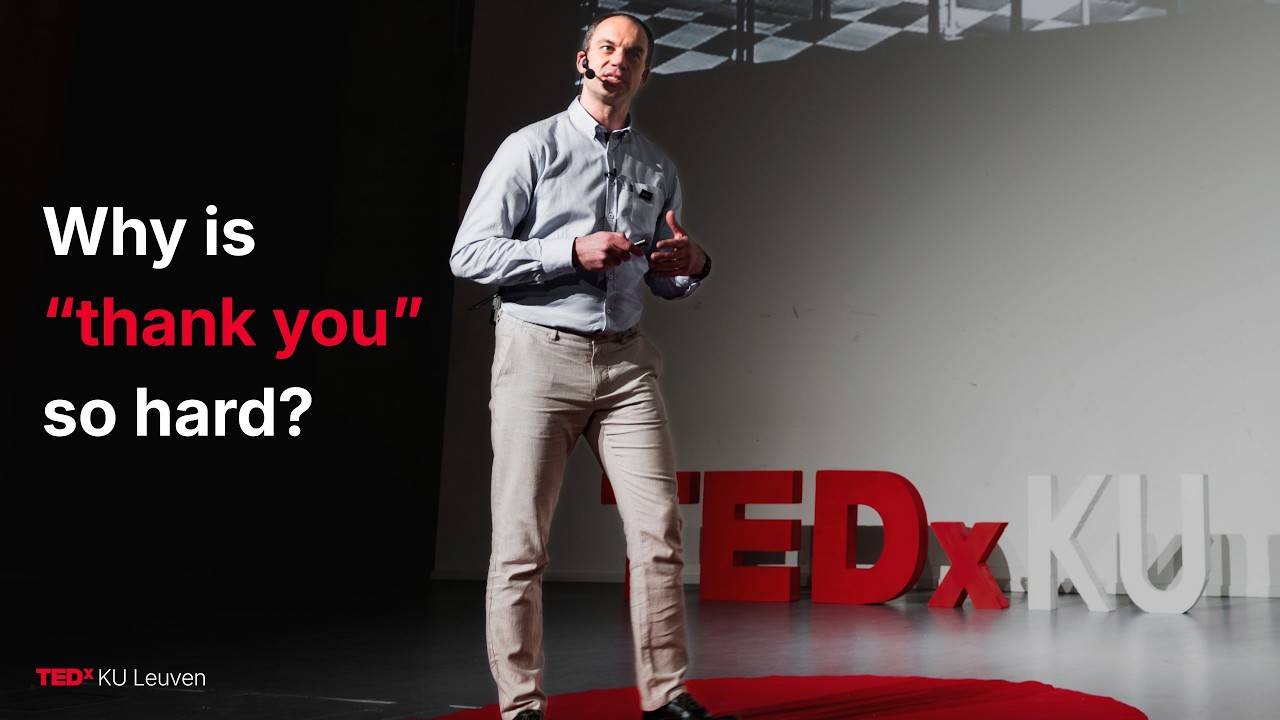
Feedback: How to overcome the discomfort of giving and receiving it | Pieter Spaepen | TEDxKU Leuven
Keywords
Summary
175 words
Critical Evaluation
Value of the Information & Strength of the Argument
The talk provides valuable, actionable insights into improving feedback interactions, particularly the often-overlooked aspect of receiving appreciation. The engineering analogy helps make the concept of feedback intuitive, though it is simplistic. The argumentation is coherent and relatable, using interactive exercises and personal anecdotes to illustrate points. However, it lacks empirical evidence or references to psychological research, making the claims primarily anecdotal. The reasoning is logically structured, moving from a technical definition to practical applications, but the effectiveness of the suggested techniques is not rigorously validated.
Scientific Rigor, Source Quality, Title Accuracy
No external scientific sources are cited; the speaker mentions a person named Jeff as an inspiration but provides no references. The only link in the description is to the TEDx program, which is a general page. The title matches the content well, as the talk indeed addresses the discomfort associated with giving and receiving feedback and offers strategies to overcome it. The lack of citations reduces the scientific rigor, but the content is presented as personal and experiential rather than research-based.
181 words
Title / Content Match
The title accurately reflects the content, focusing on the discomfort of giving and receiving feedback and strategies to overcome it.
Quality & Reliability
5/10
The talk offers practical advice and a clear conceptual framework but lacks scientific citations, relying on personal experience and an analogy with engineering control systems.
Key Moments
Markers derived by PSI from the transcript: the creator did not define chapters.
- Introduction: engineering analogy of the steam engine governor and feedback as information returning to its origin.
- First exercise: asking the audience to remember the last time they received feedback and associated emotions.
- Advocacy to discard 'positive' and 'negative' labels, proposing 'appreciative' and 'corrective' feedback instead.
- Discussion on appreciative feedback: how people brush off compliments and the importance of being specific and transparent.
- Advice on receiving appreciation: the only proper response is a genuine 'thank you', and a final reflection on the shortage of people daring to receive it.
Cited Sources
- TEDx Program — General TEDx information; the speaker is a professor at KU Leuven and this talk was independently organized under the TEDx format.
Contribution & Novelties
The talk offers a fresh perspective by reframing feedback from ‘positive/negative’ to ‘appreciative/corrective’, highlighting the often-neglected difficulty of receiving appreciation. It provides simple, practical techniques like being specific and transparent, and emphasizes that saying ’thank you’ is a skill. The engineering analogy gives an intuitive hook, but the novelty lies in shifting the focus from giving to receiving feedback.
Pour aller plus loin :
- Feedback — General concept of feedback in systems, relevant to the engineering analogy and its extension to communication.
- Constructive criticism — Related to the ‘corrective’ side of feedback and how it can be delivered effectively.
- Active listening — A communication skill that complements receiving and processing feedback, as suggested by the speaker’s advice to be present and simply say ’thank you’.
125 words
Radar Profile
The radar profile shows moderate to high quality of information (7) and a moderate quantity (6), with lower technical depth (4) reflecting the non-technical, audience-friendly nature. Reliability is moderate (5), as the content relies on personal experience and anecdotes rather than cited research.