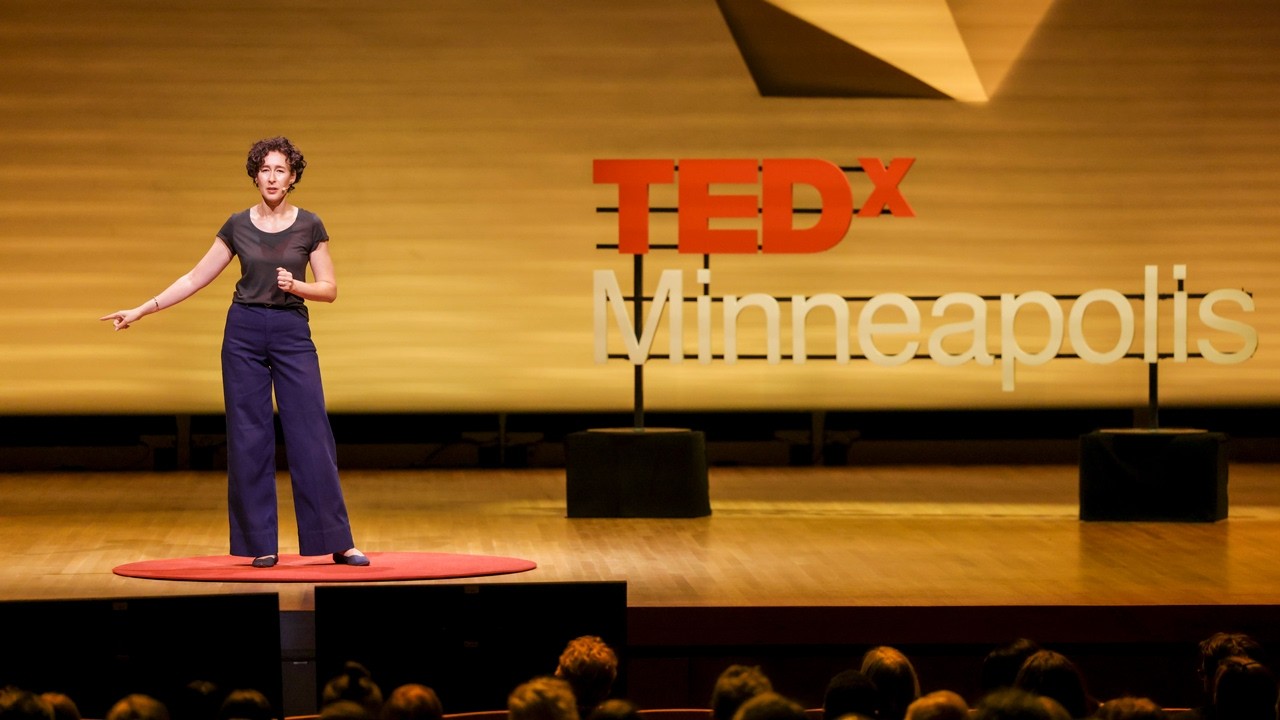
Where Democracy Lives: Leadership Before Confidence | Nadia Poluhina | TEDxMinneapolis
Title history
- Where Democracy Lives: Leadership Before Confidence | Nadia Poluhina | TEDxMinneapolis — observed on 20261112-1909 UTC (YouTube)
Keywords
Summary
176 words
Critical Evaluation
Value of the Information & Strength of the Argument
The talk provides valuable insights into civic engagement, particularly the psychological barrier that makes capable people feel they don’t belong in public service. The argument is well-structured: starting with a personal epiphany, moving through a practical challenge, and concluding with a broader philosophical point. Poluhina effectively uses her professional background to illustrate that practical judgment is often what is missing in local governance. She distinguishes between apathy and the ‘someone else will handle it’ mindset, arguing that the latter is more dangerous. The argument is persuasive and grounded in a real case study, though it remains anecdotal. The speaker’s humor and vulnerability enhance trustworthiness without detracting from the message.
Scientific Rigor, Source Quality, Title Accuracy
The talk is not a rigorous scientific presentation but an expert opinion based on personal experience. The only explicit research reference is a statement about nearly half of local elections being uncontested, which she cites without naming the study. The title is highly appropriate and accurately reflects the content. The speaker does not provide external sources beyond a general mention, but she does not make scientific claims requiring citations. The adequacy between the title and content is excellent, as the entire talk explores the theme of leadership preceding confidence. No comments were provided for analysis. The talk’s strength lies in its narrative authenticity rather than empirical data.
231 words
Title / Content Match
The title perfectly mirrors the central thesis: democracy resides in local participation, and leadership emerges from responsibility rather than confidence.
Quality & Reliability
7/10
Personal narrative backed by a reference to research on uncontested local elections; argumentation is coherent but relies primarily on anecdotal evidence and individual experience rather than systematic data.
Key Moments
Markers derived by PSI from the transcript: the creator did not define chapters.
- Nadia describes seeing her name on the ballot alongside presidential candidates, realizing democracy is local.
- She explains that the danger to democracy is not apathy but people with skills assuming leadership belongs to others.
- She recounts moving to Minnesota and the school district facing a $3 million budget crisis.
- Realizing she can contribute, she decides to run for school board despite fear of public speaking.
- Election results: she wins, and describes the responsibility as a four-year term.
- She discusses the operating levy passing and how trust is rebuilt through discipline and transparency.
- Conclusion: democracy lives in local rooms where people show up.
Cited Sources
- TEDx Talks official page — The talk was given at a TEDx event in Minneapolis, and the link is the official TEDx platform.
- Research on uncontested local elections — Nadia mentions that nearly half of school board and small town mayoral races go uncontested, but no specific study is named.
Contribution & Novelties
The talk adds a personal perspective to the discourse on local civic engagement, emphasizing that professional skills are often needed in local governance. It challenges the common perception that leadership requires confidence, proposing ‘responsibility first’ instead. The narrative provides a practical example of how an ordinary citizen can contribute.
Pour aller plus loin :
- Civic engagement — Broad overview of forms of political participation beyond voting.
- School board — Explains the role and responsibilities of local school boards.
- Uncontested election — The phenomenon of races with no challengers, relevant to Nadia’s claim.
- Servant leadership — A leadership philosophy emphasizing service, aligning with Nadia’s argument.
104 words
Radar Profile
The radar shows a balanced profile: moderate information quantity, high information quality, lower technical level, and good overall reliability. The talk is accessible and persuasive rather than data-heavy, relying on personal authority and a few cited facts. This configuration suits a motivational civic talk.