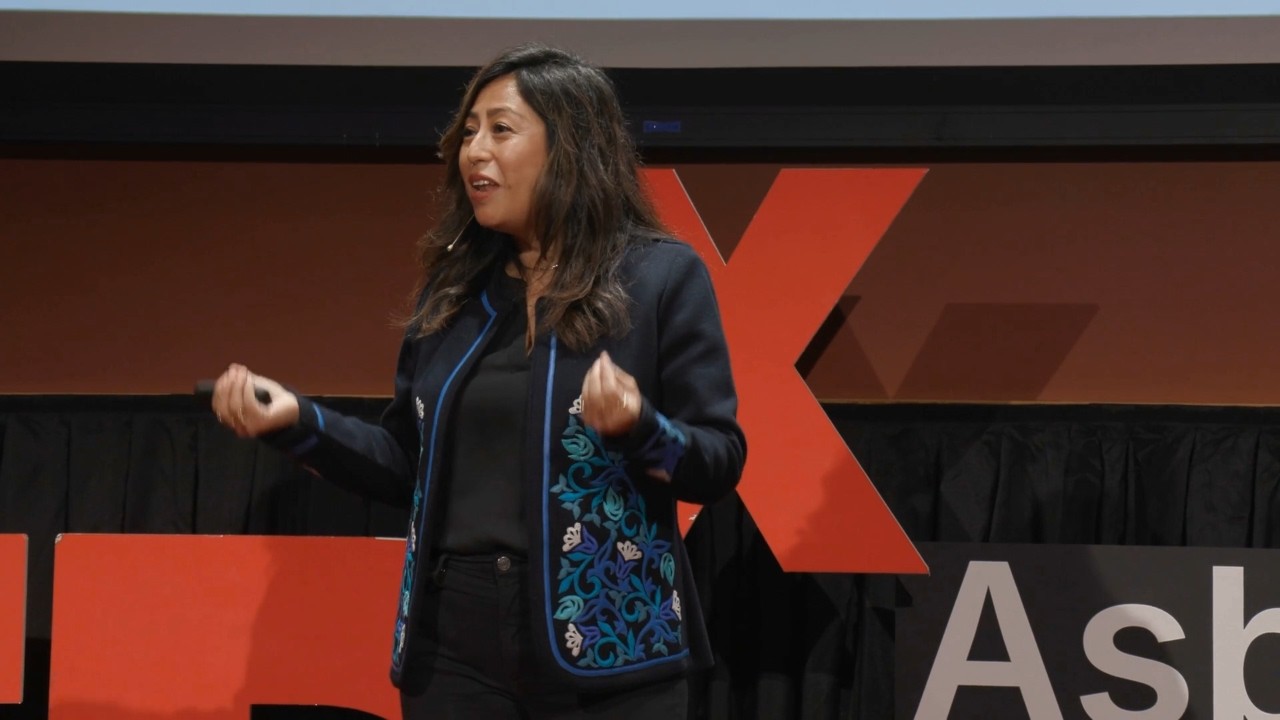
Undocumented Intelligence | Cristina Jiménez | TEDxAsbury Park Salon
Keywords
Summary
241 words
Critical Evaluation
Value of the Information & Strength of the Argument
The informational value lies mainly in the descriptive account rather than in demonstrated findings: the talk documents, from the inside, the everyday interpretive and negotiating labour performed by children of immigrants, and it gives that labour a memorable name. The supermarket episode, the parent-child role reversal before institutions and the shift from individual shame to collective strategy are concrete and informative, and the observation that this competence is invisible to diplomas and standardised tests is a genuine analytical point worth taking seriously. The demographic anchor supplied mid-talk gives the personal account a sense of scale. The argumentation, however, proceeds by juxtaposition and anecdote rather than by inference: two contrasting teachers establish that labels are arbitrary, but a two-case comparison cannot carry the general claim, and no counter-example or alternative explanation is considered. The move from ’navigational capital’ to ‘undocumented intelligence’ is an act of rebranding rather than a conceptual advance, and it is not defended against the obvious objection that ‘intelligence’ is a contested psychometric construct. The extension of the concept to US citizens is asserted more than argued: the claim that millions of people are now ‘having to learn’ the same skill is supported by three vignettes (a teacher, a pastor, one mother) whose representativeness is never discussed. The enforcement passages shift from analysis to indictment, with sweeping, unquantified statements, and the emotional register (the letter to her younger self) closes the talk on persuasion rather than on demonstration. The result is a rhetorically effective and humanly informative testimony whose analytical claims remain suggestive rather than established.
Scientific Rigor, Source Quality, Title Accuracy
On scientific rigour, the talk offers no study, dataset, report or document on screen or in speech. The one technical notion invoked, ’navigational capital’, is attributed vaguely to ‘scholars’ without author, work or date, and is then replaced by a label of the speaker’s own invention; the audience is given no way to distinguish the established concept from the coinage. The demographic statement about children living with an immigrant parent and the share born in the country is plausible and consistent with mainstream survey research, but its origin is not indicated, so it cannot be checked from the talk alone. Factual claims about her own trajectory, the organisation she co-founded and the recognition she received are externally verifiable and appear accurate. Claims about enforcement practice are formulated in absolute terms without quantification or sourcing, which lowers the evidentiary standard considerably. The overall register is testimonial and advocacy-driven, where the speaker’s authority derives from lived experience and community leadership rather than from scholarly warrant, and the talk is coherent with that register even if it does not meet an evidentiary standard it never claims. On sources, the description is minimal: it points only to the general TEDx page explaining the independently organised event format, with no bibliography, no reference to the scholarly literature on cultural capital or immigrant incorporation, and no link to the speaker’s book, which is mentioned on stage without title. On the relation between title and content, the announced concept is precisely the one developed throughout, so the framing is honest and the viewer is not misled.
532 words
Title / Content Match
The title is faithful to the content: the whole talk is built around the concept the speaker names 'undocumented intelligence', with the TEDx event and speaker credited as announced. It is somewhat narrower than the talk's wider claim about citizens now having to learn the same skill, but there is no mismatch.
Quality & Reliability
5/10
The talk is a first-person activist narrative rather than an evidence presentation. Its biographical and institutional anchors are checkable and consistent with the public record (co-founding of United We Dream, involvement in the DACA campaign, 2017 MacArthur Fellowship), and the demographic figure used (more than one in four US children living with an immigrant parent, the large majority born in the US) is in line with mainstream survey research. However, the central concept, renamed on stage as 'undocumented intelligence', is the speaker's own coinage, resting on personal anecdote and on a sociological notion ('navigational capital') that is invoked but never cited. Enforcement-related assertions are stated in sweeping, unquantified terms, and no data, study or document is presented. Rhetorical and emotional persuasion carries more weight than verifiable evidence.
Key Moments
Markers derived by PSI from the transcript: the creator did not define chapters.
- Opening: arrival from Ecuador at 13, childhood undocumented in Queens, co-founding of United We Dream, and the announcement of a talk built around 'two teachers'.
- The Quito classroom: a division problem, a request for help, and a teacher who calls her dumb and hits her on the head with chalk.
- Registration day in Queens: placed into tenth-grade math after testing, praised in front of her mother through an uncle's interpretation — 'same girl, same brain, opposite labels'.
- The stacking of labels in New York — accent, English, and the one that overrules all others, 'no papers' — alongside references to political rhetoric and to enforcement raids separating parents from children.
- The supermarket scene with the mispriced green plantains: the child stepping in for her mother, and the generalisation to immigrant children as expert cultural navigators and their parents' agents before landlords, doctors, teachers and police.
- Scale and naming: more than one in four US children living with an immigrant parent, most born in the country; the scholarly term 'navigational capital' recast by the speaker as 'undocumented intelligence', unrecognised by any diploma and measured by no test.
- The college English professor's remark about her 'beautiful indigenous face' and the realisation that she had internalised labels and lies that were holding her down.
- Meeting other undocumented young people, sharing stories and then strategies: 'the fear got smaller, the intelligence got bigger', followed by her acquisition of US citizenship to applause.
- The concept extended to citizens connected to immigrants — teachers holding students' fear, pastors whose congregations stay away, and Amanda, an evangelical mother in Florida whose husband was deported.
- Closing call: name the label you accepted and who imposed it, shed the label and the fear, and recognise that power lies in connection; the letter to her younger self, 'you are not the only one'.
Cited Sources
- TEDx — independently organised TED-format events — The only link supplied in the video description; it documents the event format under which the talk was given (TEDxAsbury Park Salon) and carries no reference to the substance of the argument.
Concurring Sources
- Deferred Action for Childhood Arrivals — reference overview — Corroborates the description's account of the speaker's involvement in the DACA campaign and the policy environment the talk refers to.
- United We Dream — reference overview — Confirms the organisation's existence, its youth-led immigrant-rights mandate and the speaker's co-founding role.
- Pew Research Center — survey research on immigrant families — The most direct external check on the demographic claim that more than one in four US children live with an immigrant parent and that the large majority were born in the country.
Contribution & Novelties
The talk’s originality is not empirical but conceptual and rhetorical: it takes a technical notion from the sociology of education and migration — the navigational component of what is often called community cultural wealth — and renames it ‘undocumented intelligence’, a formulation designed to be carried out of the room. The reframing does real work: it converts a deficit description (the undocumented child as constrained and at risk) into a competence description (the child as a skilled broker who reads institutions, negotiates on behalf of adults and translates rules into outcomes), and it insists that this competence is invisible to the instruments that officially recognise ability. The second original move is the extension of the concept beyond immigration status: the claim that citizens connected to immigrants are now acquiring the same operational skill set is a way of describing how enforcement regimes diffuse their effects outward into the citizen population, and it reframes the audience from spectators to potential learners. The talk also contributes a clear account of the mechanism by which individual shame becomes collective capacity — shared stories first, shared strategies second — which is a compact statement of a community-organising logic that is often described abstractly elsewhere.
Pour aller plus loin :
- Cultural capital — Background on the Bourdieusian framework from which notions such as navigational capital derive; useful for separating the established concept from the speaker’s coinage.
- Deferred Action for Childhood Arrivals — Reference point for the policy campaign the speaker describes having helped to win.
- United We Dream — The organisation co-founded by the speaker; context for the organising trajectory recounted in the talk.
- MacArthur Fellows Program — Institutional context for the recognition mentioned in the description.
- Pew Research Center — Body of survey research on children of immigrants in the United States, relevant to checking the demographic claim made mid-talk.
- Navigational capital and community cultural wealth (Tara Yosso) — The scholarly literature the speaker alludes to as ‘scholars talk about this’; consult it directly to assess how far ‘undocumented intelligence’ overlaps with, or departs from, the existing concept.
- Segmented assimilation and immigrant incorporation literature (Portes, Zhou) — Broader sociological frame against which the talk’s claims about second-generation mobility can be situated.
367 words
Radar Profile
The profile is characteristic of a testimonial and advocacy talk: very low technical demand and modest informational density, offset by solid internal coherence and a high verbal clarity of purpose. Reliability sits at the midpoint because the verifiable biographical anchors are sound while the central concept and the enforcement claims are asserted rather than documented. Information quantity is the weakest axis, as the argument is carried by a small number of carefully chosen scenes.