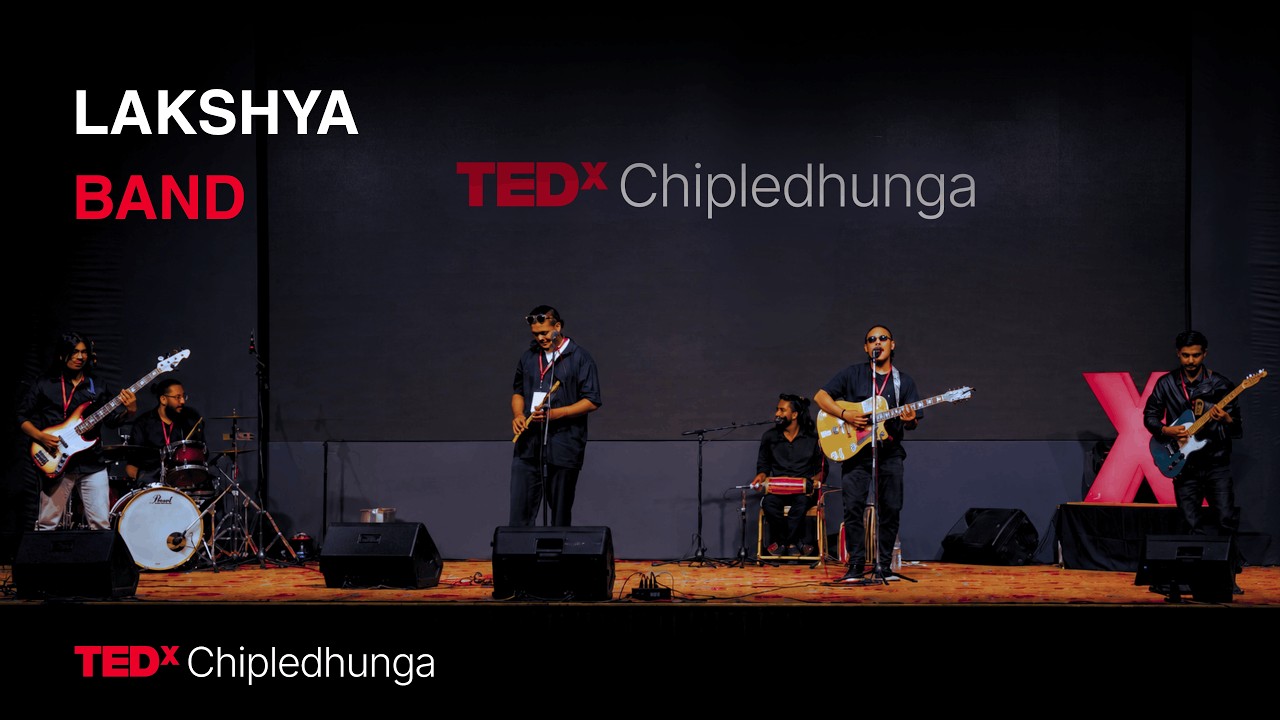
Echoes of Nepal: A Traditional Folk Performance | Lakshya Band | TEDxChipledhunga
Keywords
Summary
243 words
Critical Evaluation
Value of the Information & Strength of the Argument
The informational payload is thin by design. The video conveys no explicit thesis, no data and no explanatory framework; the only verbal content is the Nepali lyrics carried by the melodies, and the only framing comes from the written description rather than from the stage. What the performance does establish is demonstrative rather than argumentative: by placing Malshree Dhun, a Kirati Rai folk song, a 2024 contemporary composition and a 1997 film song in a single continuous set, the band enacts a claim about continuity between Nepal’s regional folk traditions and its modern popular songbook. That argument is made through programming and arrangement choices — the same folk-flavoured instrumentation applied across material of very different vintage — and it is legible to a listener who knows the repertoire, but it is never stated, justified or contextualised for anyone else. The absence of any spoken introduction means the viewer receives no explanation of what a madal or a taah is, where the Kirati Rai material comes from, what Dashain signifies, or why these four pieces were chosen. As a result, the value is experiential: it documents a living practice and gives a stage to regional repertoire, but it does not equip the viewer to understand that repertoire. There is no risk of misinformation here, since essentially nothing is asserted; the trade-off is that nothing is argued either, and the cultural content remains implicit for any audience outside the tradition.
Scientific Rigor, Source Quality, Title Accuracy
Rigour in the conventional sense barely applies: the video makes no empirical claims, cites no literature and conducts no analysis, so there is no chain of evidence to audit. The one place where scholarly discipline is visible is attribution. The description names all six performers, lists the four pieces in order, and explicitly credits ‘Kumari Janani – Furfuri’ to Kuma Sagar and the Khwopa (2024) and ‘Hamro Nepal Ma’ to the soundtrack of the Nepali film Balidaan (1997), sung by Ramesh Shrestha and Om Shrestha, while labelling the latter as an instrumental cover. That is a clean, honest separation between the band’s own arrangements and borrowed material, and it is the strongest reliability signal in the package. Beyond that, the only external reference is the generic TEDx organisational link, and no further documentation of the folk sources is provided. The title-to-content match is exact: an instrumental folk performance by the named band is what the title promises and what the video delivers.
415 words
Title / Content Match
The title announces an instrumental folk performance by Lakshya Band at TEDxChipledhunga, and that is exactly what is delivered, with no mismatch or overselling.
Quality & Reliability
6/10
The video is a live musical performance rather than an informational talk, so there is almost no factual claim to verify or falsify. Its reliability rests on the transparency of the credits given in the description (named performers, an explicit four-item setlist, and attribution of the two covered/borrowed pieces to their original authors and to the 1997 film Balidaan), which is unusually precise for a stage performance. No data, statistic, or scientific statement is presented, so the score reflects honesty of attribution rather than evidentiary strength.
Key Moments
Markers derived by PSI from the transcript: the creator did not define chapters.
- Opening of the set with the Malshree Dhun, the melody associated with the Dashain festival, played instrumentally by the full band.
- Transition into the Kirati Rai folk song 'Soi Dhole Soi', marked by the recurring sung refrain 'Soi soila ho urha' over the rhythmic accompaniment.
- Start of the instrumental interpretation of 'Kumari Janani – Furfuri' (originally by Kuma Sagar and the Khwopa, 2024), the most contemporary item of the setlist.
- Intermediate instrumental passage with drums and lead lines taking prominence between vocal sections.
- Beginning of the closing cover of 'Hamro Nepal Ma', from the 1997 film Balidaan, with its refrain 'Hamro Nepal ma' clearly audible.
- End of the set and applause from the TEDxChipledhunga audience.
Cited Sources
- TEDx — official programme page — The only external link given in the description, referring to the independently organised TEDx format under which the performance took place.
- Kuma Sagar and the Khwopa — 'Kumari Janani – Furfuri' (2024) — Named in the description as the original authors of the third piece, performed here as an instrumental interpretation; no link supplied by the channel.
- Balidaan (1997) — original soundtrack, 'Hamro Nepal Ma', sung by Ramesh Shrestha and Om Shrestha — Identified in the description as the source of the fourth piece, explicitly presented as an instrumental cover of the film song.
Concurring Sources
- Music of Nepal — Wikipedia — General reference confirming the existence and regional diversity of Nepali folk traditions such as those performed in the set.
- Madal — Wikipedia — Confirms the madal as a standard Nepali folk percussion instrument, consistent with the band's described line-up.
- Dashain — Wikipedia — Supports the description's statement that Malshree Dhun is associated with the Dashain festival.
Contribution & Novelties
The contribution is not conceptual but documentary: a professionally filmed, cleanly credited live set by a regional Nepali folk band, captured at a local TEDx event, that makes an inter-generational repertoire audible in one continuous programme. Its originality lies in the juxtaposition — a Dashain festival melody, a Kirati Rai folk song, a 2024 art-folk composition and a 1997 film song — played by the same acoustic-electric line-up of madal, flute, taah, drums, guitar, bass and keys. For anyone outside Nepal, it is a compact introduction to how folk material is being reworked by young Pokhara musicians; for anyone inside, it is an archival record of a specific performance with precise attribution of borrowed material.
Pour aller plus loin :
- Music of Nepal — Overview of the regional and ethnic traditions the set draws on, useful for situating the Kirati Rai and festival material.
- Madal — The hand drum central to Nepali folk ensembles and prominent in the band’s line-up.
- Dashain — Context for Malshree Dhun, the festival melody that opens the performance.
- Panche baja — The traditional Nepali five-instrument ensemble, a useful comparison point for the acoustic core of this band (cited by name, no stable URL offered here).
- Nepali folk-rock and lok pop revival — The broader movement of Nepali bands blending folk instrumentation with modern rhythm sections, into which Lakshya Band’s approach fits.
226 words
Radar Profile
The profile is strongly asymmetric: very low on quantity of information and technical exposition, moderate on quality and reliability because attribution is accurate and nothing is overclaimed. High cultural value, low explanatory depth — a performance document rather than an educational one.