Drop Your Stone: A Story of Insect Fossils | Soobin Lee | TEDxBASIS Nanjing Youth
Title history
- Drop Your Stone: A Story of Insect Fossils | Soobin Lee | TEDxBASIS Nanjing Youth — observed on 20261109-1737 UTC (YouTube)
Keywords
Summary
180 words
Critical Evaluation
Value of the Information & Strength of the Argument
The talk provides accessible insights into insect paleontology, demonstrating how tiny anatomical features can reveal evolutionary adaptations. The argumentation is built around concrete examples: the Meganeura’s size, the predator-avoidance structure on a Korean fossil, the oxygen-providing eggs on a Chinese fossil, and the ecological shift during the Cretaceous. These examples are presented clearly and logically, supporting the speaker’s message that small details matter. The personal narrative adds a relatable dimension, showing how incremental decisions led to his career, reinforcing the ripple metaphor. However, the scientific depth is limited, and some claims, such as the exact function of leg structures, are presented without citing specific studies, which could be seen as an oversimplification.
Scientific Rigor, Source Quality, Title Accuracy
The talk is a first-person account by a PhD candidate, not a formal scientific review. The speaker does not cite external papers during the talk, and the only provided source is the general TEDx link. The descriptions of fossil features and the Cretaceous event align with established paleontological knowledge (e.g., Meganeura is well-documented, the Cretaceous terrestrial revolution is a known concept), but the absence of specific citations reduces scientific rigor. The title is adequately representative: ‘Drop Your Stone’ metaphorically connects the content, though it does not directly mention insects, which might initially confuse viewers. Overall, the content is credible but lacks formal sourcing, typical of TEDx presentations.
234 words
Title / Content Match
The title uses a metaphor ('drop your stone') to convey the ripple effect of small discoveries, which matches the narrative about insect fossils and personal journey. It is somewhat poetic but not misleading.
Quality & Reliability
7/10
The speaker is a paleontologist PhD candidate specializing in fossil insects; the content is based on published research, though presented in an anecdotal manner typical of TEDx talks.
Key Moments
Markers derived by PSI from the transcript: the creator did not define chapters.
- Introduction: stone and ripple metaphor, speaker introduces himself as a paleontologist specializing in insect fossils.
- Describes Meganeura, a giant dragonfly-like insect from 300 million years ago with a 70 cm body length.
- Shows a Korean insect fossil with leg structures used for avoiding predators by jumping into water.
- Shows a Chinese insect fossil with eggs attached to legs to provide oxygen to embryos, an adaptation for aquatic life.
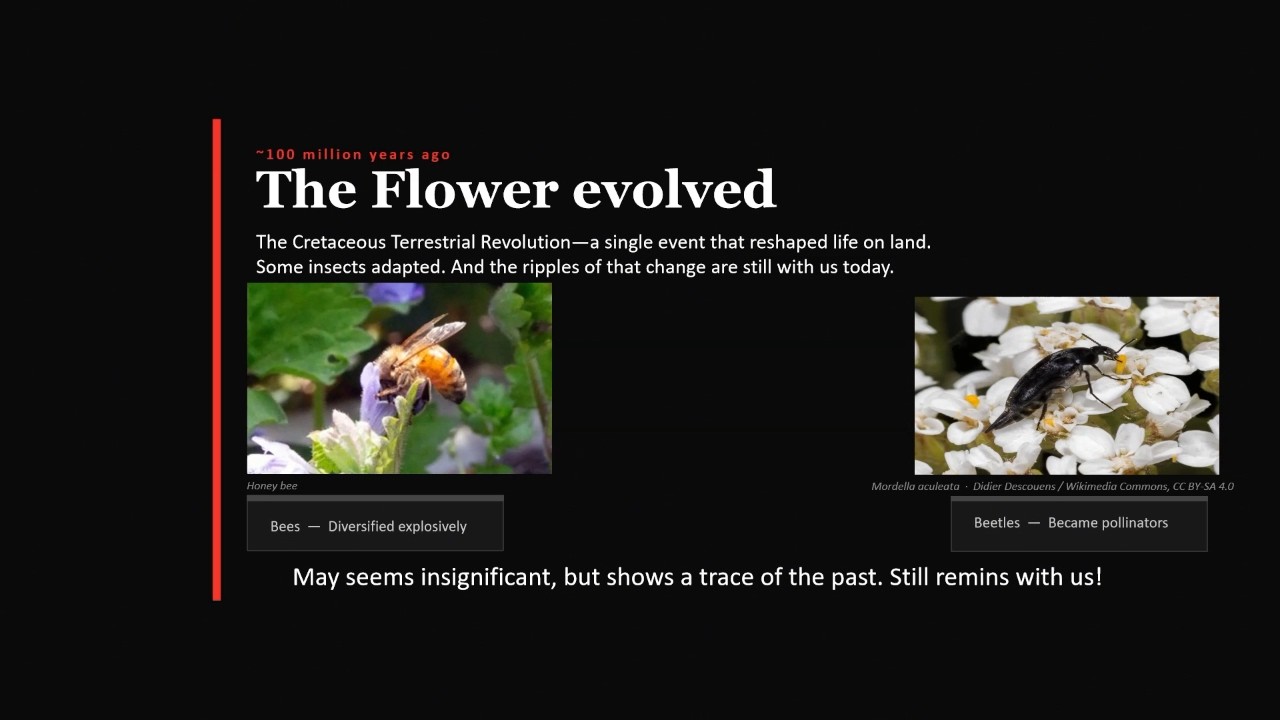
- Discusses the Cretaceous Terrestrial Revolution and the rise of flowering plants, leading to insect pollination strategies.
- Personal story: how small steps led him to study insect fossils and eventually pursue his PhD in China; concludes with the message to 'drop your stone'.
Cited Sources
- TEDx Talks — The video is a TEDx talk; the link provides general information about TEDx events and the format.
Contribution & Novelties
The talk brings a personal and narrative perspective to the field of insect paleontology, emphasizing how minute fossil features can have significant evolutionary implications. It highlights specific examples that are not widely known, such as egg-attachment strategies and predator-avoidance structures, which contribute to public understanding of insect evolution. The original contribution lies in connecting these scientific details to a broader message about small actions and their cumulative impact.
Pour aller plus loin :
- Meganeura — A representative giant dragonfly-like insect from the Carboniferous, illustrating the size and diversity of ancient insects.
- Cretaceous Terrestrial Revolution — The geological event discussed in the talk that saw the rise of flowering plants and co-evolution with pollinators.
- Entomophily — The process of insect pollination, central to the talk’s discussion of bees and beetles.
129 words
Radar Profile
The radar profile shows a balanced score across information quantity, quality, technical level, and reliability, all in the moderate range (6-7). This reflects a talk that is scientifically accurate but not deep, with good communication but limited technical detail, and a respectable level of credibility.