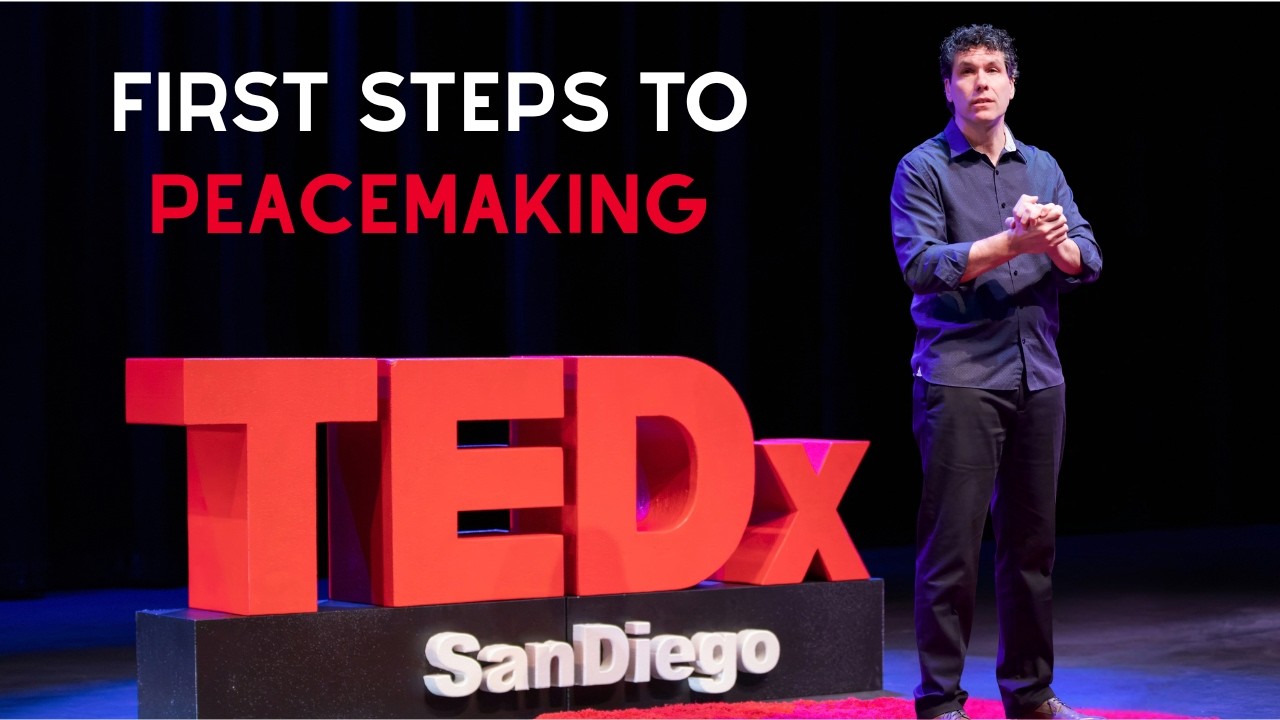
Take the first steps to peacemaking | Darren Kew | TEDxSanDiegoSalon
Keywords
Summary
167 words
Critical Evaluation
Value of the Information & Strength of the Argument
The talk provides valuable insights into the psychological and spiritual mechanisms behind peacebuilding, based on the speaker’s extensive fieldwork and research. The argumentation is compelling: Kew builds a case that ordinary people are the true catalysts for peace, supported by references to his own research and that of others, such as the study with Anthony Wanis-St. John on peace agreements. The narrative of Pastor James and Imam Ashafa is powerful and illustrates the theoretical points effectively. However, the talk relies heavily on anecdotal evidence and personal interpretation, with limited quantitative data. The spiritual dimension may not appeal to all audiences, but it is presented as one pathway among others. Overall, the argument is coherent and persuasive within its scope, though it could benefit from more empirical evidence.
Scientific Rigor, Source Quality, Title Accuracy
The scientific rigor is acceptable for a TEDx talk: the speaker cites his own book ‘Civil Society, Conflict Resolution, and Democracy in Nigeria’ and an article in International Negotiation, though without giving specific URLs. He also references the Kroc School and other institutions but does not provide detailed citations. The title ‘Take the first steps to peacemaking’ is well aligned with the content, as the talk is essentially a call to action for individuals to initiate peace efforts. The speaker’s credentials lend credibility, and the content is consistent with established literature on peacebuilding, though it does not critically engage with conflicting perspectives.
244 words
Title / Content Match
The title accurately reflects the content, which focuses on how ordinary individuals can initiate peacemaking in their communities.
Quality & Reliability
8/10
The speaker is an expert with 35 years of experience in peace studies, backed by research and a book on the topic. The talk relies on anecdotal evidence and references to published work, but does not provide detailed citations or data. Overall reliable, but with an emphasis on narrative rather than academic rigor.
Key Moments
Markers derived by PSI from the transcript: the creator did not define chapters.
- Introduction: questioning what makes ordinary people take first steps toward peace
- Discussion of transcendent moments and spiritual motivation in peacebuilders
- Story of Pastor James Wuye and Imam Muhammad Ashafa, former enemies in Nigeria
- Emphasis on storytelling with 'I' statements as a key tool for building trust
- Practical advice on how to cultivate transformative moments and take first steps
Cited Sources
- TEDx official website — General information about TEDx events
- Civil Society, Conflict Resolution, and Democracy in Nigeria — Book by Darren Kew, mentioned as basis for arguments about individual efforts in peacebuilding
- International Negotiation journal — Research with Anthony Wanis-St. John on peace agreements, referenced for evidence
Concurring Sources
- Peacebuilding - Wikipedia — Supports the idea that local actors are crucial for sustainable peace.
Contribution & Novelties
The talk offers a practical, actionable perspective on peacebuilding, bridging spiritual experiences with conflict resolution techniques. It provides a clear framework: transformative reflection, mutual storytelling, and building cross-community networks. The emphasis on individual agency over top-down diplomacy is a valuable contribution to public discourse.
Pour aller plus loin :
- Peacebuilding - Wikipedia — General overview of the field and its methods.
- Conflict resolution - Wikipedia — Key concepts and approaches relevant to the talk.
- Interfaith dialogue - Wikipedia — Directly related to the example of the interfaith mediation center.
89 words
Radar Profile
The radar profile shows high scores in information quality and reliability, moderate in quantity and technical level, reflecting a talk that is well-founded but not heavily technical or exhaustive.