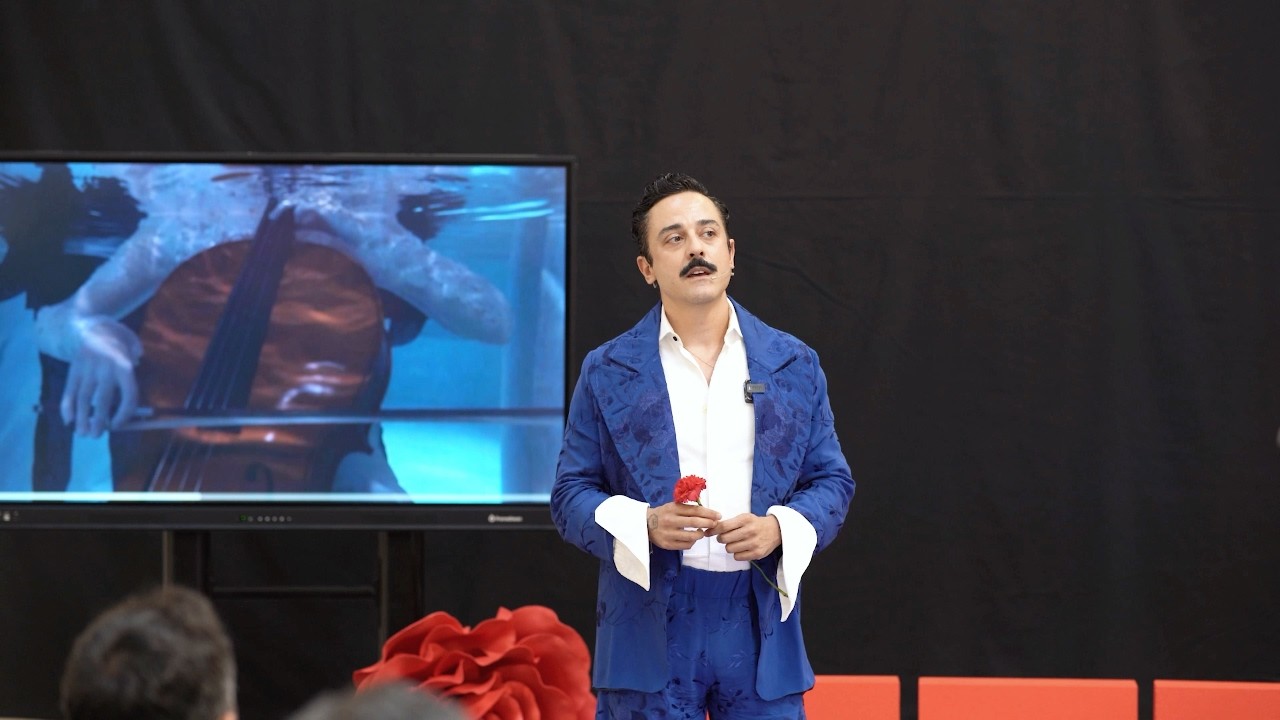
Te enseñaron a no sentir | Raúl Rosillo | TEDxCasco Antiguo
They taught you not to feel | Raúl Rosillo | TEDxCasco Antiguo
Keywords
Summary
168 words
Critical Evaluation
Value of the Information & Strength of the Argument
The talk offers a passionate and coherent personal narrative, but its value lies more in emotional resonance and cultural commentary than in factual or evidence-based argumentation. The speaker provides anecdotal examples from his career and childhood to support his points, but these are not backed by data or research. His argumentation is structured around a clear thesis—that society suppresses sensitivity—and he builds it through personal testimony and philosophical reflection. While compelling, the lack of empirical grounding limits its scientific value. The rhetorical strength of the talk is in its ability to connect with the audience on an emotional level, but it does not engage critically with counterarguments or alternative perspectives.
Scientific Rigor, Source Quality, Title Accuracy
The talk is not scientific in the traditional sense; it is an experiential and philosophical exposition. The speaker, a creative professional, does not cite any studies, sources, or established frameworks. The only link in the description is to the TEDx program, which is a general platform, not a specific reference. There is no attempt at systematic analysis or review. However, the title perfectly matches the content: the speaker explicitly discusses the societal lesson of not feeling. The talk’s structure is clear and the message is delivered with sincerity, but the absence of external evidence and reliance on subjective experience make its scientific rigor low. The public response to such a talk typically appreciates its emotional depth rather than its scholarly merit.
246 words
Title / Content Match
The title accurately reflects the content: the speaker's message about societal pressure to suppress emotion.
Quality & Reliability
4/10
Personal narrative and opinion, no scientific evidence or references, but coherent and emotionally engaging.
Key Moments
Markers derived by PSI from the transcript: the creator did not define chapters.
- Introduction: Overload of information and societal pressure to conform.
- Personal childhood: being a sensitive child and feeling like an outsider.
- Two pillars of his life: grandfather's workshop and the art gallery.
- The need to belong and the identity crisis that follows conforming.
- Critique of the creative industry: ego over talent and impact confused with emotion.
- Artificial intelligence and the unique human capacity to feel; conclusion.
Cited Sources
- TEDx Program — The video is a TEDx talk, and this is the official program page.
Contribution & Novelties
The talk contributes a personal and artistic perspective on the value of sensitivity in modern society, arguing that it is a form of intelligence and resistance. It does not introduce new scientific concepts but repackages existing ideas about authenticity and emotional awareness for a general audience. The relevance to AI is tangential, suggesting that machines cannot replicate human feeling. Overall, the novelty lies in the speaker’s individual experience and its presentation.
Pour aller plus loin :
- Emotional intelligence — Relates to the speaker’s argument that sensitivity is a form of intelligence.
- Conformity — Discusses social pressure to fit in, central to the talk.
- Artificial intelligence — Context for the speaker’s claim about machines not replicating feeling.
- Sensory processing sensitivity — A trait that may underlie the speaker’s description of being highly sensitive.
132 words
Radar Profile
The radar profile shows low technical and reliability scores, reflecting the non-technical, subjective nature of the talk, while moderate information quantity and quality indicate a substantive but not dense presentation. The talk excels in emotional appeal rather than factual rigor.