Throw Away the Script | Nana Yaw Ofori-Atta | TEDxAshesi University
Keywords
Summary
249 words
Critical Evaluation
Value of the Information & Strength of the Argument
The informational value here is motivational and heuristic rather than empirical. What the talk actually transmits is a decision framework: examine the inherited path before rejecting it, distinguish what is broken in it from what is merely unfashionable, and choose a point of differentiation knowingly rather than reactively. That framing is genuinely useful and is stated with unusual clarity for the genre; the paper-crumpling exercise makes the abstract point physically legible in under two minutes. The three closing prescriptions (audit the script, bring your whole self, build for adaptability) are actionable and internally consistent with the anecdotes that precede them.
The argumentation, however, is almost entirely inductive from a single case — the speaker’s own life — and leans on rhetorical devices rather than reasoning: repetition of the title phrase, audience interrogation, self-deprecating humour, and a closing callback. Correlations are presented as causal (reading the script produced the breakthrough) without any control on the alternative explanation that persistence, network and luck did the work. The claim that the ‘safe path is no longer safe’ and that degree-holders are being laid off is asserted, never quantified or sourced. The analogy between the microwave/Encarta/Mavis Beacon generation and AI tools is evocative but does not establish that adaptation is a matter of attitude rather than of specific, trainable skills. Several passages are digressive and the middle section on the speaker’s own ventures functions partly as self-promotion, which dilutes the argumentative thread. The talk is thus coherent and well-paced as persuasion, but its evidential base is anecdote plus assertion.
Scientific Rigor, Source Quality, Title Accuracy
No scientific source is invoked at any point. There are no studies, no statistics, no named authors or institutions, and no data on labour markets, automation or career outcomes — the only external reference in the description is the generic TEDx programme page. Claims about AI and employment are made in passing and without support, and the mention of a church projection app is anecdotal. The talk is transparent about being a personal account and never dresses opinion as research, which limits the damage, but a viewer seeking evidence-based guidance will find none here. Terminology is used loosely: ‘script’, ’lane’, ‘adaptability’ and ‘AI’ all function as rhetorical labels rather than defined concepts.
On fit between title and content: the title, thumbnail and description all frame a talk about reading and then rewriting an inherited life plan, and the delivered talk follows that arc closely, including the paper exercise that literalises the metaphor. The correspondence is strong; the only slippage is the late segment cataloguing the speaker’s own events and platforms, which is only loosely tied back to the thesis.
No audience comments were supplied, so no reading of public reception is offered.
462 words
Title / Content Match
The title and thumbnail promise a talk about rejecting a prescribed life script, and the content delivers exactly that framing, including the recurring 'read the script before you throw it away' motif. Fit is close, though the closing third drifts into promotion of the speaker's own projects.
Quality & Reliability
3/10
The talk is a personal narrative delivered by a brand strategist and musician, not a researcher. Claims are largely autobiographical and rhetorical, with no data, statistics, citations or cited literature. Where it touches on the labour market and AI, it asserts rather than demonstrates (e.g. 'even people with masters are being laid off'), and the only external reference point is the TEDx programme itself. Internal coherence is good and the speaker's own trajectory is verifiable in principle, but evidentiary support is thin.
Key Moments
Markers derived by PSI from the transcript: the creator did not define chapters.
- Opening exercise: the audience is handed a sheet of paper and told to crumple it, setting up the central 'script' metaphor.
- The 'pick a lane' pressure from family and the counter-argument that self-knowledge must come before choosing a lane.
- The reveal that almost nobody read the paper first — 'read the script before you throw it away' becomes the thesis.
- Autobiographical sequence: general arts degree, choir direction, selling banku and sachet water at KNUST, first charting single.
- National service at a bank followed by a long period of silence and self-doubt before the breakthrough.
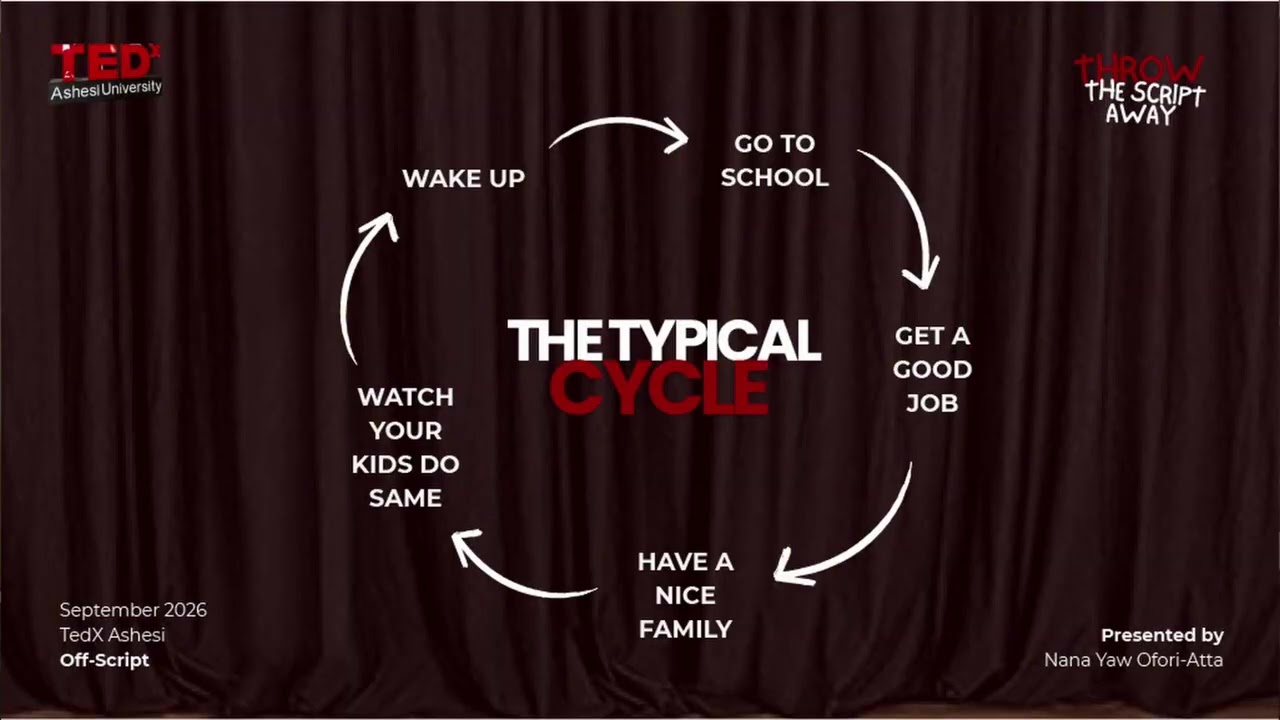
- The 'typical cycle' of school, job, family, repeat — and the question of where to stand out inside it.
- Acceleration argument: microwave generation, Encarta and typing software replaced by instant AI tools.
- Presentation of his own ventures as proof of concept — social club, men's conversation format, academy, year-end festival.
- The three practical prescriptions: audit your script, bring your whole self, build for adaptability.
- Closing claim that the safe path is no longer safe, plus the call to make your name open doors.
Cited Sources
- TEDx programme (official TED page) — The only external reference given in the video description, describing the independently organised TEDx format under which the talk was delivered. Not a source for any factual claim made in the talk.
Concurring Sources
- Mindset (Wikipedia) — Supports the talk's central claim that beliefs about one's own malleability shape how people respond to setbacks, consistent with the 'audit your script' and 'build for adaptability' prescriptions.
- Technological unemployment (Wikipedia) — Provides the economic framing for the speaker's assertion that rapid technological change destabilises previously safe career paths.
Dissenting Sources
- Technological unemployment (Wikipedia) — The same body of literature that supports concern about automation also shows the effect is uneven across sectors and that displacement has historically been partly offset by new roles. The talk presents the 'safe path is no longer safe' as settled fact, whereas the evidence is genuinely contested and heavily dependent on occupation and country.
Contribution & Novelties
The talk’s original contribution is not informational but rhetorical: it reframes career advice away from ‘follow your passion’ or ‘just quit’ toward a sequenced method — first read the inherited script carefully, identify which parts are genuinely broken, then deviate deliberately. The crumpled-paper exercise makes that sequence concrete and auditable in the room, and the emphasis on temperament (introvert/extrovert/ambivert) as a constraint on strategy is a useful corrective to one-size-fits-all advice. The grounding in a West African, specifically Ghanaian, context — family expectations, ‘uncles and aunties’ demanding a single lane, national service, the year-end ‘December’ culture — gives the material a specificity that generic Anglophone career content usually lacks. The weakest novelty claim is the AI section: the observation that the tool changes while the problem persists is sound but already commonplace.
Further reading:
- Mindset — Background on fixed versus growth mindset, the closest academic analogue to the talk’s argument about adaptability.
- Technological unemployment — Context for the claim that the ‘safe path’ is no longer safe; the literature is far more contested than the talk implies.
- Claude (language model) — Reference for the AI assistant named by the speaker when discussing tool turnover.
- Career adaptability (Savickas) — The vocational-psychology construct that most directly formalises the talk’s third prescription; cited by name rather than by URL.
- Multi-hyphenate or portfolio career — The labour-market concept underlying the speaker’s refusal to ‘pick a lane’; cited by name only.
236 words
Radar Profile
The profile is dominated by low scores on informational density, technical depth and reliability, with a slight lift on information quality reflecting internal coherence and clear structure rather than evidence. This is the expected shape for a motivational TEDx talk: high rhetorical organisation, minimal empirical backing. The radar therefore describes an argumentative and persuasive artefact, not an informational one.