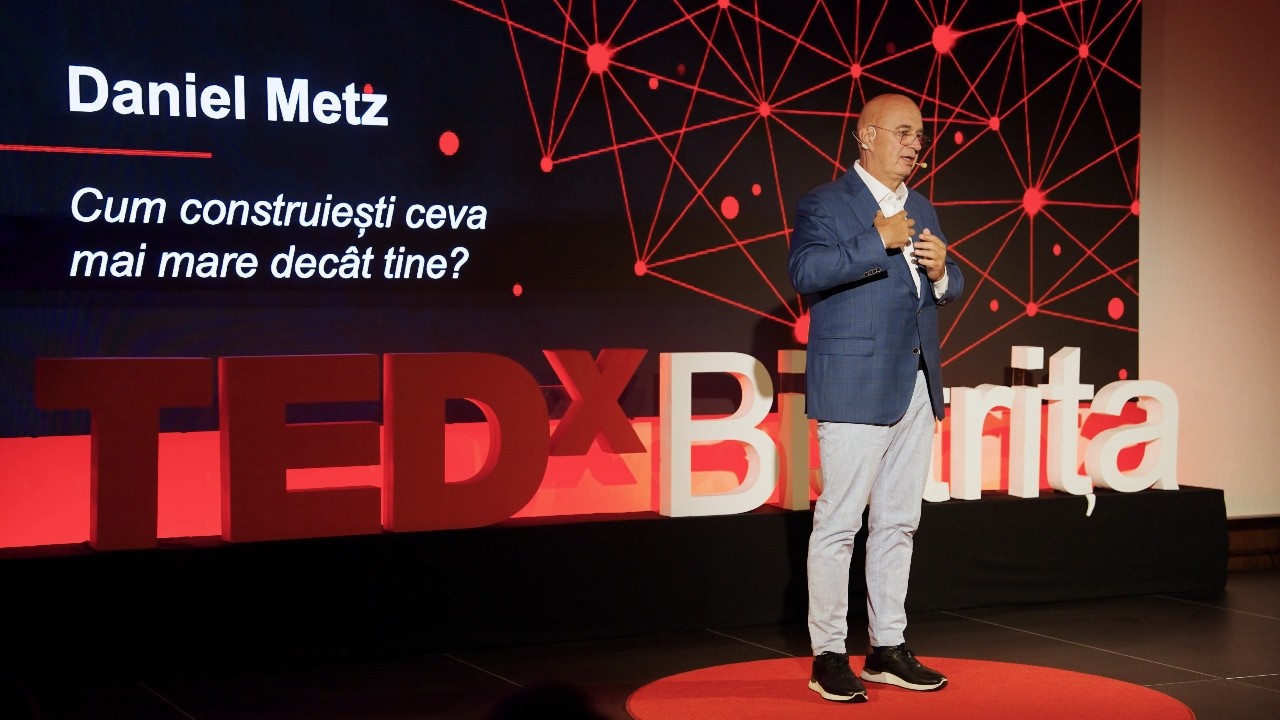
Cum construiești ceva mai mare decât tine? | Daniel Metz | TEDxBistrita
How to build something bigger than yourself? | Daniel Metz | TEDxBistrita
Keywords
Summary
281 words
Critical Evaluation
Value of the Information & Strength of the Argument
The value here lies less in transferable method than in a well-articulated experiential thesis, and that thesis is genuinely non-obvious: success, not failure, is what most often stops people from making the next move. Metz builds the argument through a sequence of autobiographical decision points — leaving a secure officer’s career, restarting in Germany, abandoning a well-paid consulting position, returning to Romania, then selling the company he had founded — each staged as a case where comfort had to be deliberately broken. The strongest passage is the diagnosis of the founder as bottleneck: he describes the company as an organic entity that outran him, and concludes that his own personal financial capacity and his personal centrality had become limits on both the firm and its employees. That reframing — the founder as constraint rather than engine — is the talk’s real intellectual contribution and it is argued with concrete detail (employee counts, the reinvestment policy, the two-room apartment) rather than with abstractions. The weaker segments are the precepts that follow: hire people better than you, close your circles, leave through the front door, find the right lever and pivot. These are delivered as maxims backed by the speaker’s authority alone, with no attempt to distinguish what generalises from what happened to work once, and there is a visible survivorship problem — the audience hears from the founder who sold successfully, not from the far more numerous founders who stepped back and lost control. The final definition of success (the ability to walk away and see the organisation thrive without you) is clean and memorable, but it is a definition to be adopted rather than a proposition that has been tested. The register is motivational and the causal claims are retrospective reconstructions of a single career, so the talk is best treated as a set of well-formulated hypotheses about delegation, ego and timing, useful as a starting point for reflection and worth confronting with broader evidence.
Scientific Rigor, Source Quality, Title Accuracy
No external source, study or figure is cited at any point; the only documentary element is the generic TEDx link in the description pointing to the TEDx format. All quantitative claims — a monthly salary of 18,000 EUR, 180 subordinates, 400 employees while living in a two-room flat, 4,000 direct and indirect jobs created, five dual-education specialisations implemented, an international group of some 300,000 people — are self-reported and unverifiable within the talk. The NTT DATA acquisition and the identity of its main shareholder are stated without reference, though they are in principle checkable facts. Methodologically, the talk is a retrospective narrative in which past decisions are reconstructed with the coherence that hindsight confers: motives are attributed to the actor after the outcome is known, and no alternative explanation is ever weighed. There is no engagement with contrary evidence, and the selection effect is structural — the speaker’s stance depends on the sale having succeeded. The title-to-content match is strong: the guiding question about building something larger than oneself is explicitly restated at the opening, returns at each biographical hinge, and is answered in the closing minute with a concrete definition, so there is no gap between promise and delivery. What the talk lacks is not integrity but apparatus: it persuades by example and by the credibility of a lived trajectory, not by demonstration.
564 words
Title / Content Match
The title's question is genuinely the spine of the talk: every biographical episode is retold as an illustration of what it means to build something that outlives your own indispensability. The promise is met, though in the form of a motivational narrative rather than a method.
Quality & Reliability
4/10
A first-person entrepreneurial narrative built almost entirely on personal recollection: no data, no external references, and figures (salary, headcount, jobs created) that cannot be checked. The reasoning is coherent and internally consistent, and the speaker's track record lends plausibility, but the talk offers anecdote and interpretation rather than verifiable evidence, so it should be read as experiential testimony, not as documented fact.
Key Moments
Markers derived by PSI from the transcript: the creator did not define chapters.
- Opening: the title's question is posed to the audience, and the speaker admits he was not sure he had ever asked it of himself.
- Central observation: major life decisions, in his experience, were made from a position of comfort and success rather than under pressure.
- Leaving Romania at 26 as an army finance officer, with two suitcases and a three-month-old child, for a Germany where his qualifications were not recognised.
- The first interview: a former Bundeswehr officer turns the Romanian military past from a perceived handicap into a hiring argument.
- Move into IT consulting, rapid promotion, 180 German staff and a salary he calls indecent — the moment success itself becomes the problem.
- Return to Romania and building the company past 400 employees while still living in a two-room flat and reinvesting everything.
- The turning point: the company becomes an organic entity running faster than he can, and he recognises himself as the limit on its growth.
- Decision to sell to NTT DATA, whose main shareholder is the Japanese government, to give the company room it could not get from him alone.
- Closing circles deliberately: leaving through the front door and at the moment you choose, while everything still works.
- Move to the university in Alba Iulia and the creation of five dual vocational education specialisations with large Romanian partner companies.
- Final definition of success: the door closes behind you and the organisation keeps running and growing without you.
Cited Sources
- TEDx — official programme page — Link given in the video description to the TEDx format under which this independently organised local event took place; the talk cites no external study or document.
Concurring Sources
- Founder's syndrome — Wikipedia — Corroborates the central diagnosis of a founder becoming the limiting factor of an organisation, and documents the usual remedies of delegation and external governance.
- Succession planning — Wikipedia — Situates the deliberate handover and the sale to a larger group within a known management practice rather than as a purely personal intuition.
- Servant leadership — Wikipedia — Gives a theoretical frame to the talk's practical rule of hiring stronger people and measuring one's success by the autonomy left to others.
Contribution & Novelties
The talk’s distinctive contribution is not a new framework but a sharply framed inversion of the usual entrepreneurial narrative: it locates the obstacle to growth inside the founder’s own success rather than in failure, markets or competition, and it describes the founder as the binding constraint on an organisation that has outgrown its personal capacity to finance and to decide. The sequence of deliberate exits — country, profession, salaried comfort, then the company itself — is presented as a repeatable discipline rather than a single lucky break, and the closing criterion (the organisation works without you) is an unusually operational test of what leadership is supposed to produce. The move into dual vocational education is the most concrete and least self-referential part of the talk, connecting the entrepreneurial argument to an institutional question about how technical skills are produced.
Further reading:
- Founder’s syndrome — Directly frames the phenomenon Metz describes: a founder remaining the central bottleneck of an organisation that has outgrown them.
- Succession planning — Provides the established vocabulary and practice for the handover he improvised by selling the company.
- Servant leadership — Theoretical counterpart to his rule of hiring people better than himself and measuring success by others’ growth.
- Dual vocational education (German-style dual system) — The model behind the five specialisations he helped set up in Alba Iulia; worth reading alongside his account to see how much of it is institution-specific.
- Survivorship bias in entrepreneurial testimony — Useful caution when reading a single successful founder’s retrospective account of what caused his outcomes.
255 words
Radar Profile
The profile is that of a motivational first-person talk: low technical density and modest informational yield, offset by a clear and consistently pursued thesis. Reliability sits low because every claim rests on self-report, while quantity of information stays middling — a handful of concrete facts embedded in a largely narrative delivery. The overall shape is a narrow, sharp peak on argumentative coherence rather than a broad plateau of documented content.