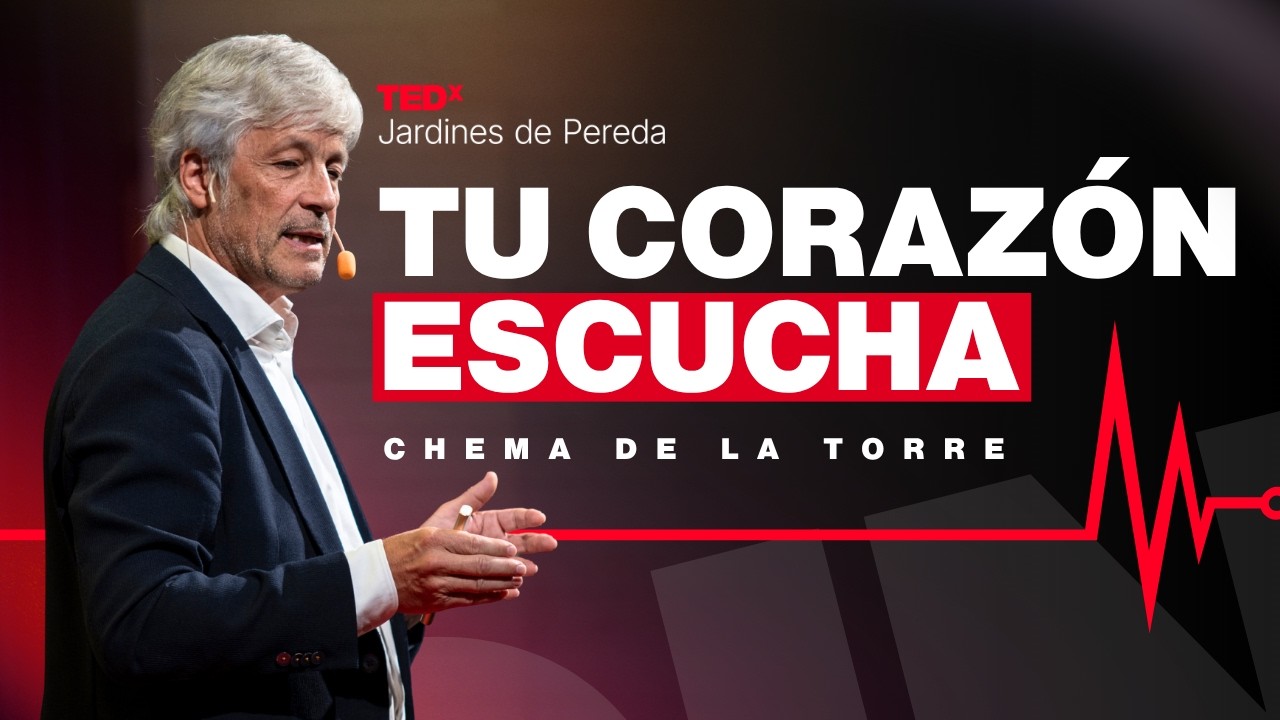
La conexión entre la mente y la salud cardiovascular | Chema de la Torre | TEDxJardines de Pereda
The connection between the mind and cardiovascular health | Chema de la Torre | TEDxJardines de Pereda
Title history
- La conexión entre la mente y la salud cardiovascular | Chema de la Torre | TEDxJardines de Pereda — observed on 20261103-1821 UTC (YouTube)
Keywords
Summary
199 words
Critical Evaluation
Value of the Information & Strength of the Argument
The talk provides valuable information by connecting well-established cardiology knowledge with emerging evidence on psychosocial factors. The argumentation is solid for the scientific part: he cites specific studies (e.g., INTERHEART) and clinical observations, and explains physiological mechanisms (inflammation, sympathetic activation). However, the later part shifts to personal opinion and social critique, which is less evidence-based and more subjective. He acknowledges this transition, but the persuasive tone may oversimplify complex issues like happiness pursuit.
Scientific Rigor, Source Quality, Title Accuracy
The scientific rigor is generally high, as the speaker references credible sources like the ESC consensus document and major epidemiological studies. He distinguishes between evidence and personal views. The title is accurate; the talk indeed centers on the mind-heart connection. However, some claims, such as the equivalence of loneliness to smoking 15 cigarettes, are stated without exact references, and the clinical anecdotes are used to illustrate, not prove. The adequacy of the title is good, with a minor mismatch in that the talk also covers societal critique beyond just the medical connection.
180 words
Title / Content Match
The title accurately reflects the content, which focuses on the mind-heart connection through clinical examples and epidemiological evidence.
Quality & Reliability
8/10
The speaker is a senior interventional cardiologist and head of the cardiology department, citing specific studies and a recent ESC consensus document. The talk is a well-structured popularization with clear scientific grounding, although it includes personal opinions and lacks detailed references on screen.
Key Moments
Markers derived by PSI from the transcript: the creator did not define chapters.
- Introduction of Takotsubo syndrome with the 1983 case in Hiroshima and its hallmark of reversible heart dysfunction triggered by emotional stress.
- Discussion on psychiatric disorders and their independent association with cardiovascular risk, adjusted for lifestyle factors.
- The role of loneliness as a risk factor equivalent to smoking 15 cigarettes per day, and the mitigating effect of having a dog.
- Reference to the INTERHEART study showing that chronic stress doubles heart attack risk, similar to hypertension.
- Critique of contemporary society's obsession with health and happiness, leading to chronic stress and self-exploitation.
- Mention of the European Society of Cardiology consensus document on mind-heart interactions and recommendation of Byung-Chul Han's book.
- Conclusion emphasizing the importance of listening to one's heart and caring for mental health to protect cardiovascular health.
Cited Sources
- TEDx — The talk was delivered at a TEDx event, and the description points to the TEDx platform.
- INTERHEART study — Mentioned as a large international study by Salim Yusuf showing the impact of chronic stress on heart attack risk.
- Takotsubo syndrome — The speaker describes the syndrome, first identified in 1983, and its link to emotional triggers.
- European Society of Cardiology consensus document — Referenced as a 70-page document led by Héctor Bueno and Marta Ferrero on mind-heart interactions, but no specific URL is given.
- The Burnout Society — Book by Byung-Chul Han, published about 12-14 years ago, recommended by the speaker to explain societal auto-exploitation and fatigue.
- Tu corazón tiene algo que decirte — Book by cardiologist Aurelio Rojas, mentioned as a popularization on cardiac warnings.
Concurring Sources
- American Heart Association on depression and heart disease — Supports the link between mental health and heart health, though not directly named in the talk.
- Wikipedia on loneliness and health — Aligns with the speaker's claims about loneliness as a risk factor.
Dissenting Sources
- Lack of specific references for some claims — The equivalence of loneliness to smoking 15 cigarettes per day is cited without a precise source, and the talk does not provide direct citations for several statistics.
Contribution & Novelties
The talk offers an integrative perspective from a practicing interventional cardiologist, emphasizing that psychological well-being is not an alternative but a core component of cardiovascular health. It contextualizes recent evidence on stress, loneliness, and mental health in daily cardiology practice. The speaker also bridges clinical science with societal critique, suggesting a need for cultural change.
Pour aller plus loin :
- Takotsubo syndrome — Understanding the heart-brain connection in stress-induced cardiomyopathy.
- Psychological stress — Mechanisms of stress and its physical health effects.
- Loneliness — Health impacts including cardiovascular risk, as discussed in the talk.
- Byung-Chul Han, ‘The Burnout Society’ — A philosophical analysis of modern self-exploitation, relevant to the talk’s social critique (no URL available).
114 words
Radar Profile
The radar profile shows high scores in quantity and quality of information, with moderate technical level. The fiabilité is reasonably high, reflecting the speaker's expertise and use of well-known studies, but with a slight dip due to subjective opinions in the latter part.