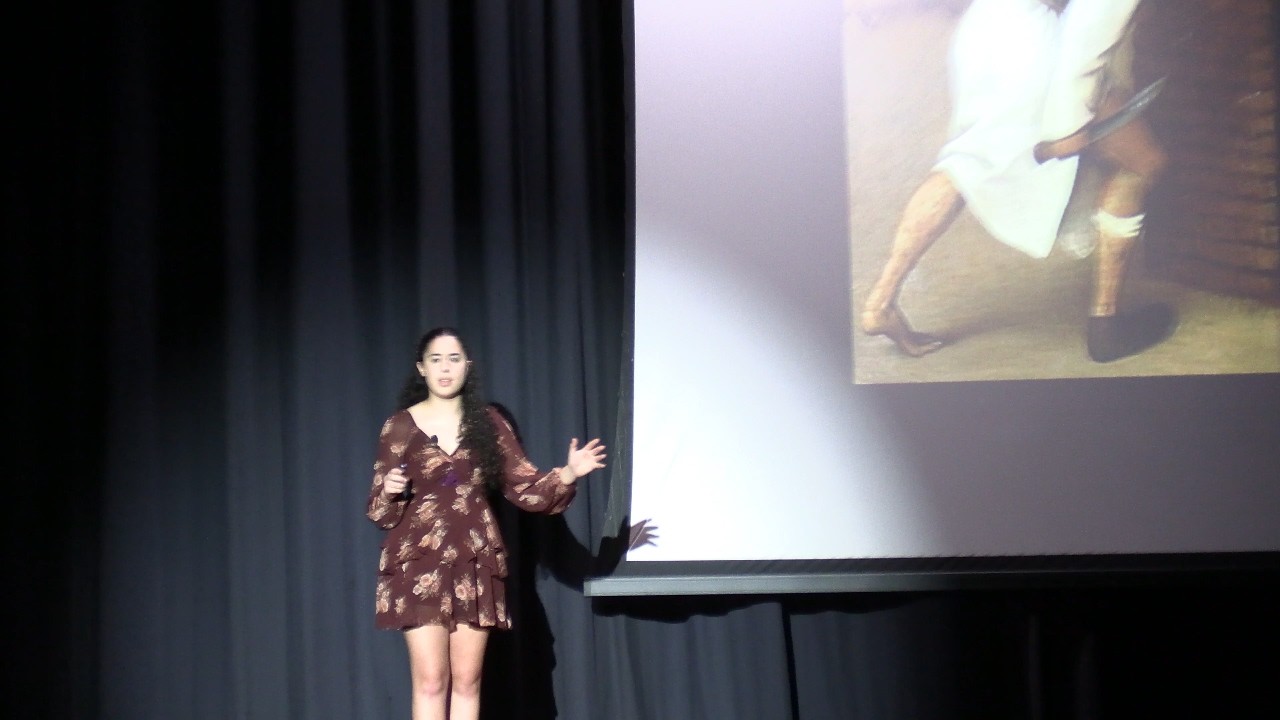
Historical Reflections of Humor | Thea Kupersmith | TEDxPWHS Youth
Keywords
Summary
299 words
Critical Evaluation
Value of the Information & Strength of the Argument
The value of the talk lies in a compact, well-chosen corpus of examples spanning four millennia, each used to make a single analytic point rather than simply decorating a timeline. The Mesopotamian tablet establishes the core methodological claim — that humour is context-bound and partly unrecoverable — and the rest of the talk applies it consistently: Aristophanes is read as evidence of a civic culture that licensed public mockery of power; Bruegel’s proverbs are read as a shift from sacred to human subject matter; Swift is read as a rhetorical strategy that uses economic register to expose economic dehumanisation; mass political cartoons are read as evidence of who was gaining and losing cultural authority. The argument’s spine, that humour both reflects and shapes society, is stated at the start, tested through the examples, and restated at the end, which gives the talk an unusually clean structure for its format. Its weaknesses are analytic rather than factual. Several causal claims are asserted without support — that Athenian democracy ‘facilitated’ comic critique, that humanism and scientific thinking drove the change in visual art, that print industrialisation ‘mass-produced’ humour — where a single counter-example or a cited historian would have been needed. Key concepts are used but not defined: satire, irony, parody and the carnivalesque are treated as interchangeable, and the medieval distinction between courtly and popular humour is presented in binary terms that specialist work on festivity and misrule would complicate. The theoretical literature on why humour exists (superiority, incongruity and relief theories) is entirely absent, which matters because the talk’s central claim about what jokes reveal depends on which theory one adopts. The final move toward the internet is the thinnest part: the global-joke-with-local-variation analogy is illustrated with lingua franca and fast-food comparisons rather than with evidence about how memes actually travel or mutate. Overall a genuinely argued thesis rather than a list, but one carried by illustration more than by demonstration.
Scientific Rigor, Source Quality, Title Accuracy
No formal citations, bibliography or academic references are given, in the video or in the description; the only link is the generic TEDx page. What the talk does instead is name its primary materials precisely enough to be checkable: a Mesopotamian tablet presented as one of the earliest recorded jokes, Aristophanes’ The Acharnians, Neidhart von Reuenthal, Chaucer’s Canterbury Tales, Bruegel’s Netherlandish Proverbs, and Swift’s A Modest Proposal. These are real works and the characterisations are broadly accurate, which is the main strength of the sourcing: the audience can go and read or look at every object mentioned. Against that, the talk makes no distinction between what is documented and what is interpretation; the Mesopotamian joke is presented without provenance, edition or translation tradition, and the claim that it is ‘considered one of the world’s first documented bar jokes’ is attributed to nobody. Quotations are paraphrased from memory rather than cited, the Swift passage is presented in a slightly compressed form, and no historian of humour, medievalist or art historian is named to support the generalisations about class and period. Dates are given only at the level of century, and the medieval discussion treats ‘upper class’ and ’lower class’ humour as discrete registers without acknowledging how much popular material survives only through elite transcription. On adequacy between title and content, the promise of a historical reflection on humour is met squarely, with a chronological structure announced and followed; only the framing word ‘reflections’ oversells the theoretical ambition of what remains a survey.
587 words
Title / Content Match
The title announces a historical survey of humour and the talk delivers exactly that, running chronologically from Mesopotamia to internet memes; the 'reflections' framing is slightly broader than the actual argument, which is mostly about satire. Fit is good overall.
Quality & Reliability
5/10
The talk is a well-structured cultural-history overview built on genuine primary artefacts and authors (a Mesopotamian joke tablet, Aristophanes' The Acharnians, Neidhart von Reuenthal, Chaucer, Bruegel, Swift), and its central claim — that humour encodes the values and anxieties of its society — is a standard, defensible position in cultural history. However, no dates, editions, translations or scholarly references are given, the ethnographic and historical generalisations (e.g. 'upper-class humour' vs 'lower-class humour' in the Middle Ages) are asserted rather than demonstrated, and several attributions are simplified or loosely stated (the Mesopotamian tablet is presented without provenance, the medieval class divide in humour is flattened). As a synthesis it is honest and coherent; as a sourced argument it remains at the level of a well-researched student essay.
Key Moments
Markers derived by PSI from the transcript: the creator did not define chapters.
- The 4,000-year-old Mesopotamian 'bar joke' is introduced as the entry point: the joke survives but its pun does not, framing the talk's central problem of cultural translation.
- Satire is defined as exaggeration and absurdity used to expose human shortcomings, with modern examples (SNL, The Onion, political cartoons) before the historical cases.
- Aristophanes' The Acharnians analysed: a private peace with Sparta and caricatured, war-hungry politicians as a critique of Cleon and the Peloponnesian War.
- Medieval humour split along social lines: courtly poets such as Neidhart von Reuenthal mocking commoners, and court jesters whose proximity to power allowed licensed criticism.
- Chaucer's Canterbury Tales as popular counter-humour, in which ordinary people are witty and the aristocracy foolish.
- Pieter Bruegel's Netherlandish Proverbs read as a visual shift from religious and royal subjects to human folly, set against the spread of humanism.
- Swift's A Modest Proposal: deadpan economic reasoning about eating Irish children as a mirror of how British society already treated the poor as an economic burden.
- Industrialisation and print make humour mass-produced: widely circulated political cartoons, including ones attacking women's suffrage and reflecting anxieties about gender roles.
- Globalisation and the internet: jokes cross continents in minutes on a shared structure with local content, and anyone with a phone can now produce satire.
- Conclusion: humour records and shapes society, and societies change when they learn to laugh at what they once accepted.
Cited Sources
- TEDx official site — Only link provided in the description; general information about the independently organised TEDx format under which the talk was given. No bibliographic source is cited for the historical claims.
- Mesopotamian joke tablet (as described in the talk) — A roughly 4,000-year-old tablet presented as one of the earliest documented 'bar jokes'; cited by description only, without museum reference, edition or translation.
- Aristophanes, The Acharnians — Used as the earliest example of satire: a private peace treaty with Sparta and caricatured politicians critiquing Cleon and the Peloponnesian War.
- Neidhart von Reuenthal, courtly comic poetry — Cited as an example of aristocratic humour portraying commoners as foolish and uncultured.
- Geoffrey Chaucer, The Canterbury Tales — Presented as popular, bodily, subversive humour in which peasants are clever and nobles foolish.
- Pieter Bruegel the Elder, Netherlandish Proverbs — Analysed as a visual catalogue of proverbs about human folly, marking a shift toward humanist subject matter in the Northern Renaissance.
- Jonathan Swift, A Modest Proposal — Read as an ironic essay whose deadpan economic logic exposes British treatment of the Irish poor; quoted and paraphrased.
Concurring Sources
- Aristophanes (Wikipedia) — Confirms Aristophanes' use of comedy to attack contemporary political figures including Cleon, consistent with the talk's reading of The Acharnians.
- A Modest Proposal (Wikipedia) — Corroborates the satirical target and the ironic economic register described in the talk.
- Pieter Bruegel the Elder (Wikipedia) — Supports the description of Bruegel's peasant genre scenes and proverb paintings as a departure from religious and courtly subjects.
- The Canterbury Tales (Wikipedia) — Confirms the pilgrimage frame and the socially mixed, often satirical characterisation of the tellers.
Contribution & Novelties
The talk’s originality is not in the thesis — that humour is historically and socially situated is a commonplace of cultural history — but in its compression and in the specific pairing it constructs: ancient comic material (the Mesopotamian tablet, Aristophanes) set alongside early modern visual and literary satire (Bruegel, Swift) and then against industrial print and internet circulation, treated as three successive regimes of humour production and distribution. Framing mass-printed cartoons and internet memes as analogous moments of democratised comic authorship is a genuinely useful didactic move, and it gives a non-specialist audience a portable question — ‘what does this joke tell us about the society that made it?’ — that can be applied to any comic object. The claim that humour is not merely reflective but formative, capable of defending or destabilising the status quo, is the most substantive point and the one the talk argues most explicitly. What is missing is engagement with the theoretical literature on humour and with the historiography of popular culture, which would have converted a well-organised survey into an argument with a position. The material on the internet is the most time-bound and least evidenced section.
Pour aller plus loin :
- Satire — Background on the rhetorical mode the talk relies on most heavily, including the distinction between Horatian and Juvenalian registers that the talk blends.
- Aristophanes — Context for Old Comedy and its institutional setting in Athenian civic festivals, which supports the talk’s claim about democracy and licensed mockery.
- The Acharnians — The specific play analysed in the talk, useful for checking the details of the private-peace plot and the Cleon caricature.
- A Modest Proposal — Full text background and the Irish famine and absentee-landlord context behind Swift’s irony.
- Pieter Bruegel the Elder — Career context for the shift from religious to peasant genre scenes that the talk attributes to humanism.
- The Canterbury Tales — The framing device and the estates-satire readings of the tales the speaker summarises.
- Theories of humour (superiority, incongruity, relief) — The missing theoretical layer: the talk’s claim that jokes reveal social values depends on which account of humour one adopts, and this literature is never invoked.
- Carnival and the carnivalesque (Bakhtin) — The obvious scholarly frame for the medieval licensed-fool and popular-rebellion material, which the talk describes empirically but does not name.
386 words
Radar Profile
The profile is characteristic of a well-crafted short cultural-history talk: information density and informational quality are solid for the format, while technical depth stays low because concepts are introduced rather than examined. Reliability sits mid-range — the primary objects are real and accurately described, but the argument rests on illustration and generalisation rather than on cited scholarship. The resulting shape is a broad, readable plateau rather than a spike in any single dimension.