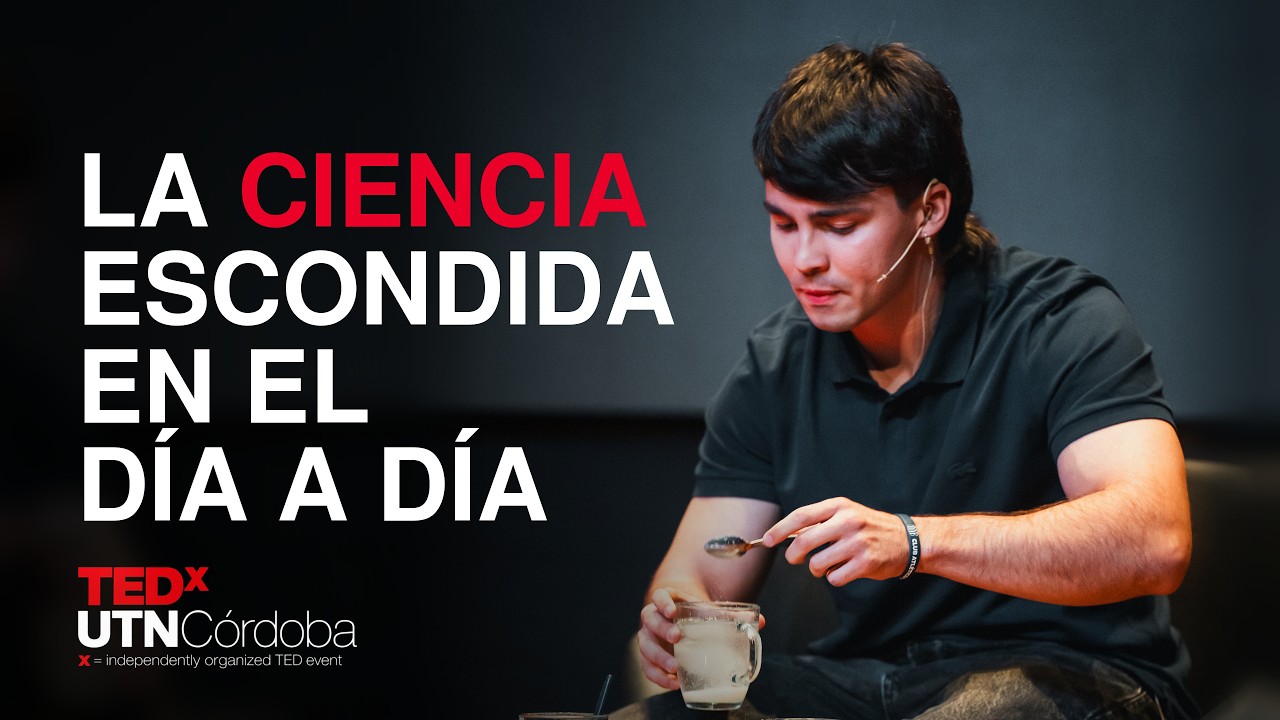
Química y Física en la vida cotidiana | Ignacio Bustos Fierro | TEDxUTN Córdoba
Chemistry and Physics in Everyday Life | Ignacio Bustos Fierro | TEDxUTN Córdoba
Keywords
Summary
160 words
Critical Evaluation
Value of the Information & Strength of the Argument
The main value lies in the narrative device: a continuous daily routine turns abstract principles into a sequence of concrete, memorable cases. The argument is cumulative and accessible: each object—coffee, toothpaste, soap, jacket, car seat, mate, microwave, pulley, grill—is used to make a mechanism visible, and several examples are demonstrated or physically enacted. The reasoning is strongest where a simple causal chain is clear, as with polarity, evaporation, insulation or microwave rotation of polar molecules. Its limits are those of illustration rather than proof: examples are selected to fit the explanation, competing mechanisms are rarely weighed, and quantitative claims are sparse and sometimes approximate. The talk’s persuasive force depends on plausibility and narrative coherence more than on evidence, measurement or explicit uncertainty.
Scientific Rigor, Source Quality, Title Accuracy
Scientific rigor is moderate. The talk uses broadly accepted textbook concepts—hydrogen bonding, non-Newtonian flow, surfactant action, thermal insulation, evaporative cooling, leaching, microwave dielectric heating, pulley mechanical advantage and thermal radiation—but it provides no bibliography, data tables or primary references. The only link in the description is the general TEDx site, not a scientific source, and the scientists named in passing, including Newton, Fick, Planck, Fourier, Boltzmann, Schrödinger and Heisenberg, are not tied to specific works. Several formulations are imprecise or erroneous: flame visibility is attributed to soot particles falling in the infrared spectrum rather than to incandescent emission across visible wavelengths; the Newton line about shoulders of giants is a much older image; and the carbon-mass and asado calculation is presented as a rough equivalence without derivation. The title is accurate: the talk is indeed about chemistry and physics in everyday life, and the content matches the announced day-in-the-life structure.
287 words
Title / Content Match
The title accurately announces a talk about chemistry and physics in everyday life, and the content follows the promised day-in-the-life structure.
Quality & Reliability
6/10
Broadly accurate popular-science explanations with clear everyday examples, but no citations, simplified or imprecise claims in several places, and no explicit uncertainty.
Key Moments
Markers derived by PSI from the transcript: the creator did not define chapters.
- Introduction: everyday actions already rely on physical and chemical principles; water polarity is introduced.
- Coffee and sugar: dissolution, saturation, agitation and why stirring speeds up a process that would otherwise take much longer.
- Toothpaste and ketchup as non-Newtonian fluids with a yield stress: they flow only after sufficient force is applied.
- Soap as an amphiphilic molecule: polar and non-polar parts allow micelle formation and removal of dirt.
- Clothing and wind: trapped air as thermal insulation, and wind accelerating heat loss by breaking the insulating layer.
- Sweating, evaporation and humidity: evaporative cooling and why humid days feel heavier.
- Mate as solid-liquid extraction or leaching: hot water extracts caffeine and polyphenols over successive pours.
- Microwave heating: polar water molecules rotate under an electromagnetic field; liquid water responds more efficiently than ice.
- Fire and barbecue: incandescent soot, radiation cooking, aroma molecules and a rough carbon-balance estimate.
- Conclusion: curiosity, experimentation, explaining an everyday phenomenon to someone else, and the limits of AI-generated answers.
Cited Sources
- TEDx official site — Linked in the video description as the TEDx event framework; it is not a scientific reference for the talk’s claims.
Concurring Sources
- Water — Wikipedia — Supports the talk’s explanation of water polarity, hydrogen bonding and its role as a solvent.
- Non-Newtonian fluid — Wikipedia — Corroborates the toothpaste and ketchup examples by describing yield-stress and shear-dependent flow.
- Microwave oven — Wikipedia — Provides background on dielectric heating of polar molecules, consistent with the talk’s microwave explanation.
Dissenting Sources
- Black-body radiation — Wikipedia — Incandescent soot emits across visible and infrared wavelengths; this corrects the talk’s compressed statement that flame visibility is due to particles in the infrared.
Contribution & Novelties
The original contribution is pedagogical rather than scientific. It does not claim new findings; instead, it builds a tightly linked everyday narrative that connects household operations to standard physical-chemical concepts and ends with a transferable method: choose one ordinary object, understand it well enough to explain it, then ask someone else to repeat the exercise. The talk also frames AI as an answer machine that leaves question-formation to humans.
Further reading:
- Water — background on polarity, hydrogen bonding and solvent properties.
- Non-Newtonian fluid — explains yield-stress and shear-thinning behaviour relevant to toothpaste and ketchup.
- Surfactant — covers amphiphilic molecules and micelle formation.
- Microwave oven — dielectric heating of polar molecules and limits related to ice.
- Standing on the shoulders of giants — historical context for the Newton attribution.
128 words
Radar Profile
The profile is broad rather than deep: information quantity and reliability are moderate, while technical depth is deliberately kept low. The talk is strong on illustrative coverage and weaker on formal rigor and sourcing, which fits a science-communication format rather than a research presentation.