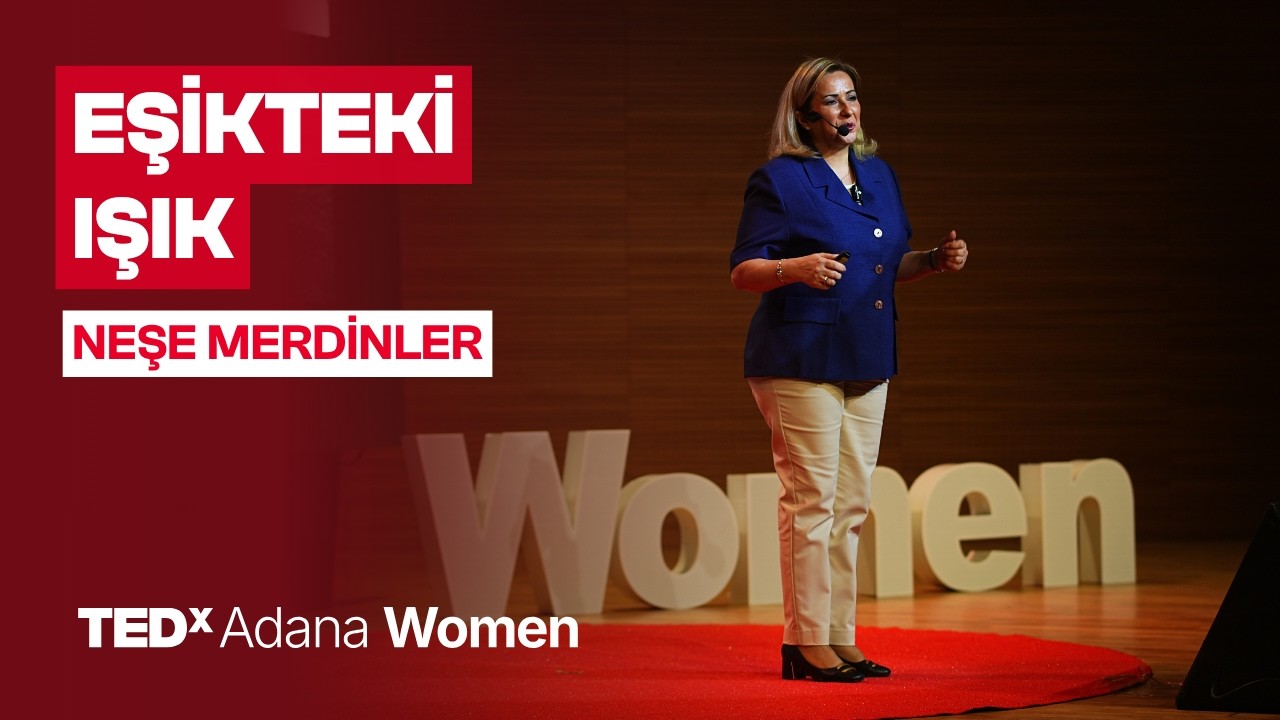
Eşikteki Işık | Neşe Merdinler | TEDxAdana Women
The Light at the Threshold | Neşe Merdinler | TEDxAdana Women
Keywords
Summary
190 words
Critical Evaluation
Value of the Information & Strength of the Argument
The talk offers high personal value by illustrating how neuroscientific principles can be applied to real-life struggles. The argumentation is built on a compelling personal narrative rather than formal data, but it effectively communicates that the brain is malleable and that intentional practice—like breath therapy—can alter emotional responses. The speaker connects her experience with panic attacks to the role of the amygdala and chronic stress, providing a clear and relatable explanation. She also emphasizes the importance of questioning automatic thoughts and consciously reshaping them, which aligns with established cognitive-behavioral concepts. The argumentation is coherent and persuasive, though it relies more on anecdotal evidence than on rigorous scientific citation. The talk’s strength lies in its inspirational and practical message for those facing similar challenges.
Scientific Rigor, Source Quality, Title Accuracy
The talk demonstrates moderate scientific rigor. The speaker mentions WHO statistics on Alzheimer’s prevalence and references prominent researchers like Joe Dispenza, Gabor Maté, and Greg Braden, but does not provide specific citations or links. The description includes only the general TEDx link, which does not directly support the claims. The speaker’s educational background at Cambridge adds credibility, yet the lack of in-talk sourcing limits verifiability. The title ‘The Light at the Threshold’ is highly appropriate, symbolizing finding hope amidst crisis, and the content consistently reflects that metaphor. Overall, the title matches the content well, and the talk is well-structured, though the sources are not explicitly documented.
244 words
Title / Content Match
The title 'The Light at the Threshold' faithfully captures the central metaphor of finding hope and transformation during difficult transitions, and the content aligns closely with this theme.
Quality & Reliability
7/10
The speaker holds a Cambridge University certificate in Cognitive Neuroscience and Neuropsychology, and cites WHO data and experts like Joe Dispenza, Gabor Maté, and Greg Braden. However, the talk is primarily a personal narrative with anecdotal evidence, lacking direct citations or verifiable references beyond the TEDx program.
Key Moments
Markers derived by PSI from the transcript: the creator did not define chapters.
- The surprise anniversary home renovation and her father's puzzled response 'Burası neresi?' (Where is this?)
- A neurologist diagnoses her father with early-stage Alzheimer's, warning of a challenging 7-10 year progression.
- She describes her first severe panic attack, waking with heart palpitations and shortness of breath, later diagnosed as panic disorder.
- She begins psychotherapy and then breath therapy, which leads to a complete disappearance of panic attacks.
- Driven by curiosity, she resigns from her corporate job in 2016 to study neuroscience and neuroplasticity, including a Cambridge program.
- She reflects on her father's passing in 2019, his military legacy, and the central message about finding meaning in loss and becoming a light for others.
Cited Sources
- TEDx Program — This talk was delivered at a TEDx event, organized independently by a local community following the TED conference format.
Contribution & Novelties
The talk uniquely intertwines a deeply personal caregiving experience with accessible explanations of neuroplasticity and stress physiology. It offers an authentic perspective on how chronic fear of loss can manifest as panic attacks, and how targeted interventions like breath therapy can rewire the brain. The speaker’s transition from a corporate career to a neuroscience educator exemplifies a practical application of ‘brain aesthetics’—the deliberate reshaping of thought patterns. This contributes to the broader discourse on personal development through a neuroscientific lens, making complex concepts relatable to a lay audience.
Pour aller plus loin :
- Neuroplasticity — The fundamental concept that the brain can reorganize itself through experience, central to the talk’s message.
- Amygdala — The brain region involved in fear and stress responses; the speaker discusses how chronic stress enlarges it.
- Panic attack — The acute condition the speaker experienced and treated via breath therapy.
- Alzheimer’s disease — The progressive neurodegenerative disorder affecting her father, which she explains through stages.
159 words
Radar Profile
The radar profile shows a balanced distribution: moderately high scores in information quantity and reliability, with a lower technical depth. This suggests the talk is informative and personally reliable, but scientifically accessible rather than deeply technical, fitting its inspirational and educational purpose.