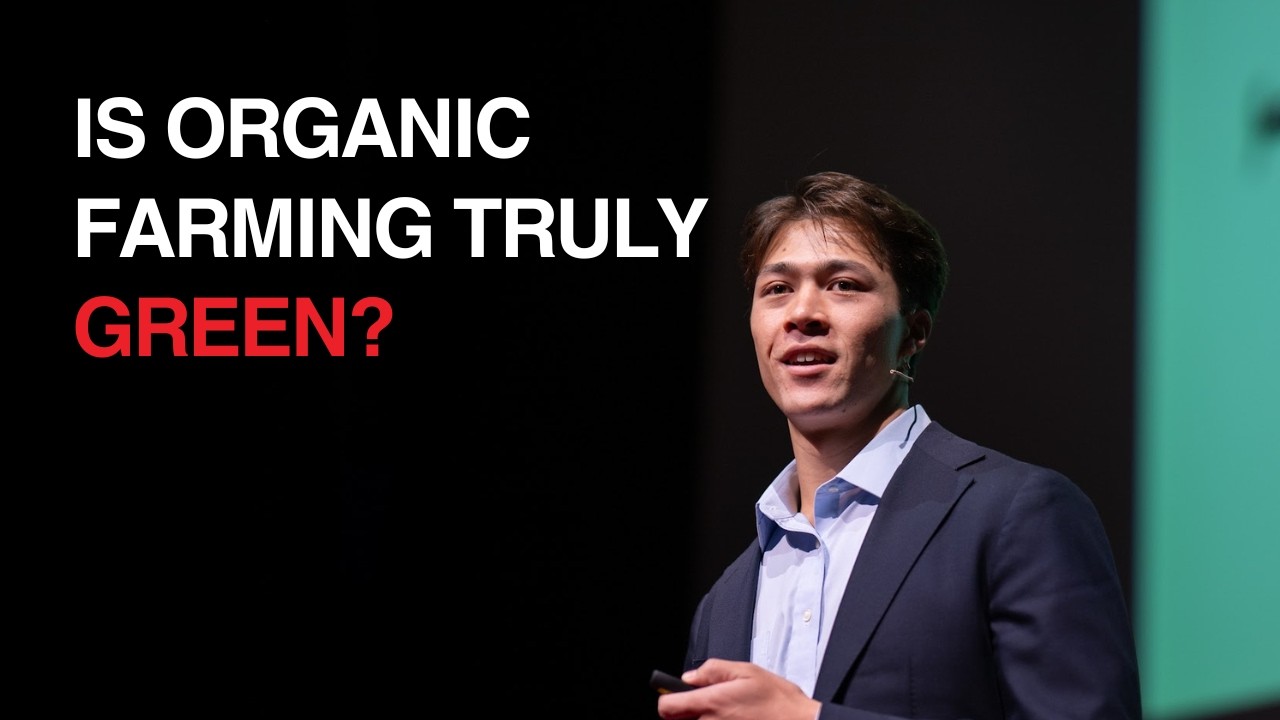
Exploring the environmental impact of farming | Alex Tseng | TEDxPrincetonU
Keywords
Summary
193 words
Critical Evaluation
Value of the Information & Strength of the Argument
The talk presents a provocative viewpoint that challenges common perceptions of organic farming, which is valuable for stimulating discussion. However, the argumentation relies heavily on selective statistics and simplified causal reasoning. For instance, the claim that organic farming is uniformly 25% less efficient is presented without nuance, and the extrapolation to land sparing is based on a land-sparing logic that ignores complex socio-economic and ecological trade-offs. The speaker acknowledges some counterarguments (health, taste, animal welfare) but dismisses them quickly. The argument is rhetorically strong but scientifically shaky, especially given the TED note that experts contest multiple claims.
Scientific Rigor, Source Quality, Title Accuracy
The scientific rigor is weak. The talk cites a single book (We Are Eating the Earth by Michael Grunwald) and uses statistics without clear citations. The TED disclaimer explicitly states that several claims lack scientific support. The source quality is low, with only two links in the description (TEDx guidelines and TEDx page) that are not directly relevant to the scientific content. The title/content fit is adequate, though the title suggests a general exploration while the talk is a polemical argument. No public comments were provided for analysis, so this element is omitted.
205 words
Title / Content Match
The title accurately reflects the content, focusing on the environmental impact of farming, though the talk is more of an opinion piece than a comprehensive analysis.
Quality & Reliability
3/10
The talk is flagged by TED with a note stating that several claims lack scientific support and are contested by experts. The speaker, a student, presents an argumentative perspective with selective data and does not provide rigorous sourcing. Consequently, the scientific reliability is low.
Key Moments
Markers derived by PSI from the transcript: the creator did not define chapters.
- Introduction: the speaker's motivation and the story of his ceramics class and instructor Todd.
- The question: Is organic farming actually good for the environment? Introduction of the book 'We Are Eating the Earth'.
- Land use statistics: agriculture uses half of habitable land, drives deforestation, and threatens biodiversity.
- The argument against organic: yield losses without GMOs and pesticides, and efficiency gains in livestock.
- Historical evidence: pre-industrial civilizations cleared land, causing measurable climate changes.
- Technological innovations: precision agriculture, RIPE, vertical farms, and biopesticides like GreenLight.
- Consumer responsibility and the 3% climate financing for agriculture; call to shift public sentiment.
Cited Sources
- TEDx Content Guidelines — Linked in the description; relevant to the TED disclaimer about the talk's content.
- TEDx official page — Linked in the description; general information about TEDx events.
- We Are Eating the Earth — Book by Michael Grunwald cited in the talk as the inspiration for his investigation.
Contribution & Novelties
The talk offers a contrarian perspective that challenges the popular eco-friendly image of organic farming, arguing that technological intensification can be more environmentally beneficial. While the core idea is not new (land-sparing debate), the speaker presents it in an accessible narrative. The main value lies in raising awareness about trade-offs in agricultural production and the need for investment in agricultural R&D.
Pour aller plus loin :
- Land sparing vs land sharing — Related to the trade-off between agricultural intensification and conservation.
- Precision agriculture — A technology highlighted in the talk for optimizing inputs and yields.
- Vertical farming — Innovative indoor farming method with potential to reduce land and water use.
- Biopesticide — Pesticides derived from natural materials, relevant to the GreenLight example.
122 words
Radar Profile
The radar shows moderate quantity and technical level but low quality and reliability scores, reflecting the talk's accessible presentation but questionable scientific basis. The fiabilité_globale is particularly low due to the TED disclaimer and unsupported claims.