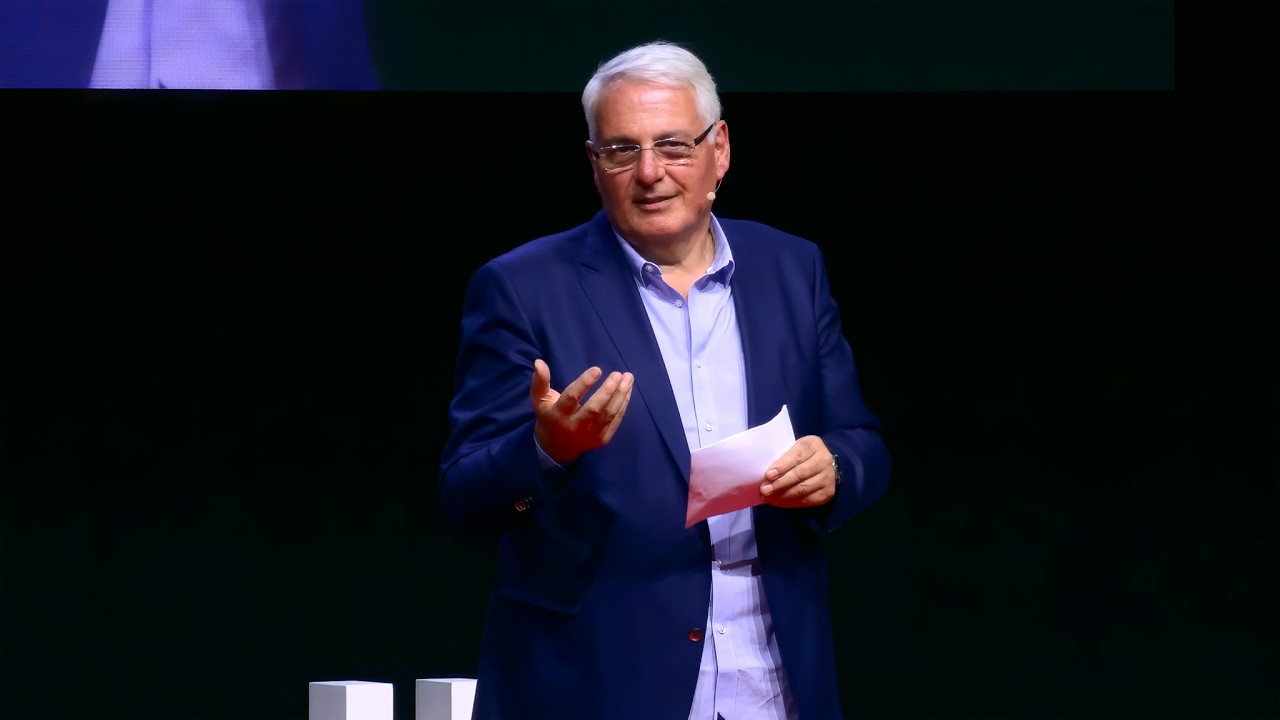
L'IA ci sta abituando a non pensare? | Bruno Giussani | TEDxBellinzona
Is AI training us not to think? | Bruno Giussani | TEDxBellinzona
Keywords
Summary
204 words
Critical Evaluation
Value of the Information & Strength of the Argument
The talk provides a powerful and passionate critique of AI’s role in society, emphasizing the erosion of critical thinking and democratic values. Giussani’s argument is built on logical progression from a simple observation to broader systemic concerns, using rhetorical questions and concrete examples like the elevator scene and the trust gap. He effectively employs cultural references (Bernanos, Pope Leo) to anchor his position, though he does not present empirical evidence or counter-arguments. The argument is persuasive for a general audience, relying on ethical reasoning and personal authority rather than data, which is appropriate for an opinion piece but limits its academic rigor.
Scientific Rigor, Source Quality, Title Accuracy
The talk is an expert opinion with minimal cited sources; only the TEDx platform is referenced. Giussani mentions his own books and a couple of quotes but provides no external links or verifiable data. The title accurately captures the core message, as the entire talk revolves around the risk of losing independent thought to AI. There is no discernible mismatch between title and content; it is a precise summary of the central thesis. The lack of sources is compensated by the speaker’s credentials as a journalist and former TED curator, but the absence of references to studies or reports weakens the scientific reliability.
220 words
Title / Content Match
The title asks if AI is getting us used to not thinking, which accurately reflects the talk's central concern about cognitive delegation to AI and its consequences.
Quality & Reliability
7/10
The speaker presents a coherent critical perspective on AI and its societal impact, referencing cultural figures but providing limited empirical evidence. The argument relies on personal conviction and observation rather than data-driven analysis.
Key Moments
Markers derived by PSI from the transcript: the creator did not define chapters.
- Opening scene with elevator and people on phones, introducing the 'hypnosis from screens'.
- Audience interaction: who uses ChatGPT and who trusts OpenAI leaders; highlights the trust gap.
- Acknowledges AI's wonders but warns of power in untrustworthy hands, framing the core tension.
- Critique of big tech as sovereign entities, lacking democratic control and shaping real-world rules.
- Discussion of algorithms as surveillance and manipulation, and the struggle to choose without them.
- Cognitive delegation leads to loss of thinking; quotes George Bernanos and Pope Leo.
- Call to break the spell, ask what technology should do, and choose a different future.
Cited Sources
- TEDx Talks — The talk was given at a TEDx event; this link is the official TEDx platform.
Contribution & Novelties
The talk offers a compelling and accessible synthesis of concerns about AI’s impact on cognitive autonomy and democratic institutions. Its original contribution lies in framing the daily use of AI as a form of intellectual abdication, reinforced by corporate control and manipulative design. It connects seemingly disparate issues—smartphone addiction, cloud dependence, and AI ‘cognitive bottles’—into a coherent critique of technological inevitability.
Pour aller plus loin :
- Surveillance capitalism — Key concept for understanding the economic model of data extraction and exploitation.
- Attention economy — Explains how platforms capture and monetize attention, relevant to Giussani’s points on digital hypnosis.
- Cognitive offloading — Directly relates to the idea of delegating thinking to AI and its potential consequences.
115 words
Radar Profile
The profile shows moderate quantity and quality of information, with a lower technical level, reflecting an accessible opinion piece. Fiabilité is moderate, appropriate for a subjective critique. The radar suggests the talk excels in qualitative argumentation but lacks the data density of research-based content.