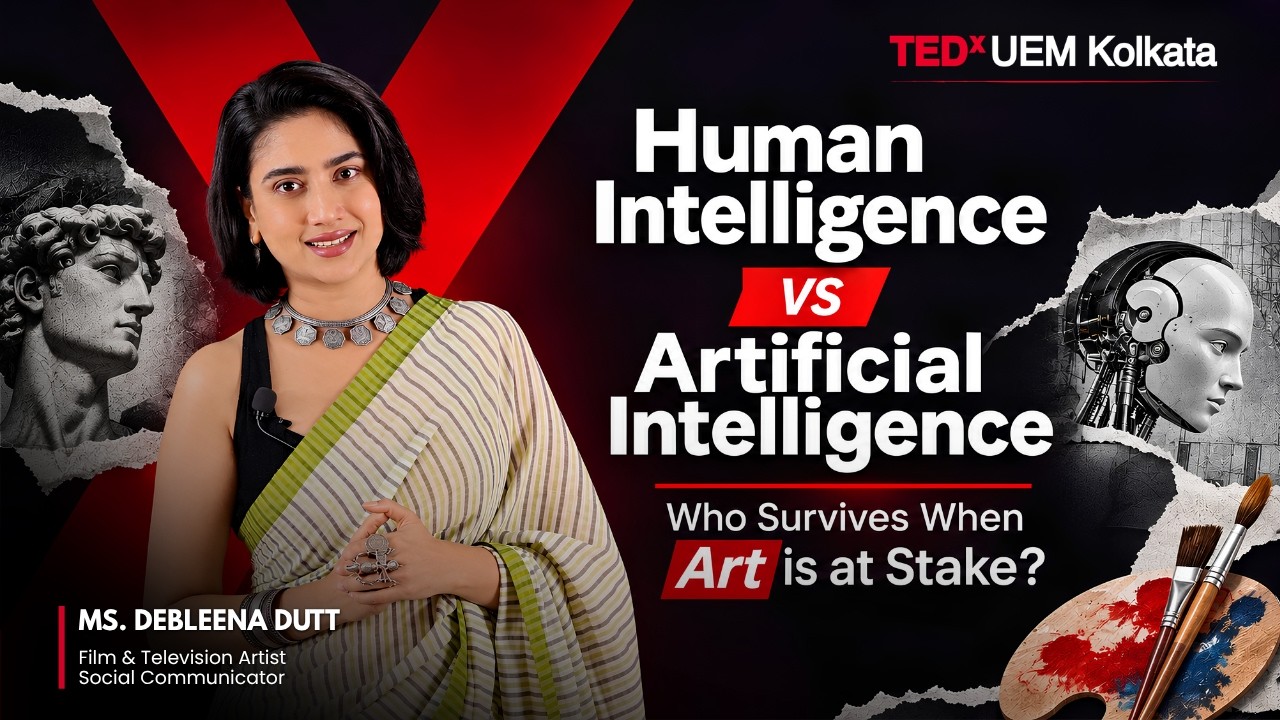
Art at Stake : Human Intelligence VS Artificial Intelligence | Debleena Dutt | TEDxUEM Kolkata
Title history
- Art at Stake : Human Intelligence VS Artificial Intelligence | Debleena Dutt | TEDxUEM Kolkata (PSI archive)
- Art at Stake : Human Intelligence VS Artificial Intelligence | Debleena Dutt | TEDxUEM Kolkata — observed on 20261114-0309 UTC (YouTube)
Keywords
Summary
172 words
Critical Evaluation
Value of the Information & Strength of the Argument
The talk offers valuable personal insight from a working actress, humanizing the debate on AI in creative industries. The core argument that AI depends on human-provided data and cannot spontaneously generate novel ideas is well-illustrated by the choker example. The warning about habitual reliance on AI leading to cognitive and physical atrophy is thought-provoking, though it rests on speculative evolutionary extrapolation. The rhetorical style is engaging and emotionally persuasive, but the argumentation is anecdotal rather than systematic. The lack of empirical data or citations weakens the scientific rigor, but the articulation of a performer’s perspective adds a dimension often missing in technical discussions.
Scientific Rigor, Source Quality, Title Accuracy
The talk exhibits limited scientific rigor: it contains no formal references, no statistical evidence, and no verifiable data. The only external source is the TEDx program itself (linked in the description). The speaker references the SAG-AFTRA strike and personal contract issues, but these are not backed by links or documents. The title accurately matches the content, presenting a clear juxtaposition of human and artificial intelligence in the context of art. However, the talk leans heavily on personal experience and metaphor rather than on scholarly analysis, making it more opinion-driven than evidence-based.
209 words
Title / Content Match
The title accurately reflects the central theme of the talk: the tension between human intelligence and artificial intelligence in the artistic domain. The speaker directly addresses this comparison throughout.
Quality & Reliability
6/10
The talk relies on personal anecdotes and rhetorical analogies rather than empirical data or cited research. It references real-world events (SAG-AFTRA strike, personal contract experience) but lacks verifiable sources for these claims. The evolutionary speculations are presented without scientific grounding. The reasoning is coherent but not rigorous.
Key Moments
Markers derived by PSI from the transcript: the creator did not define chapters.
- Introduction with the boiling water metaphor for AI and the choice between being a potato or an egg.
- Life-saving drug analogy: AI as a powerful tool that becomes dangerous without proper regulation.
- Discussion of how AI democratizes creative roles, diminishing the need for expertise and human actors.
- Personal anecdote about designing a coin-choker, illustrating AI's inability to conceive novel ideas without explicit prompts.
- Account of personal misuse of AI for ads without consent, highlighting contract and ethical violations.
- Evolutionary speculation: unchecked AI reliance could lead to physical and cognitive regression, including reduced brain size.
- Conclusion urging listeners to exercise 'choice' (the C in BCD) to prevent AI from controlling human lives.
Cited Sources
- TEDx Program — The talk was given at a TEDx event; this is the official TEDx page.
Contribution & Novelties
The talk brings a practitioner’s perspective to the AI debate, framing the issue as an existential choice for creative professionals. Its originality lies in connecting AI’s impact to potential human evolutionary regression—a provocative but speculative thesis. The personal narrative of unauthorized AI use in advertising adds a tangible, current example of rights infringement. While the talk doesn’t present new research, it contributes to public discourse by humanizing the consequences of AI adoption.
Pour aller plus loin :
- 2023 SAG-AFTRA strike — Essential context for the strike mentioned in the talk.
- Artificial intelligence art — Overview of AI’s role in creative generation.
- Evolution of the brain — Background on brain size changes referenced by the speaker.
115 words
Radar Profile
The radar profile shows moderate scores in information quantity and reliability, with low technical depth. The speaker excels in qualitative, anecdotal argumentation but lacks empirical support. This indicates a talk that is engaging and thought-provoking but not scientifically rigorous.