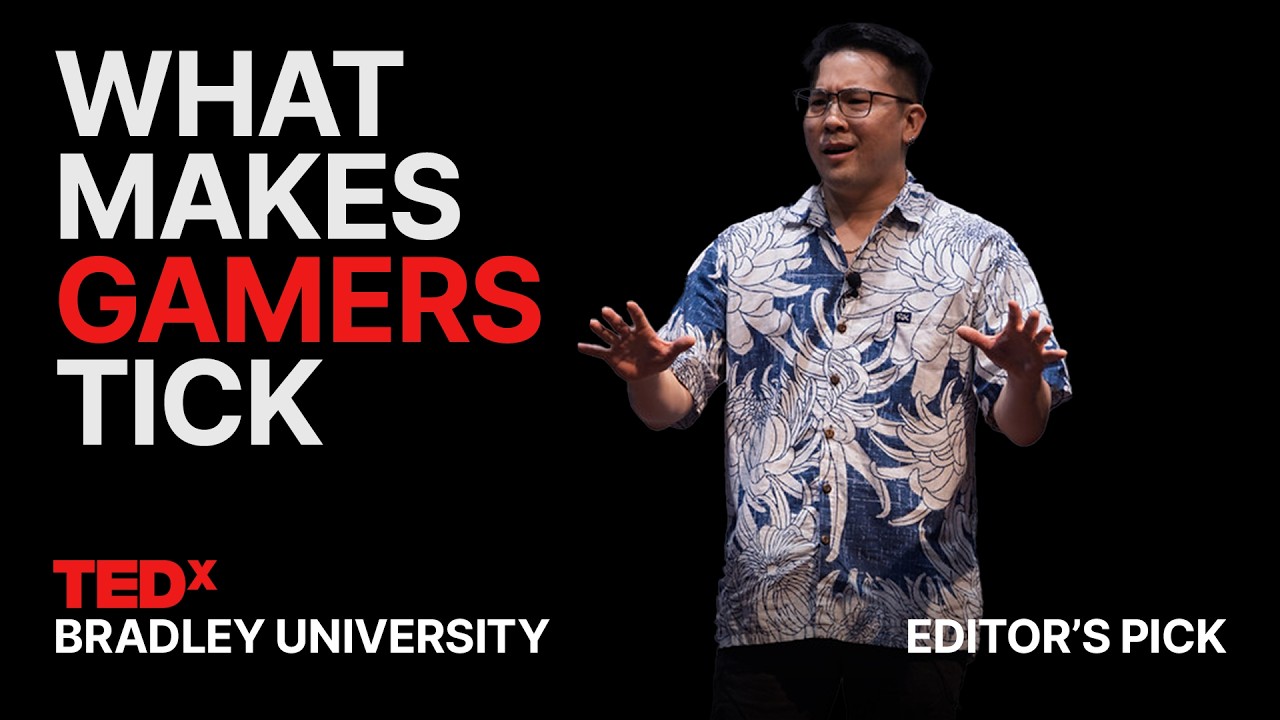
Why you love video games like GTA so much | Ryan Terao | TEDxBradley University
Title history
- Why you love video games like GTA so much | Ryan Terao | TEDxBradley University — observed on 20261120-1939 UTC (YouTube)
Keywords
Summary
170 words
Critical Evaluation
Value of the Information & Strength of the Argument
The talk’s value lies in its accessible reframing of gaming as a potentially purposeful and skill-building activity. The argumentation is persuasive, blending personal narrative, clinical expertise, and citations to neuroscience and psychology. However, some claims are overly broad (e.g., ‘full brain activity’) and lack nuance or specific study details. The PIC framework is practical but not empirically validated in the talk. The strongest evidence comes from the case study of coaching a team, which illustrates the importance of connection and intention over raw skill.
Scientific Rigor, Source Quality, Title Accuracy
The speaker cites a few studies (MDPI, Tilburg, ESA) but does not provide direct URLs or full citations, limiting verification. The title aligns well with the content, which explores psychological motivations for gaming. The talk was given in a TEDx setting, which often emphasizes popular appeal over academic rigor. The use of neuroscience is simplified, though not inaccurate. Overall, the sources are credible but under-referenced, and the title is apt without exaggeration.
171 words
Title / Content Match
The title accurately reflects the content, which explores the psychological and cognitive reasons people enjoy games like GTA, supported by neuroscience and practical examples.
Quality & Reliability
7/10
The talk blends neuroscience and clinical psychology with personal coaching anecdotes, citing several studies (MDPI, Tilburg) without providing detailed references or methodological critique. Overall credible but not deeply rigorous.
Key Moments
Markers derived by PSI from the transcript: the creator did not define chapters.
- Introduction: Mom's Wordscapes cheating as a gateway to 'we are all gamers'.
- Neuroscience perspective: MDPI study on full brain activity during gaming.
- Intention concept: Fico's training and the 'playing for fun, skills, or reals' mindsets.
- Tilburg study on tilt (frustration and boredom) and loss of intention.
- Coaching the League of Legends team: metrics of success from connection and team culture.
- Conclusion: True gaming is about perspective, intention, and connection, not just the screen.
Cited Sources
- TEDx Talks (official platform) — The event and broadcasting platform for this talk.
- Entertainment Software Association (2025) study on gaming demographics — Cited to show that 65% of US population plays games weekly.
- MDPI study on cognitive engagement during gaming — Referenced to support claim that gaming is a full-brain activity.
- Tilburg University (2019) study on tilt in gaming — Cited to explain frustration and boredom as leading causes of tilt.
Contribution & Novelties
The talk contributes a practical framework (PIC) for approaching gaming with purpose, drawing on clinical psychology and esports coaching experience. It reframes gaming as a tool for cognitive and social development, moving beyond simplistic ‘brain rot’ narratives. The emphasis on intention as a key variable is a useful lens for both players and researchers.
Pour aller plus loin :
- Self-determination theory — Explains psychological needs (autonomy, competence, relatedness) that games often satisfy; relevant to why we gravitate toward certain genres.
- Flow (psychology) — Csikszentmihalyi’s concept of optimal experience, closely linked to the immersive and rewarding aspects of gaming.
- Esports psychology — Overview of the competitive gaming landscape and its psychological demands, grounding the speaker’s clinical work.
116 words
Radar Profile
The scores indicate a moderately informative talk with stronger quality and reliability than quantity or technical depth. It excels in conveying established psychological concepts in an engaging way but lacks detailed data or novel empirical contributions, aligning with its science-communication nature.