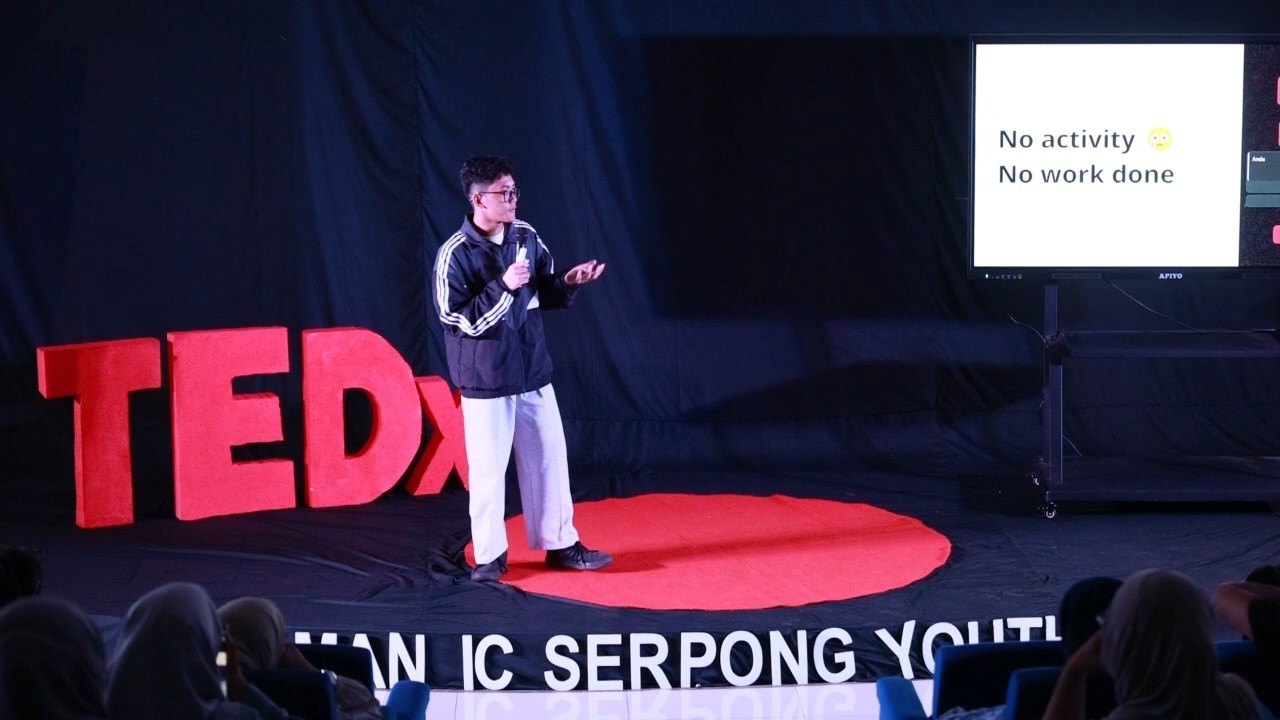
To Be a Human? | Ananda Firaz | TEDxMAN IC Serpong Youth
Keywords
Summary
227 words
Critical Evaluation
Value of the Information & Strength of the Argument
The informational yield is thin and mostly autobiographical. Beyond three rough figures (four billion versus eight billion inhabitants, a total fertility rate moving from about 2.3 to 2.2, and a ten-to-fifteen-year horizon for routine task automation), the talk supplies no data, no mechanisms and no case studies that a listener could reuse or verify; its substance is a personal trajectory — a counselling-class question, a period of event organising, a moment of feeling worthless in front of an AI prompt — from which a general thesis is drawn. That thesis, that empathy-intensive and community-building work is the durable comparative advantage of humans, is a reasonable and widely held position, but here it arrives by assertion rather than by demonstration.
The argumentative architecture, on the other hand, is well built for an oral format. The speaker uses a hook (a question from a teacher), an escalation (population figures, the impossibility of out-credentialling everyone), a turn (the discovery that the overpopulation premise is contested), and a resolution (AI as a helper, humans as the ones who make people care). The rhetorical devices are effective: an audience quiz, self-deprecating humour, a repeated phrase, and an emotionally timed closing line. The weakness is logical rather than stylistic. The same demographic growth is first used as the engine of unbearable competition and then dismissed as a myth without the tension being resolved; the total fertility rate is conflated with population size; the projection of a return to ‘4 million’ people is not a figure any major demographic body publishes; and the pivot from ’the problem is competition’ to ’the problem is distribution’ is announced rather than argued, with inequality asserted as the true cause and no evidence offered for the causal claim. AI is likewise treated inconsistently — first as an existential threat embodied by a horror film, then as a benevolent co-worker — with the contradiction left unexamined because the emotional register, not the logic, carries the audience from one to the other. The talk is persuasive as testimony and weak as analysis: it tells you what the speaker concluded and how it felt to conclude it, not why the conclusion should hold for anyone else.
Scientific Rigor, Source Quality, Title Accuracy
No source is named at any point. The demographic figures are delivered without attribution to any census office, United Nations report or academic study, so the listener cannot tell whether they come from a primary dataset, a news article or a social-media post; the phrase ‘I read a little bit of news’ is the closest the talk comes to a citation, and it is offered precisely at the moment the argument reverses. The film reference is used as a cultural illustration of the ‘AI will replace you’ narrative, which is legitimate rhetoric but not evidence, and the description’s single external link points to the generic TEDx programme page rather than to any of the works alluded to. Several quantitative statements are also imprecise to the point of being unreliable: the total fertility rate is described as falling ‘from 2.3 to 2.2’ in a way that blurs the reference years, and the claim that humanity will shrink back to a few million people within two centuries contradicts every mainstream projection, which instead shows a peak near ten billion followed by a slow decline. Nothing here is fabricated in the sense of invented studies, but the absence of provenance means the audience is asked to trust numbers on the speaker’s authority alone.
On title-to-content fit, the question ‘To Be a Human?’ promises a reflection on what distinguishes human beings; the talk actually delivers a talk about job competition, automation anxiety and the demographic transition, and only arrives at the humanity question in its closing minutes, where empathy, community and ‘messy’ imperfection are named as the human core. The framing is therefore defensible but generous: a more accurate title would foreground work, AI and empathy. The gap does not destroy the talk, but a viewer drawn in by the philosophical title will spend two-thirds of the runtime on labour-market anxiety before reaching the announced subject.
689 words
Title / Content Match
The title 'To Be a Human?' is broad; the talk spends most of its first half on population, job competition and AI replacement fears, and only connects explicitly to the humanity theme in its final third. The link is real but loose.
Quality & Reliability
3/10
The talk is a persuasive personal narrative rather than an evidence-based briefing: the few quantitative claims (world population, total fertility rate, job-displacement timelines) are stated without provenance and one of them (a fall back to '4 million' people within two centuries) is not supported by mainstream demographic projections. The reasoning is rhetorical and anecdotal, built on a school anecdote and on a film reference used as illustration rather than evidence. It remains honest about being one student's viewpoint, contains no fabricated citations, and its qualitative claim that empathy-intensive and community-building work is more resilient to automation is a defensible, widely discussed position.
Key Moments
Markers derived by PSI from the transcript: the creator did not define chapters.
- Opening: the speaker introduces himself as a Grade 11 student running on four hours of sleep and coffee, and declines a conventional self-introduction.
- He recalls the counselling teacher's question — 'what do you want to be when you grow up?' — and his blank, uncertain answer.
- Audience quiz over a picture of a crowd, leading to the demographic claim: four billion people in the 1970s, eight billion in 2022.
- The competition argument: job markets are no longer local but global, and credentials alone no longer guarantee standing out.
- Introduction of artificial intelligence through the film M3GAN and the popular narrative that 'AI will replace you'.
- Personal anecdote about organising student events, the suggestion to replace human effort with a single prompt, and the resulting feeling of worthlessness.
- The reversal: he reports reading that the overpopulation premise is misleading, citing a global total fertility rate falling from about 2.3 to 2.2.
- Reframing of the problem: not competition but economic distribution, inequality and a deficit of human empathy.
- AI recast as an opportunity — billions of extra helpers — with the concession that routine automated, email and spreadsheet work may vanish in ten to fifteen years.
- Closing: what code cannot do is make people care; the future belongs to community builders and empathetic listeners, and he wants to be a 'messy, incomplete, yet beautiful human soul'.
Cited Sources
- TEDx — official programme page — The only external link in the video description; it documents the TEDx format and the independently organised local event, not any of the demographic or labour-market figures used in the talk. No study, report or dataset is named on screen or in the description.
Concurring Sources
- Fertility rate — Our World in Data — Confirms the broad direction the speaker reports: global total fertility has been declining and now sits slightly above the replacement level, although the talk's figures and reference years are imprecise.
Dissenting Sources
- World Population Prospects — United Nations Population Division — Mainstream projections show world population peaking around ten billion in the 2080s and then declining slowly, not collapsing back to a few million within two centuries as the speaker asserts. The talk also conflates the fertility rate with total population size.
Contribution & Novelties
The genuine contribution is not informational but rhetorical: a secondary-school student articulates the automation anxiety of his generation from the inside, and stages an explicit reversal — the demographic ‘flood’ that supposedly explains job scarcity is reframed as a distribution problem, and AI is recast from replacement threat to collaborator. The talk is also a useful record of how the ’learn to code versus learn to care’ debate is being absorbed at the level of secondary education, and of the moral vocabulary (empathy, community building, imperfection) that young speakers now use to defend human distinctiveness against machine capability. It offers no new data, model or finding, and its factual scaffolding is shaky; its value lies in the framing and in the testimony.
Further reading:
- M3GAN (film) — The film explicitly invoked in the talk as the cultural shorthand for the ‘AI will replace you’ narrative.
- Fertility rate — Our World in Data — Provides the global total fertility series the speaker gestures at, with sources and reference years that the talk leaves unstated.
- World Population Prospects — United Nations Population Division — The standard reference for population projections; useful for checking the claims made about growth and future decline.
- TEDx — Background on the independently organised event format in which the talk was delivered.
- Automation and labour-market task displacement (concept, no URL) — The economic literature on which tasks are automatable versus which require social and care competencies, the substantive question the talk raises without engaging.
246 words
Radar Profile
The profile is flat and low: little data, little technical depth, moderate reliability, with the argument carried by delivery rather than evidence. The one marked strength is communicative — structure, timing and a clear emotional arc — which is invisible on a purely informational radar and explains the gap between the talk's persuasive force and its thin factual base.