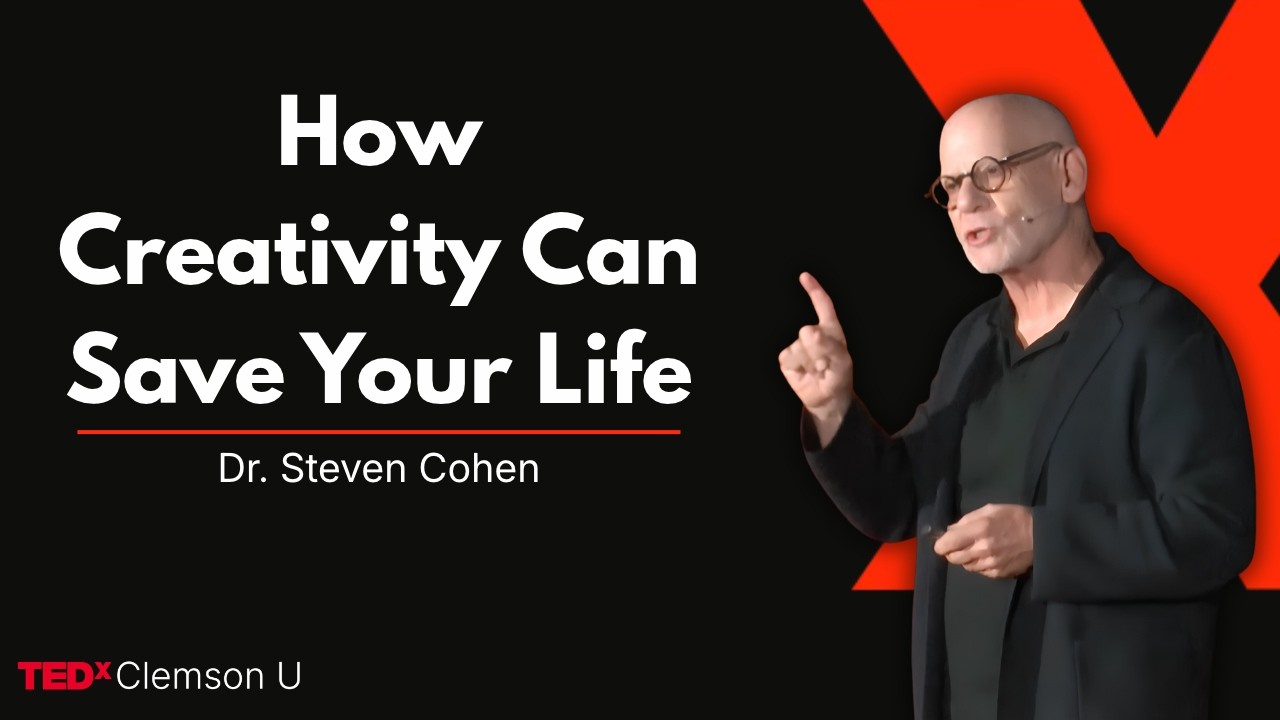
How Creativity Can Save Your Life | Steven Cohen | TEDxClemson U
Title history
- How Creativity Can Save Your Life | Steven Cohen | TEDxClemson U — observed on 20261117-0328 UTC (YouTube)
Keywords
Summary
140 words
Critical Evaluation
Value of the Information & Strength of the Argument
The value of this talk lies in its inspirational narrative and the practical examples of how creativity can lead to tangible outcomes in medicine. Cohen’s argument is built on personal anecdotes rather than systematic evidence, which limits its scientific rigor. However, his credibility as a surgeon and his demonstrated innovations provide compelling illustrative cases. The reasoning is coherent, showing a consistent pattern of using unconventional approaches to solve problems, but the lack of empirical data or broader case studies weakens the overall argument.
Scientific Rigor, Source Quality, Title Accuracy
The talk does not cite external sources or studies, relying fully on personal experience. The only provided link is the generic TEDx website, which is not a specific source for the claims made. The title and content are well-aligned, as the speaker clearly discusses how creativity saved his life. However, the absence of verifiable references and the purely anecdotal nature reduce its scientific credibility. No comments were provided for analysis.
168 words
Title / Content Match
The title accurately reflects the content, which focuses on how creative thinking helped the speaker overcome challenges and innovate in medicine.
Quality & Reliability
6/10
The speaker is a medical professional with significant credibility, but the talk is anecdotal and relies on personal experience rather than empirical evidence. The claims about creativity are plausible but not rigorously substantiated.
Key Moments
Markers derived by PSI from the transcript: the creator did not define chapters.
- Intro: uncle's death and promise to become a doctor.
- Flunking 10th grade and changing grades on report card.
- Meeting poet William Stafford and discovering passion for writing.
- Struggling pre-med, becoming English major, and getting into medical school.
- Using sculpture class to innovate cherubism surgery.
- Developing new device and the ISOG protocol.
Cited Sources
- TEDx Talks official page — Description mentions this as the source for TEDx events.
Contribution & Novelties
This talk offers a personal perspective on how creativity can be cultivated from adversity. Its novelty lies in the concrete medical examples where artistic skills directly informed surgical innovation, particularly the cherubism case. It also introduces the ‘ISOG’ framework as a self-coined protocol for embracing one’s perceived weaknesses. However, the concept of creativity as a tool for problem-solving is not new, and the talk does not present empirical evidence.
Pour aller plus loin :
- Creativity - Wikipedia — Explores psychological and neurobiological aspects of creativity, useful for contextualizing the talk’s claims.
- Regenerative medicine - Wikipedia — Provides background on the field Cohen works in, highlighting its innovation-driven nature.
- Growth mindset - Wikipedia — Carol Dweck’s concept, relevant to the theme of overcoming academic failure through alternative thinking.
127 words
Radar Profile
The radar profile indicates moderate scores across all dimensions, with a slightly higher emphasis on quality of information relative to technicality. This reflects a balance between personal anecdote and accessibility, but overall the talk is more motivational than scientific.