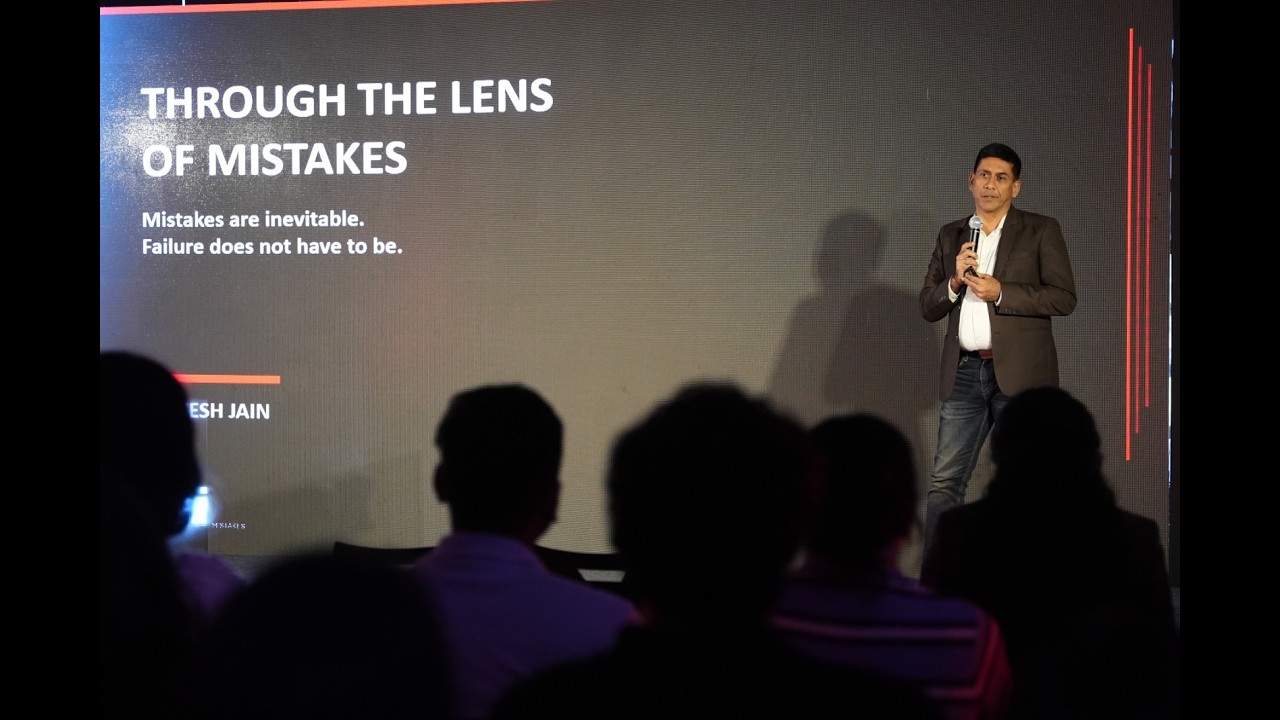
The Art of Making Mistakes | Mukesh Jain | TEDxBocconiUMumbai
Keywords
Summary
172 words
Critical Evaluation
Value of the Information & Strength of the Argument
The talk offers valuable, pragmatic insights from a practitioner who has built products used by billions. The value lies in concrete case studies—Hotmail’s downfall, Microsoft’s error reporting, Jio’s network improvements—that illustrate abstract concepts. The argumentation is largely based on personal experience and logical reasoning, such as the probability calculation for duplicate mistakes, which is mathematically sound but not deeply explored. While the speaker does not provide external sources, his authority and tangible examples strengthen the message. The framework (eliminate, prevent, detect, recover) is actionable and memorable, though it would benefit from more rigorous evidence or formal research to validate its general applicability.
Scientific Rigor, Source Quality, Title Accuracy
Scientifically, the talk relies on anecdotal evidence and personal recollections, lacking peer-reviewed sources or quantitative data. The probability calculation, while illustrative, oversimplifies human error independence. The speaker mentions his book but does not cite it explicitly, and no external references are provided. The title adequately reflects the core topic, though it might imply a more philosophical treatment rather than the practical system-design angle. The single source (TEDx official site) offers no additional rigor. Overall, the content is credible due to the speaker’s experience but would benefit from citation of industry studies or research on human error.
213 words
Title / Content Match
The title aligns with the central theme of mistakes and innovation, though the talk emphasizes systematic prevention and learning from errors rather than celebrating mistakes per se. It is accurate but slightly broader than the content's focus.
Quality & Reliability
6/10
The talk is based on the speaker's three decades of industry experience, providing practical anecdotes from Microsoft, Hotmail, and Jio. However, it lacks verifiable citations and presents a simplified probabilistic model without rigorous nuance. The speaker is a credible executive, but the content is anecdotal rather than systematically researched.
Key Moments
Markers derived by PSI from the transcript: the creator did not define chapters.
- Introduction to the four categories of mistakes and the probability calculation for double-checking.
- Microsoft's 'send error report' initiative and the value of collecting crash data.
- Hotmail's market share collapse due to ignoring bandwidth limitations and using the wrong metric.
- Discussion on knowledge mistakes, the LinkedIn thumb rule, and the necessity of continuous learning.
- Introduction of poka-yoke and the eliminate-prevent-detect-recover framework, with examples like USB-C.
- Application of AI at Jio for predictive network optimization and the conclusion that innovation requires mistakes.
Cited Sources
- TEDx Official Site — Mentioned in the video description as the organizing body and general resource for TEDx talks.
Contribution & Novelties
The talk contributes a practical, system-oriented perspective on mistake management, particularly the emphasis on building ‘failure-proof’ systems rather than ‘mistake-proof’ ones. It combines personal stories with the established poka-yoke concept, adding a recovery layer and stressing the importance of active user metrics. The main novelty is the holistic framework—eliminate, prevent, detect, recover—applied across large-scale products.
Pour aller plus loin :
- Poka-yoke (Wikipedia) — This is the core concept of mistake-proofing, relevant to the speaker’s framework.
- Fault tolerance (Wikipedia) — Related to building systems that continue functioning despite errors, aligning with the idea of failure-proof systems.
- High reliability organization (Wikipedia) — Conceptual background for organizations that manage high-risk operations with near-zero errors, extending the speaker’s ideas.
115 words
Radar Profile
The radar profile shows high scores in quantity of information and moderate technical level, reflecting the density of examples. Quality and reliability are slightly lower, consistent with the anecdotal nature. The overall balance indicates a talk that is informative and accessible, but with limited scientific depth.