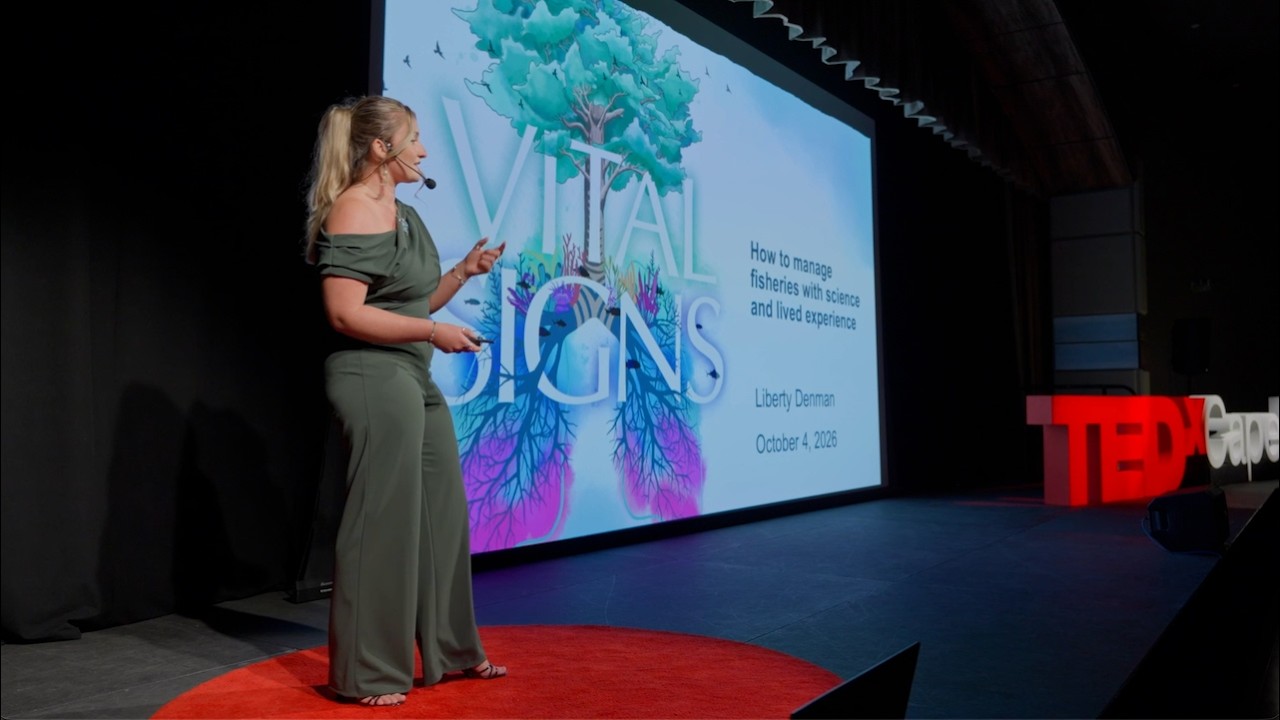
How to manage our fisheries with science and lived experience | Liberty Denman | TEDxCapeMay
Title history
- How to manage our fisheries with science and lived experience | Liberty Denman | TEDxCapeMay — observed on 20261119-1754 UTC (YouTube)
Keywords
Summary
169 words
Critical Evaluation
Value of the Information & Strength of the Argument
The talk provides valuable insights into the practical challenges of fisheries management, emphasizing the human dimension often overlooked in conservation science. The argumentation is coherent: Denman systematically lists three structural problems and supports each with concrete examples (e.g., the 2012 lobster heat wave, the UK trust survey, the spiny dogfish story). She uses persuasive rhetoric to bridge divides, but the evidence is largely anecdotal, and she does not provide rigorous statistical or methodological details. The value lies in highlighting the importance of participatory approaches and the role of local knowledge, which is an emerging area in marine science. However, the argumentation lacks depth in addressing potential criticisms or alternative management models, and some claims (e.g., ’every port in decline’) are not sourced.
Scientific Rigor, Source Quality, Title Accuracy
The scientific rigor is moderate: the speaker references specific statistics and studies (e.g., the Proceedings of the National Academy of Sciences study on illegal fishing, though not named) and describes documented cases like the Gulf of Maine Research Institute, but she does not provide citations during the talk. The description includes only the general TEDx link, offering no additional references. The title accurately reflects the content, but the talk is more of an opinionated call to action than a systematic review. The speaker’s credibility is established through her roles, but the lack of transparent sourcing weakens the overall fiabilite. There are no comments provided to analyze.
243 words
Title / Content Match
The title accurately reflects the content: the talk focuses on integrating scientific knowledge with fishers' lived experience for better fisheries management, as exemplified throughout.
Quality & Reliability
6/10
The talk draws on credible but limited specific data (e.g., 35.5% overfished stocks, $2.4 billion illegal imports) and anecdotal examples, while lacking in-depth citations or peer-reviewed references. The speaker has professional background in marine biology, but the arguments rely heavily on personal narrative and illustrative cases rather than systematic evidence.
Key Moments
Markers derived by PSI from the transcript: the creator did not define chapters.
- Introduces the problem: 35.5% of fish stocks overfished, illegal imports $2.4 billion.
- Lists three limiting factors: lack of timely data, slow policy, and case-by-case thinking.
- Presents success stories like Gulf of Maine lobster monitoring and Project Hiu in Indonesia.
- Calls for co-management, trust-building, and recognizing that we are part of the ecosystem.
Cited Sources
- TEDx Talks official page — General TEDx platform, no specific reference to the talk's content.
Contribution & Novelties
The talk aporta a fresh perspective by framing fisheries management as a social-ecological problem, emphasizing trust and communication as key levers. It synthesizes known concepts like co-management and local ecological knowledge but highlights their practical obstacles through personal anecdotes. The originality lies in the speaker’s direct experience as a founder and her call to blend generational knowledge with tech solutions.
Pour aller plus loin :
- Co-management in fisheries — This concept central to the talk; explains collaborative governance between state and resource users.
- Local ecological knowledge — Core to the argument for integrating fishers’ observations into science.
- Marine Stewardship Council — Their definition of sustainable fisheries is referenced in the talk.
- Gulf of Maine Research Institute — Example cited of fisher-scientist collaboration on temperature monitoring.
125 words
Radar Profile
The profile shows moderate scores across all dimensions, with a slight edge in quantity and quality of information, but lower technical and reliability scores. This reflects a well-communicated but not deeply technical presentation that relies on narrative rather than rigorous citation.