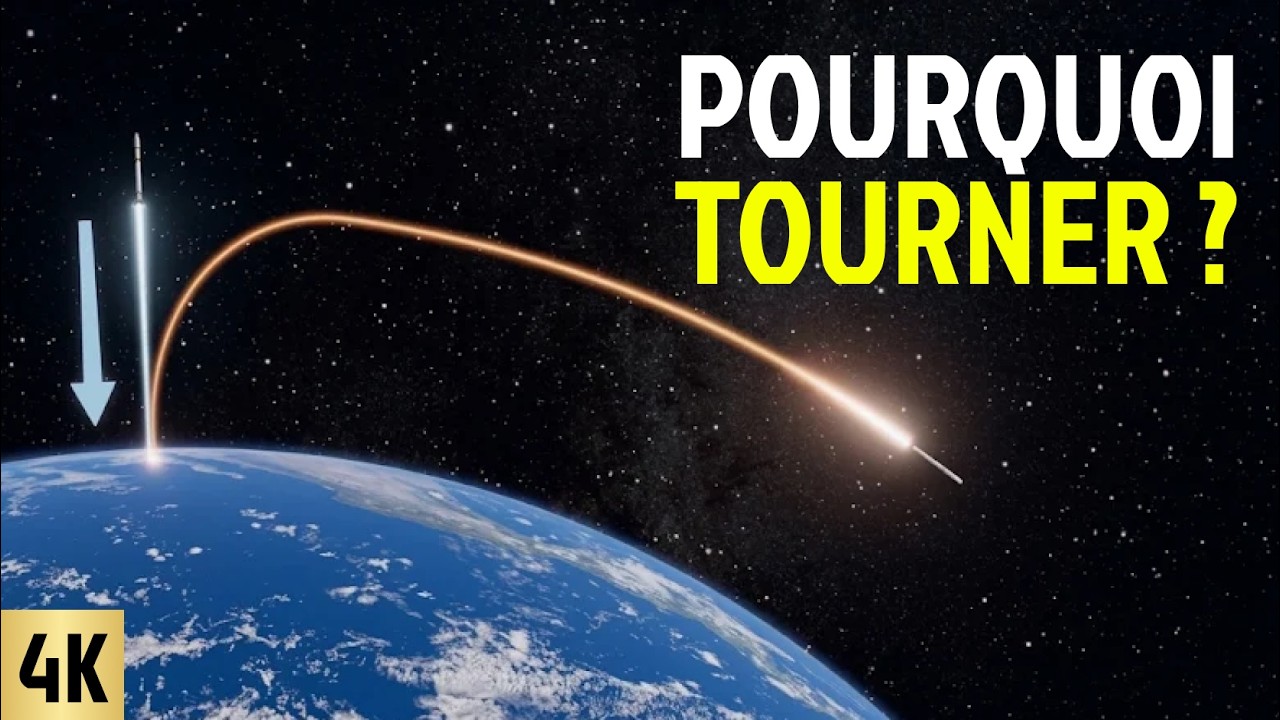
Pourquoi Les Fusées Se Penchent Au Lieu De Monter Tout Droit 4K
Why Rockets Lean Instead of Going Straight Up 4K
Title history
- Pourquoi Les Fusées Se Penchent Au Lieu De Monter Tout Droit 4K — observed on 20261112-1554 UTC (YouTube)
Keywords
Summary
211 words
Critical Evaluation
Value of the Information & Strength of the Argument
The video is extremely valuable in that it explains a deceptively simple question (why rockets lean over) by unpacking the fundamental physics of orbits. The argumentation is rigorous and step‑by‑step: it starts with an intuitive thought experiment (Newton’s cannon) that directly yields the value of orbital speed, then connects it to real‑world launch operations, the gravity turn, and the subsequent challenge of leaving the ecliptic plane. Each point is illustrated with concrete numbers (e.g., 94% of the energy goes to speed, 6% to altitude) and historical references (Tsiolkovsky, Mariner 10, Voyagers). The structure is logical, progressively building on previous concepts, and the climax (the vertical escape difficulty) is surprising yet exactly derived from the earlier cited physics. The argumentation is solid and avoids unfounded claims.
Scientific Rigor, Source Quality, Title Accuracy
The video cites a large set of reputable sources, including NASA Space Place, NASA Science’s Basics of Space Flight, Stanford course notes on launch trajectories (AA284a), and an academic paper on the Kármán line (McDowell, Acta Astronautica 2018). These cover the key technical claims: orbital speed, no‑gravity fall, Kármán line definition, microgravity, and launch trajectory design. The content is carefully sourced and aligns with standard aerospace knowledge. The title perfectly matches the video’s focus, which is both engaging and accurate. The description also lists the footage credits (ESO, ESA/Hubble, Envato Elements) ensuring transparency of media sources. No discrepancies or obvious errors were found.
243 words
Title / Content Match
The title directly and accurately captures the central question, which the video answers thoroughly with numerous concrete examples.
Quality & Reliability
8/10
Clear, well‑structured explanation of orbital mechanics, backed by a list of authoritative references (NASA, ESA, Stanford course notes). The physics is sound and the historical and mathematical context (Tsiolkovsky equation, gravity turn, Kármán line) is precise.
Chapters
Cited Sources
- NASA Space Place — « How Do We Launch Things Into Space? » — Basic explanation of the launch process and orbital mechanics.
- NASA Science (JPL) — Basics of Space Flight, chapitre 14 : Launch — Detailed description of ascent trajectories and orbital insertion.
- NASA Science (JPL) — Basics of Space Flight, chapitre 3 : Gravity and Mechanics — Forces acting on spacecraft, gravity, and orbital motion.
- J. C. McDowell — « The edge of space: Revisiting the Karman Line », Acta Astronautica 151 (2018) — Academic paper discussing the definition of the edge of space.
- NASA — « X-15 Space Pioneers Now Honored as Astronauts » (2013) — Historical context on suborbital flight and the 80 km altitude.
- NASA — « What Is Microgravity? » — Explanation of microgravity and free‑fall conditions.
- NASA Scientific Visualization Studio — « Gallery: Sounding Rockets » — Examples of suborbital rockets and their trajectories.
- NASA — Sounding Rockets Program — Suborbital research rocket operations.
- NASA — « Space Station Facts and Figures » — Orbital altitude and speed of the ISS.
- NASA — « What Is the International Space Station? » — General description about the ISS.
- NOAA JetStream — « Layers of the Atmosphere » — Atmospheric density profile and the lifestyle of the lower layers.
- A. Karabeyoglu — « Launch Trajectories », cours AA284a, leçon 7, Université Stanford — Technical course notes on launch trajectory optimization.
- NASA — « Rocket Reaches Max Q », Crew-7 blog (2023) — Real‑time example of the max‑Q phase during a launch.
- NASA — « Rocket Reaches Max Q », Commercial Crew blog (2026) — Another example of max‑Q event.
- NASA Glenn Research Center — « Mass Ratios », Beginner's Guide to Aeronautics — Derivation of the rocket mass ratio and Tsiolkovsky equation.
- NASA Glenn Research Center — « Rocket Parts », Beginner's Guide to Aeronautics — Explanation of rocket stages and propellant tanks.
- NASA Space Place — « Launch a rocket from a spinning planet » — Effect of Earth's rotation on the launch velocity.
- D. P. Stern — « Rotating Frames of Reference in Space and on Earth », NASA Goddard — Inertial and rotating frames, why equatorial launches help.
Concurring Sources
- NASA Space Place — « How Do We Launch Things Into Space? » — Agrees with the basic explanation of why rockets need horizontal velocity.
- NASA Science (JPL) — Basics of Space Flight, ch. 14 — Supports the description of the gravity turn and ascent trajectory.
Contribution & Novelties
The video’s original contribution is a clear, intuitive explanation of why rockets quickly tilt, using a two‑rocket thought experiment that illuminates the difference between reaching space and reaching orbit. It then extends this insight to a much less known but fascinating consequence: the difficulty of escaping the ecliptic plane, which is harder than reaching Pluto. It effectively connects orbital mechanics to a rarely discussed problem (solar poles), and provides a quantified account (delta‑v, Tsiolkovsky) that is rarely accessible to a general audience.
Pour aller plus loin :
- Kármán line — The commonly used 100 km boundary of space, whose historical and physical definition is explained in the video.
- Gravity turn — The ascent technique discussed at length, whereby the rocket tips and follows a curved path.
- Tsiolkovsky rocket equation — The exponential relation between required delta‑v and propellant mass, central to the “speed prison” section.
- Gravity assist — The technique used to get extra speed and change direction, applied by Voyager and proposed for ecliptic escapes.
- Invariable plane — The mathematical plane defined by the angular momentum of the solar system, discussed in the video.
185 words
Radar Profile
The radar plot shows a balanced profile with high scores in quality and quantity of information, a slightly lower technical depth, and a high reliability. This indicates excellent, well‑sourced science communication suitable for a broad audience, with particularly strong didactic clarity.