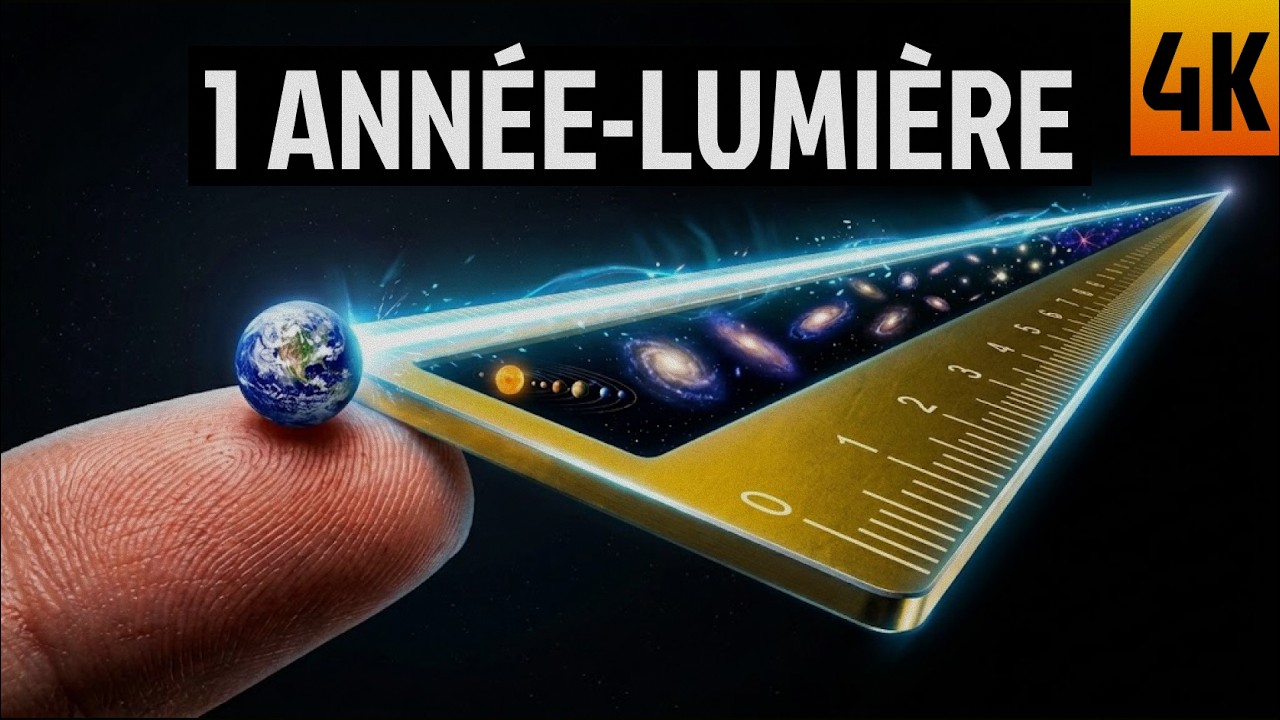
Une Année-Lumière est si Immense que Votre Cerveau ne Peut pas la Concevoir 4K
A Light-Year is so Immense that Your Brain Cannot Comprehend It 4K
Keywords
Summary
168 words
Critical Evaluation
Value of the Information & Strength of the Argument
The value of the information is exceptional for a general audience. It synthesizes fundamental physics, historical breakthroughs, and contemporary space missions into a coherent narrative. The argumentation is rigorous; the video builds its case step-by-step, from accessible planetary analogies toward the incomprehensible interstellar numbers, using a self-declared didactic ‘four different rulers’ structure. The argument that human intuition fails due to evolutionary calibration is supportable and presented clearly. However, the emotional framing (‘pire’, ’troublante’) adds a slight sensationalist tone that does not undermine the underlying factual rigor.
Scientific Rigor, Source Quality, Title Accuracy
The rigor is high, presenting a flawless chain of logic based on established physics. It correctly identifies exact distances and speeds for planetary bodies and deep-space probes. The explanation of parallax and the role of Bessel and New Horizons are accurate and well-contextualized. Notably, the transparent use of NASA calculations for Voyager 1’s future milestone, aligning with the 2026 publication date, adds verisimilitude. The title accurately encapsulates the video’s mission: to demonstrate the conceptual impossibility of grasping the scale mentally. Even if the video does not cite specific academic papers, its content perfectly aligns with standard astrophysical data.
199 words
Title / Content Match
The title perfectly matches the content. The entire video is built around the proposition that the human brain cannot intuitively grasp the magnitude of a light-year, using multiple layered analogies to prove this point.
Quality & Reliability
9/10
The video presents a highly accurate account of physics and astronomy. Every factual claim regarding distances (light-year, planetary distances), the speed of light, optical parallax, and historical milestones (Ole Rømer, Friedrich Bessel, Voyager 1, New Horizons) is correct and consistent with established scientific knowledge. The argumentation is logically structured and didactically effective.
Key Moments
Markers derived by PSI from the transcript: the creator did not define chapters.
- Introduction presenting the problem of grasping a light-year and the 'four rulers' method that will structure the entire video.
- Scale model of the solar system: Sun as a 2.5cm ball, Earth as a grain of sand, and the light-year distance stretching to 173 kilometers (Paris-Le Havre).
- Historical discovery of the finite speed of light by Ole Rømer in 1676, observing the eclipses of Jupiter's moon Io.
- Analysis of light communication delays, ranging from 40-minute round-trips to Mars to over 4 hours to reach Neptune.
- Visualizing the failure of intuition with the rule of 32 quadrillion rulers (one per second) required to cover a single light-year in a billion years.
- Explaining the parallax method for measuring stellar distances, from Friedrich Bessel's 1838 work to the 2020 New Horizons experiment.
Cited Sources
- NASA — Cited for the calculations regarding Voyager 1's speed, trajectory, and projected distance milestone on November 18, 2026.
- Ole Rømer's speed of light measurement — Historical narrative of the 1676 discovery of the finite speed of light using observations of Jupiter's moons.
- Friedrich Bessel's stellar parallax — Historical account of the first successful measurement of a star's distance (Cygni) using parallax in 1838.
Concurring Sources
- Light-year — Confirms the exact definition, distance, and the equivalence to 63,241 astronomical units mentioned in the video.
- Parallax — Supports the method of measuring stellar distances as explained in the video, including the historical context.
Contribution & Novelties
The originality of this video lies in its pedagogical methodology, not in scientific novelty. It successfully translates an abstract astronomical unit into layered, tangible analogies (the billiard ball model, the Paris-Le Havre distance, the time-delays in communication) that specifically target the evolutionary limits of human intuition. Its historical narrative connecting Rømer, Bessel, and New Horizons provides a rare, coherent timeline of our knowledge about stellar distances.
Pour aller plus loin :
- Light-year - Wikipedia - Provides the canonical definition and various equivalents (63,241 AU).
- Speed of light - Wikipedia - Details the constant nature of this fundamental speed and its implications.
- Parallax - Wikipedia - Explains the geometric method used globally to measure stellar distances.
- Ole Rømer - Wikipedia - Historical background on the first measurement of the speed of light.
131 words
Radar Profile
The radar profile shows a globally high and balanced content across all dimensions. Quantity and quality of information peak at 9/10, driven by the dense but accurate blend of history and physics. Reliability is equally high. The technical level, while substantial, is deliberately kept accessible for a general audience, sitting at 8/10. The overall shape suggests a well-constructed, reliable, and information-rich didactic resource.