Quantum Computation and Quantum Information: Lecture 28 (Physical Realizations of Qubits)
Keywords
Summary
150 words
Critical Evaluation
Value of the Information & Strength of the Argument
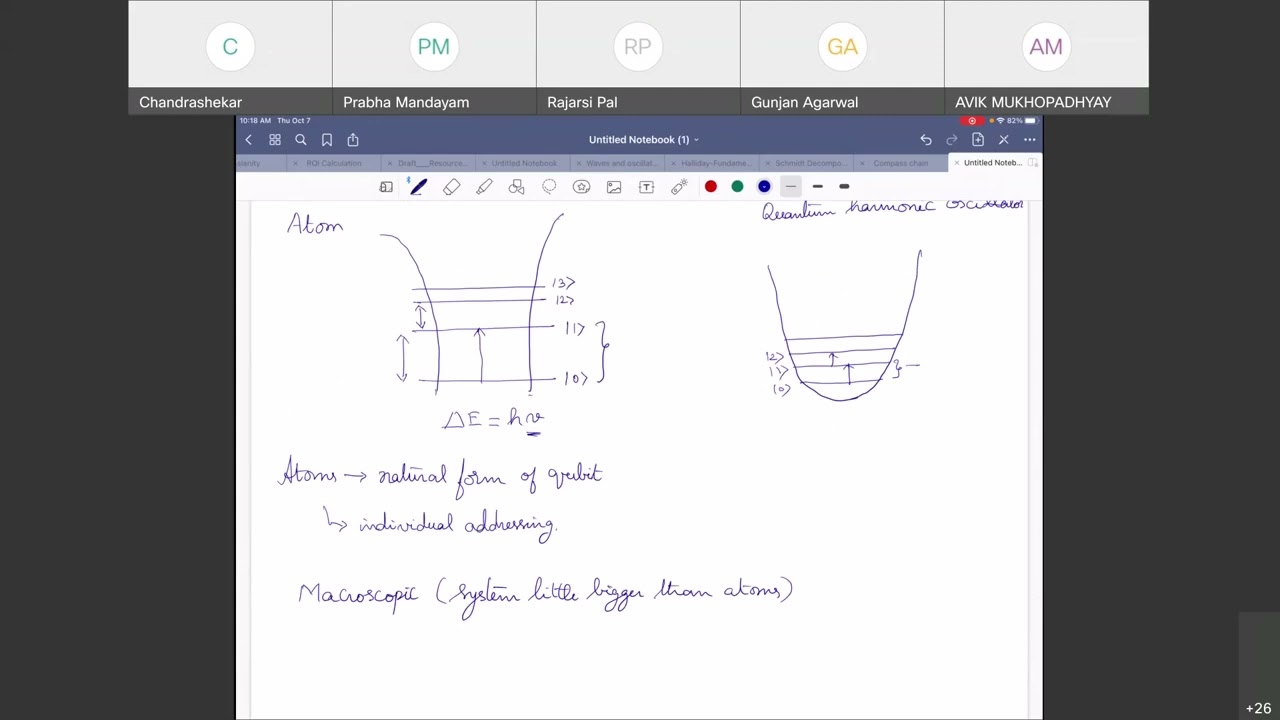
The lecture delivers a valuable and well-structured overview of qubit physical implementations. The speaker systematically presents each qubit type, explaining the underlying physics, operational principles, and key advantages or limitations. For example, he clarifies why atoms are natural qubits due to anharmonic energy levels, while harmonic oscillators are unsuitable because of equal spacing. The comparison between liquid NMR (ensemble computation) and solid-state NMR (individual addressing) is particularly instructive. The discussion of superconducting qubits includes the crucial parameter EJ/EC and explains how transmon qubits solve the charge noise sensitivity. The argumentation is solid, relying on established principles of quantum mechanics and condensed matter physics. However, the lecture is expository rather than critical; it does not delve deeply into comparative trade-offs or current research frontiers, but it effectively establishes a foundational understanding. The inclusion of practical aspects, such as IBM Quantum with cloud access, enhances the applied value.
Scientific Rigor, Source Quality, Title Accuracy
The scientific rigor is appropriate for an educational lecture. The content aligns with established knowledge in quantum physics; no factual errors are apparent. The speaker cites no external references directly, but the description links to the course context (IIT Madras, PH 5840). The lecture appears to be based on widely accepted textbook knowledge, such as Nielsen and Chuang’s ‘Quantum Computation and Quantum Information.’ The title is perfectly accurate, as the lecture exclusively discusses qubit physical realizations. There is no discernible discrepancy between the title and the content. The lack of explicit citations weakens the ability to verify specific claims, but the academic setting lends credibility. The inclusion of a question from a student, clarified by Prof. Mandayam, demonstrates interactive engagement and further reinforces the lecture’s reliability.
287 words
Title / Content Match
The title matches the content exactly: the lecture covers physical realizations of qubits.
Quality & Reliability
8/10
Lecture from a university course delivered by a subject matter expert. Covers major qubit implementations with accurate physics, though some simplifications are inherent to the lecture format.
Key Moments
Markers derived by PSI from the transcript: the creator did not define chapters.
- Introduction by Prof. Prabha Mandayam, mentioning IBM Quantum and assignments.
- Discussion of classical bits and the origin of binary encoding in telegraphy.
- Explanation of qubits and the need for two-level isolation; contrast with harmonic oscillator.
- Liquid-state NMR qubits: ensemble quantum computation, limitations in scaling and mixed states.
- Solid-state NMR and nitrogen-vacancy (NV) centers in diamond, including crystal defects.
- Photonic qubits: polarization states (linear, diagonal, circular) and path entanglement.
- Superconducting qubits: phase, flux, and charge qubits, and the introduction of transmon.
- Ion-trap qubits and other approaches; summary and closing remarks.
Contribution & Novelties
The lecture provides a concise yet comprehensive survey of qubit physical implementations, which is valuable for learners bridging theory and experimentation. It clarifies the distinguishing features of each platform and the practical challenges. The discussion of transmon qubits is particularly useful given their use in IBM and Google quantum computers.
Pour aller plus loin :
- Transmon qubit — Reference on the transmon, the most prevalent superconducting qubit type.
- Josephson effect — Underlying physics for superconducting qubits, including phase and charge qubits.
- Nitrogen-vacancy center — Detailed overview of NV centers used in diamond qubits.
- Ion trap — Framework for ion-trap quantum computing, as mentioned in the lecture.
106 words
Radar Profile
The radar profile shows high scores in information quantity (9) and good quality (8), with moderate technical depth (7). The reliability (8) reflects the academic setting. The shape is relatively balanced, indicating a well-rounded introductory lecture.