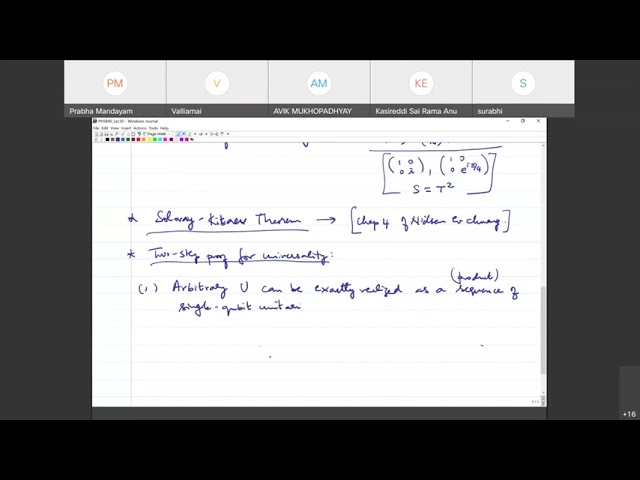
Quantum Computation and Quantum Information: Lecture 30 (Universal set of quantum gates)
Keywords
Summary
178 words
Critical Evaluation
Value of the Information & Strength of the Argument
The value of the information is high as it covers a core topic in quantum computing with a rigorous mathematical approach. The argumentation is well-structured: the instructor clearly defines universality, distinguishes exact vs approximate, and provides a step-by-step reasoning for the proof. The example with a 3×3 unitary makes the abstract algorithm concrete, enhancing comprehension. The reliance on established references (Nielsen & Chuang, Solovay-Kitaev) strengthens the argument’s credibility.
Scientific Rigor, Source Quality, Title Accuracy
The scientific rigor is excellent; the lecture adheres to standard textbook material and includes references to the Solovay-Kitaev theorem and Nielsen & Chuang. The title accurately describes the lecture’s focus on universal quantum gates. The teaching method is systematic, with necessary recaps and clear definitions. No external sources beyond the mentioned texts are used, but they are authoritative. The title-content alignment is perfect, with no misleading information.
150 words
Title / Content Match
The title accurately reflects the content, which focuses on universal sets of quantum gates and their proof.
Quality & Reliability
9/10
Lecture by a professor at IIT Madras, presenting standard quantum computing results with clear explanations and references to known theorems (Solovay-Kitaev, Nielsen & Chuang). Content is rigorous and academically sound.
Key Moments
Markers derived by PSI from the transcript: the creator did not define chapters.
Cited Sources
- Nielsen and Chuang, Quantum Computation and Quantum Information — Referenced for detailed proof of universality, especially Chapter 4.
- Solovay-Kitaev theorem — Mentioned as a result quantifying the approximability of unitaries using finite gate sets.
Concurring Sources
- Nielsen and Chuang, Quantum Computation and Quantum Information — Standard textbook covering the same material.
Contribution & Novelties
The lecture provides a clear pedagogical explanation of a standard result in quantum computing, emphasizing the algorithmic decomposition of arbitrary unitaries. It bridges abstract theory with concrete examples, making the concept of universality accessible. The discussion of practical gate implementation (e.g., native gates on IBM Q) adds a real-world perspective.
Pour aller plus loin :
- Quantum gate — Overview of quantum gates and their properties.
- Toffoli gate — A universal reversible gate relevant to quantum computing.
- Solovay–Kitaev theorem — Detailed explanation of the theorem and its implications.
- Nielsen and Chuang — The standard textbook reference for quantum information.
98 words
Radar Profile
The radar profile shows high scores across all dimensions, indicating a well-balanced and reliable lecture. The lowest score is in quantity of information (8), still strong, while quality and rigor are rated 9. This suggests a focused, in-depth treatment of the topic with excellent clarity.