Quantum Computation and Quantum Information: Lecture 19 (Teleportation and No Cloning Theorem)
Keywords
Summary
177 words
Critical Evaluation
Value of the Information & Strength of the Argument
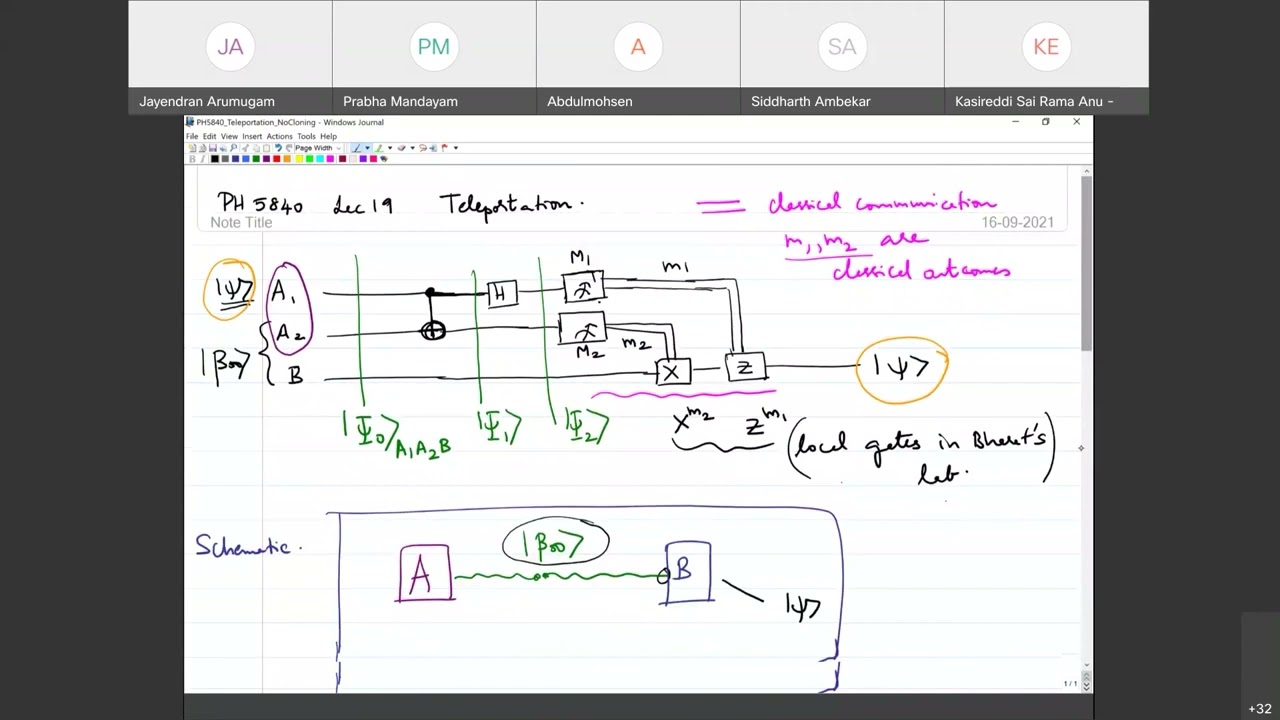
The lecture delivers high-value pedagogical content, breaking down the teleportation protocol into explicit mathematical steps. The argumentation is solid: the instructor derives the state after each operation, clearly groups terms to show the correlation between measurement outcomes and the required correction gates, and underscores the necessity of classical communication. The reasoning is logical and thorough, making the protocol understandable. The historical context adds credibility, and the discussion of resource usage (one ebit, two classical bits) is informative.
Scientific Rigor, Source Quality, Title Accuracy
The scientific rigour is high: the mathematics are correct, and the instructor appropriately references the foundational paper (Bennett et al., 1993). The presentation is clear and consistent with standard quantum information pedagogy. However, the title promises a discussion of the no-cloning theorem, which is not covered in the transcript—a notable omission that slightly undermines the title-content alignment. The sources cited (the original paper and experimental works) are authoritative, but no direct URLs are provided in the description, so only vague references are given.
175 words
Title / Content Match
The title includes 'No Cloning Theorem' but the lecture focuses exclusively on quantum teleportation; the no-cloning theorem is not discussed in the visible content.
Quality & Reliability
8/10
The lecture is rigorous, mathematically detailed, and delivered by an academic instructor as part of an IIT Madras course. The explanations are clear and technically accurate, though the title's mention of the no-cloning theorem is not addressed in the transcript.
Key Moments
Markers derived by PSI from the transcript: the creator did not define chapters.
- Introduction of the teleportation circuit and the roles of Alice and Bob.
- Initial state written as product of unknown qubit and Bell state.
- Action of CNOT gate on the first two qubits.
- Hadamard applied to first qubit; state psi2 derived.
- Regrouping terms by measurement outcomes of first two qubits.
- Table of outcomes and corresponding correction gates (X and Z).
- Discussion of the need for two classical bits and resource statement.
- Emphasis that teleportation does not violate superluminal communication.
- Historical references to original paper and experimental implementations.
Cited Sources
- Bennett, Brassard, Crépeau, Jozsa, Peres, Wootters, Teleporting an unknown quantum state via dual classical and EPR channels, PRL 70, 1895 (1993) — Original proposal for quantum teleportation.
- Experimental demonstrations (e.g., bouwmeester et al. 1997; Nielsen et al. 1998) — Mentioned as early implementations, details not provided.
Contribution & Novelties
The lecture provides a thorough, step-by-step walkthrough of quantum teleportation, reinforcing the fundamental concepts of entanglement and measurement. While not original research, it serves as an excellent pedagogical resource that clarifies the mechanics of the protocol. For those seeking to extend their understanding, the following suggest further exploration.
Pour aller plus loin :
- Quantum teleportation - Wikipedia — Detailed overview with history and variations.
- No-cloning theorem - Wikipedia — Important limitation of quantum state copying, related to teleportation.
- Original Bennett et al. paper (DOI) — The seminal reference.
88 words
Radar Profile
The radar profile shows high scores (8-9) across all four dimensions, indicating a balanced, comprehensive educational resource. The technical depth is strong, and the information is both quantitative and qualitative, making it a reliable reference for learners.