Quantum Computation and Quantum Information: Lecture 17 (Multipartite quantum systems)
Keywords
Summary
171 words
Critical Evaluation
Value of the Information & Strength of the Argument
The lecture provides a solid, didactic introduction to the mathematical description of multipartite quantum systems. Its value lies in building the tensor product formalism from first principles, using explicit matrix representations that make the transition from single-qubit to multi-qubit systems concrete. The argumentation is clear and logical: it defines the state space, introduces operators, states the rules for inner products, and then applies these to generate an entangled state, efficiently demonstrating why entanglement prevents product-state decomposition. The interactive Q&A reinforces understanding by addressing common misconceptions, such as the order of operator action on different qubits. The reasoning is consistent with standard textbooks and is pedagogically effective.
Scientific Rigor, Source Quality, Title Accuracy
The scientific rigor is high: all definitions and manipulations align with canonical quantum information theory. The instructor relies on fundamental linear algebra and quantum mechanics, and the examples are accurate. Sources are limited to an implicit reference to Nielsen & Chuang, which is appropriately used as a textbook reference; no external sources are cited, which is acceptable for a tutorial lecture. The title accurately mirrors the content, focusing on multipartite quantum systems. The lecture does not overclaim and stays within well-established formalism. No misleading statements or oversimplifications were detected.
210 words
Title / Content Match
The title accurately describes the lecture, which focuses on multipartite quantum systems, specifically bipartite qubit systems and the tensor product formalism.
Quality & Reliability
8/10
Lecture presents standard quantum information concepts (tensor product, basis states, inner product rules, CNOT) with mathematical rigor and clear examples. No external citations beyond a passing reference to Nielsen & Chuang; correctness is solid but relies on common textbook knowledge.
Key Moments
Markers derived by PSI from the transcript: the creator did not define chapters.
- Introduction to multipartite systems and motivation for tensor products
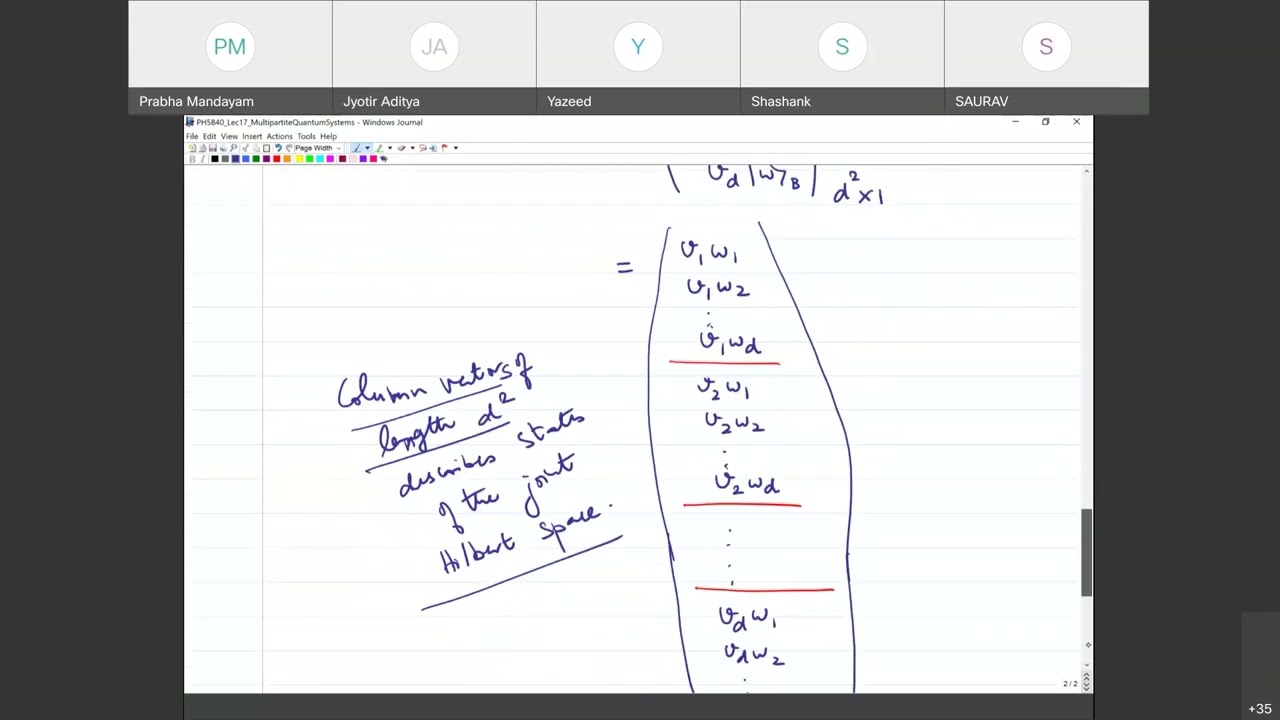
- Definition of tensor product for matrices and block matrix representation
- Construction of two-qubit computational basis states (|00⟩, |01⟩, |10⟩, |11⟩)
- Rules for inner products and operator action on tensor product states
- General two-qubit state as superposition of basis states
- Example circuit with X and Z gates on different qubits showing order dependence
- Hadamard + CNOT circuit producing the Bell state |00⟩+|11⟩/√2
Cited Sources
- Quantum Computation and Quantum Information (Nielsen & Chuang) — Referenced as a supplementary resource for understanding inner product rules in tensor product spaces.
Concurring Sources
- Bell state — The entangled state derived in the lecture is a canonical Bell state, described in this reference.
- Controlled NOT gate — The CNOT gate used in the lecture is a standard two-qubit gate, with its action defined as in this reference.
- Kronecker product — The tensor product definition and matrix representation used in the lecture are consistent with this mathematical description.
Contribution & Novelties
This lecture is a clear pedagogical exposition of the tensor product formalism for multipartite quantum systems, leading to the generation of an entangled Bell state via a simple circuit. Its contribution is in making the abstract math accessible to students, with explicit matrix examples and interactive corrections. The session effectively demonstrates that the joint Hilbert space dimension grows as the product of individual dimensions and that some states (Bell states) are inherently non-separable.
Pour aller plus loin :
- Bell state — Directly illustrates the entangled state produced in the lecture and its significance in quantum information.
- Controlled NOT gate — The two-qubit gate used to generate entanglement; its unitary matrix is shown.
- Kronecker product — The mathematical operation underlying tensor products, with detailed properties and examples.
126 words
Radar Profile
The score profile is balanced, with high reliability and quality, slightly lower technical depth (step-by-step derivation) and a strong focus on clarity. This reflects a tutorial-style lecture that prioritizes understanding over advanced topics.