QEC and Quantum Information Theory: Lecture 7 Classical vs Quantum Codes
Keywords
Summary
110 words
Critical Evaluation
Value of the Information & Strength of the Argument
The lecture provides a solid foundation for understanding the transition from classical to quantum error correction. The instructor carefully builds the classical case, emphasizing the key steps of encoding, noise, detection, and correction. Her argumentation is logical and rigorous, with explicit assumptions (like IID noise) and clear justification for each step. The pedagogical value is high: she uses concrete examples, addresses student questions, and clarifies subtle points such as the pairwise parity check. The inherent limitations of the repetition code are properly identified, motivating the need for more sophisticated quantum codes.
Scientific Rigor, Source Quality, Title Accuracy
The lecture is scientifically rigorous, with precise definitions of channels, codes, and syndromes. No external sources are cited, but the content is standard textbook material in quantum information theory, and the instructor’s presentation is internally consistent and mathematically sound. The title accurately reflects the focus on classical vs quantum codes. The description reveals this is part of an advanced graduate course (PH 5842) at IIT Madras, lending credibility to the expertise conveyed.
178 words
Title / Content Match
The title accurately reflects the content: the lecture focuses on classical vs quantum error-correcting codes, with emphasis on the three-bit repetition code and its quantum counterparts.
Quality & Reliability
8/10
The lecture is a clear, rigorous exposition of classical error correction and its meditation for quantum systems. The mathematical content is accurate, the pedagogy is solid, and the instructor demonstrates a deep understanding of the subject, although no original research is presented.
Key Moments
Markers derived by PSI from the transcript: the creator did not define chapters.
- Introduction to the binary symmetric channel and bit-flip errors.
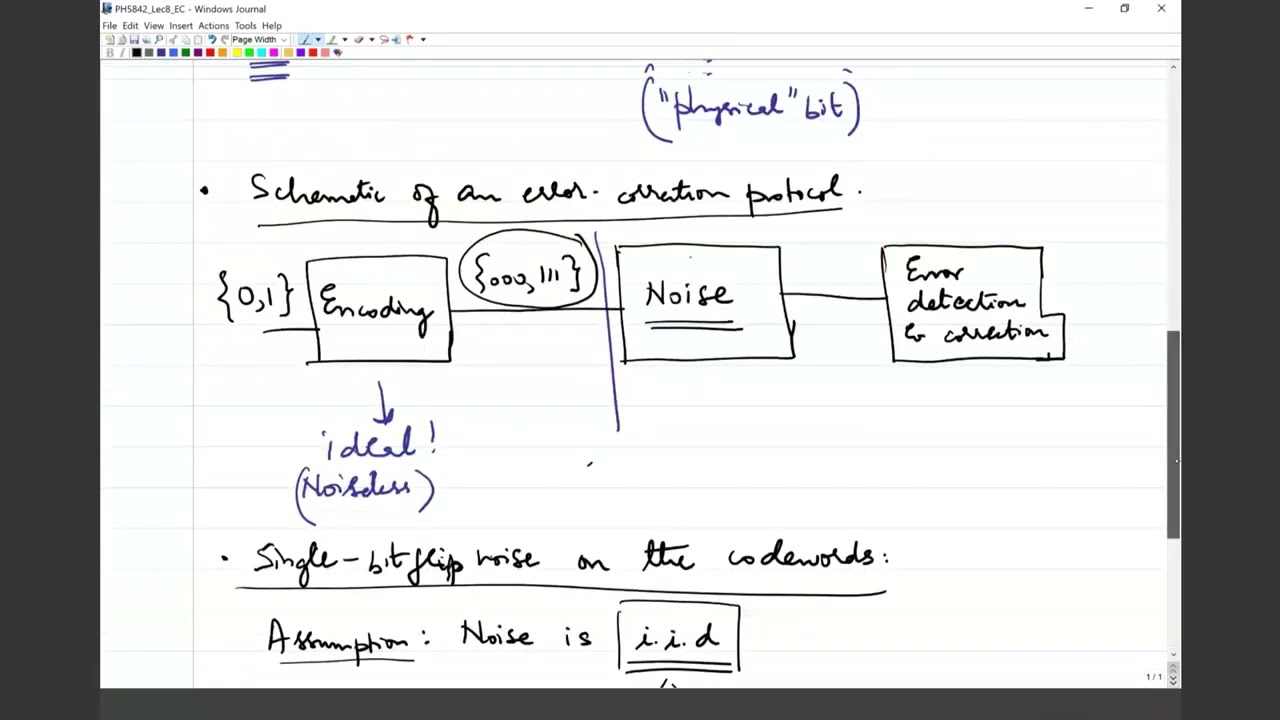
- Encoding using the three-bit repetition code.
- Explanation of the IID noise assumption and its physical relevance.
- Calculation of error probabilities for single and multiple bit flips; leading order analysis.
- Error detection via pairwise parity checks and definition of the error syndrome.
- Correction procedure and decoding; discussion of two-bit error limitations.
Contribution & Novelties
This lecture offers a clear pedagogical bridge from classical error correction to quantum error correction, but it does not present new research. Its value lies in the structured exposition of core concepts and the anticipation of quantum-specific challenges. For a deeper understanding, the following pointers are helpful:
Pour aller plus loin :
- Quantum error correction (Wikipedia) — Overview of QEC principles and key codes.
- Repetition code (Wikipedia) — General classical repetition codes and their properties.
- Quantum Hamming bound and stabilizer codes — Mathematical framework for many QEC codes.
88 words
Radar Profile
The radar profile shows high scores in quality, technical level, and reliability, with a somewhat lower score in quantity of information due to the focused scope. This reflects a technically deep but narrowly targeted lecture.