Quantum Computation and Quantum Information: Lecture 4 (Postulates of Quantum Mechanics I)
Keywords
Summary
157 words
Critical Evaluation
Value of the Information & Strength of the Argument
The lecture provides a solid and clear exposition of the mathematical foundations of quantum states, particularly the vector space structure and the role of inner products. The argumentation is well-built: it begins with a contrast to classical mechanics, progressively defines necessary concepts, and uses concrete examples to build intuition. The instructor emphasizes finite-dimensional systems relevant to quantum computing while acknowledging infinite-dimensional cases. The use of multiple examples (column vectors, matrices, function spaces) reinforces understanding. The reasoning is logically rigorous and accessible to those with basic linear algebra, and it correctly highlights that no unique basis exists even with orthonormality.
Scientific Rigor, Source Quality, Title Accuracy
The lecture is rigorous, with formal definitions and careful distinctions (e.g., field, vector space, basis, linear independence). The primary source is the standard textbook by Nielsen and Chuang (Chapter 2), cited explicitly. The content is consistent with established quantum mechanics formalism. The title precisely describes the lecture’s focus on the postulates of quantum mechanics, specifically the state postulate. No external links are provided in the description, and no other sources are named. The presentation style is academic and careful, suitable for a graduate-level course.
198 words
Title / Content Match
The title accurately reflects the content: a lecture on the postulates of quantum mechanics, focusing on state spaces and Hilbert spaces.
Quality & Reliability
9/10
Rigorous university lecture from IIT Madras, logically structured, with clear mathematical definitions and references to a standard textbook (Nielsen & Chuang).
Key Moments
Markers derived by PSI from the transcript: the creator did not define chapters.
- Introduction: goals of the lecture, outline of postulates of quantum mechanics.
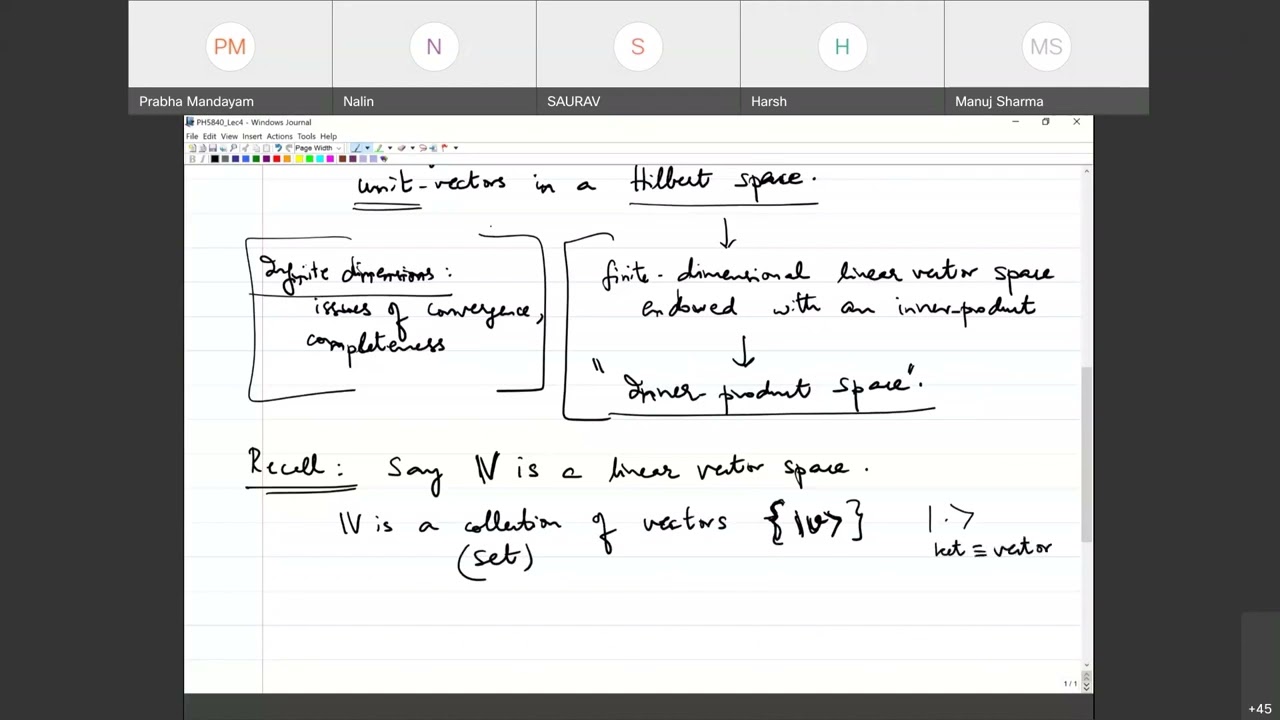
- Statement of Postulate 1: states are unit vectors in a Hilbert space; contrast with classical state description.
- Review of linear vector spaces: definition, closure properties, field of scalars.
- Example: space C^d of complex column vectors; basis and representation of vectors.
- Example: space of 2x2 complex matrices as a 4-dimensional vector space; basis matrices.
- Square integrable functions as an infinite-dimensional Hilbert space; wavefunctions.
- Definition of linear independence and basis; no unique basis even with orthonormality.
- Introduction of bra-ket notation and definition of inner product.
Cited Sources
- Quantum Computation and Quantum Information — Primary textbook reference for the course, especially Chapter 2 on quantum mechanics postulates.
Contribution & Novelties
This lecture offers a pedagogical and self-contained introduction to the mathematical prerequisites for quantum computation, emphasizing finite-dimensional Hilbert spaces and the qubit. It bridges linear algebra and quantum mechanics explicitly, which is valuable for students entering quantum information. The originality lies in the targeted selection of concepts necessary for understanding qubits, avoiding the breadth of a full quantum mechanics course.
Pour aller plus loin :
- Bloch sphere — A geometrical representation of a single qubit, directly extending the lecture’s content.
- Density matrix — Generalization of state vectors to mixed states, essential for decoherence and statistical mixtures.
- Tensor product of Hilbert spaces — Formal construction used to describe multi-qubit systems, a natural next step.
113 words
Radar Profile
The radar profile shows high scores across technical level, information quality, and reliability, with slightly lower quantity of information due to the focused scope. This indicates a dense, rigorous lecture ideal for a specialized audience.