QEC and Quantum Information Theory: Lecture 12 Conditions for QEC II
Keywords
Summary
195 words
Critical Evaluation
Value of the Information & Strength of the Argument
The lecture provides a thorough and rigorous derivation of both sufficiency and necessity of the Knill-Laflamme conditions, which are fundamental to quantum error correction. The argumentation is logically sound, starting from the definition of a correctable code and progressively building the recovery channel. The use of polar decomposition to show that errors become unitary on the code space, and the subsequent construction of orthogonal projectors for error detection, is elegant and clear. The necessity proof leverages unitary freedom to relate any effective recovery process to the algebraic condition, closing the logical loop. The lecturer takes care to justify each step, including trace-preservation and the handling of the complementary part of the recovery map. The value lies in the clarity and completeness of the exposition, making a mathematically intricate topic accessible without oversimplification.
Scientific Rigor, Source Quality, Title Accuracy
The lecture is scientifically rigorous, rooted in well-established literature: it references the foundational paper by Knill and Laflamme (PRL, 1997) and standard textbooks such as Nielsen & Chuang for polar decomposition arguments. The derivation follows accepted methods and includes formal proofs and verification of the CPTP property. The title is perfectly aligned with the content, as it is indeed the second part of the conditions for quantum error correction. The video description mentions the affiliated course at IIT Madras, and the presentation style confirms an academic setting. No external sources are provided in the description, but the internal citations are appropriate and accurately used.
251 words
Title / Content Match
The title accurately describes the video: it is the 12th lecture in a series on quantum error correction, specifically covering the necessary and sufficient conditions (Knill-Laflamme) in detail.
Quality & Reliability
9/10
The lecture provides a rigorous, complete proof of the Knill-Laflamme quantum error correction conditions, with detailed mathematical derivations. The lecturer is a professor at IIT Madras and the content is standard, well-established theory. The presentation is clear and technically sound.
Key Moments
Markers derived by PSI from the transcript: the creator did not define chapters.
- Introduction and recall of the QEC conditions, notation for error operators, projector P, and recovery map R.
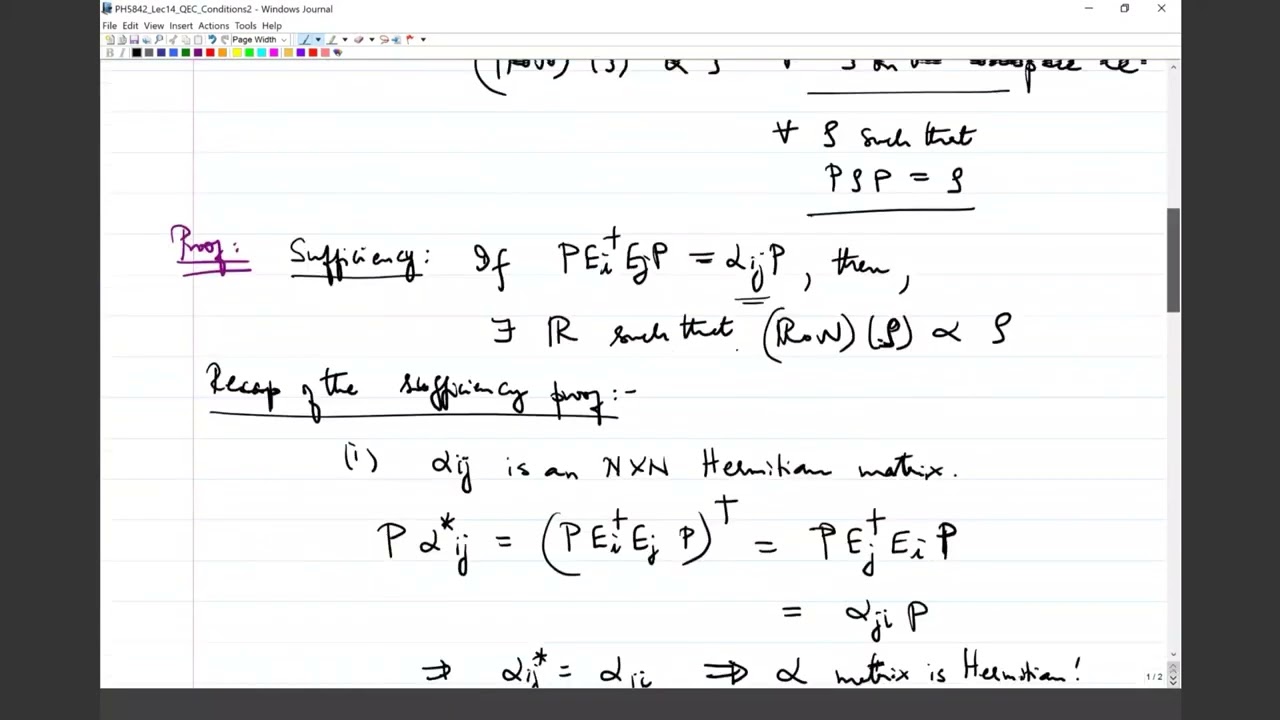
- Statement of the sufficiency part: if the conditions hold, a recovery map exists. Recap of key steps: Hermitian matrix alpha, diagonalization.
- Use of polar decomposition to show each error acts like a unitary on the code space, leading to reversibility.
- Construction of orthogonal projectors for error detection, and definition of the recovery map as a three-step process: measurement, unitary reversal, and projection.
- Verification that the recovery map is CPTP (adding a complementary operator) and formal proof that the recovery works for any code state.
- Beginning of the necessity proof: assuming existence of a recovery map, use unitary freedom to derive the algebraic condition.
- Completion of the necessity proof: from the unitary freedom relation, obtain P E_i† E_j P = alpha_ij P, thus establishing the converse.
Cited Sources
- Knill & Laflamme, PRL 1997 (Quantum Error Correction) — Referenced as the origin of the QEC conditions, often called Knill-Laflamme conditions.
- Nielsen & Chuang, Quantum Computation and Quantum Information — Referenced for polar decomposition and general quantum information formalism.
Contribution & Novelties
This lecture delivers a complete and self-contained proof of the Knill-Laflamme conditions, both sufficiency and necessity, which is the cornerstone of quantum error correction. It goes beyond a mere statement by explicitly constructing the recovery map and demonstrating its validity. The pedagogical approach of first proving sufficiency with polar decomposition, then using unitary freedom for necessity, clarifies the structure of the conditions. The lecture also notes historical context and practical relevance.
Pour aller plus loin :
- Quantum error correction (Wikipedia) — Overview of the field, including the conditions and examples.
- Knill-Laflamme condition (Wikipedia) — Direct reference to the conditions and their significance.
- Quantum threshold theorem (Wikipedia) — Extension of QEC to fault-tolerant quantum computing.
114 words
Radar Profile
The radar profile shows very high scores across all dimensions, reflecting a dense, rigorous, and technically deep lecture. The high 'information quantity' and 'quality' scores align with the complete proof presentation, while the 'technical level' is at the maximum, consistent with an advanced graduate course. The 'reliability' is also high, as the content is standard and well-cited.