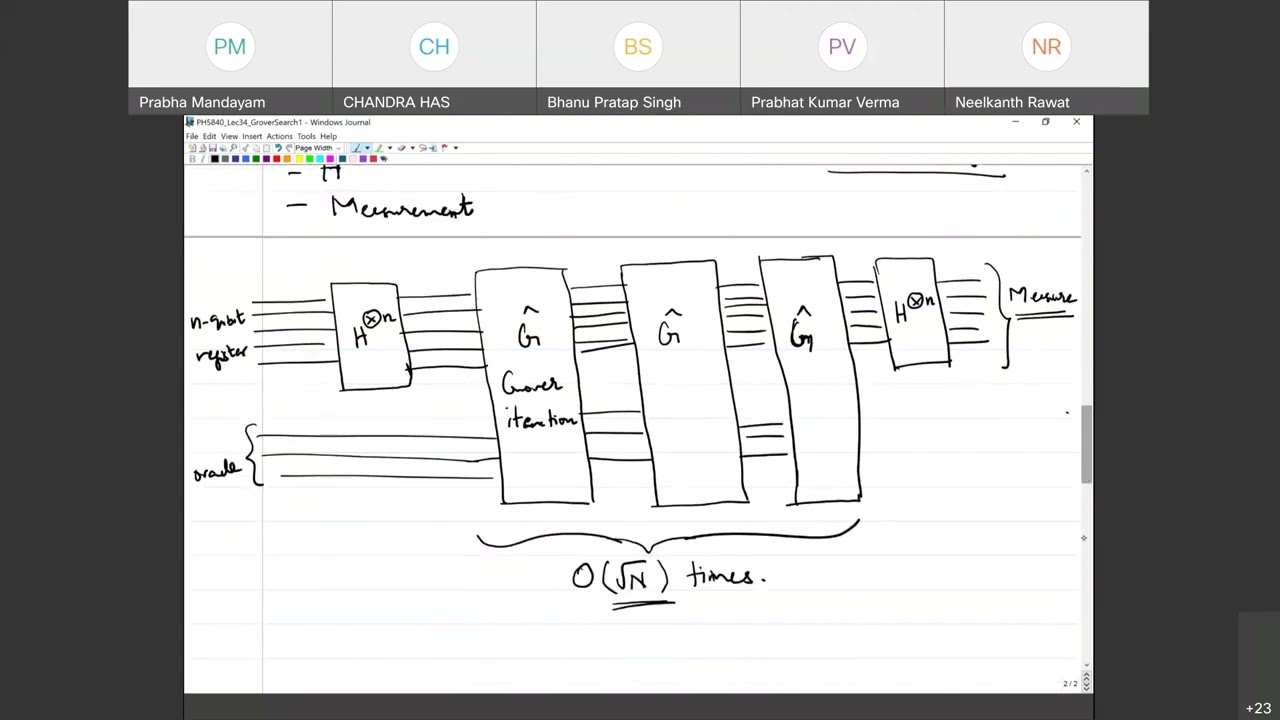
Quantum Computation and Quantum Information: Lecture 34 (Quantum Search Algorithm I)
Keywords
Summary
165 words
Critical Evaluation
Value of the Information & Strength of the Argument
The lecture provides a valuable, structured exposition of a fundamental quantum algorithm. The arguments are logically presented, starting from the oracle model and gradually constructing the Grover iterate. The instructor explains the circuit components, including the conditional phase shift and the inversion-about-the-mean operation, with clear mathematical derivations. The geometric interpretation in a two-dimensional subspace is particularly effective for understanding why the algorithm converges. The argumentation is solid, with proper justifications for each step, and the lecturer anticipates and addresses student queries, reinforcing the conceptual clarity.
Scientific Rigor, Source Quality, Title Accuracy
The lecture is academically rigorous, consistent with the standards of a university course. It references the standard textbook by Nielsen and Chuang and cites Grover’s 1996 work, though without explicit bibliographic details. The title accurately reflects the content: it is the 34th lecture in a series on quantum computation and information, specifically covering the quantum search algorithm. The content aligns well with the title, focusing on the algorithmic aspects rather than broader topics. The presentation is clear and technically precise, with appropriate notation and derivations.
185 words
Title / Content Match
The title accurately describes the content: a lecture on the quantum search algorithm (Grover's algorithm) as part of a course on quantum computation.
Quality & Reliability
9/10
Lecture delivered by a professor at IIT Madras, covering well-established quantum algorithms with clear explanations. The content is accurate and based on standard references like Nielsen and Chuang.
Key Moments
Markers derived by PSI from the transcript: the creator did not define chapters.
- Introduction to the search problem and motivation for quantum speedup
- Definition of the oracle and query complexity
- Overview of the quantum circuit for the search algorithm
- Detailed breakdown of the Grover iterate operator
- Analysis of the inversion-about-the-mean operation
- Introduction of the two-dimensional subspace and geometric visualization
Cited Sources
- Quantum Computation and Quantum Information — Standard textbook referenced for notation and background.
- Grover's algorithm (1996) — The algorithm being described in the lecture.
Contribution & Novelties
The lecture offers a clear pedagogical presentation of Grover’s algorithm, emphasizing the geometric intuition behind the iterative process. It effectively connects the algorithmic steps to the underlying mathematical operations, making it accessible to students with a basic background in quantum mechanics and linear algebra. The discussion of the inversion-about-the-mean operator and its role in amplitude amplification is particularly illuminating.
Pour aller plus loin :
- Grover’s algorithm - Wikipedia — Comprehensive overview of the algorithm, including its history, applications, and variations.
- Quantum amplitude amplification - Wikipedia — Generalization of Grover’s technique, relevant to many quantum algorithms.
- Quantum computing - Wikipedia — Background on quantum computation principles and models.
107 words
Radar Profile
The radar profile indicates high technical depth and reliability, moderate information quantity, and a strong focus on theoretical foundations, consistent with an expert-level tutorial.