Quantum Computation and Quantum Information: Lecture 2 (Quantum Parallelism)
Keywords
Summary
171 words
Critical Evaluation
Value of the Information & Strength of the Argument
The lecture provides high pedagogical value, building concepts from simple qubits to multi-qubit gates with clear examples. The argumentation is rigorous, relying on linear algebra to justify operations. The use of eigenvalue equations to explain gate actions reinforces understanding. The lecturer effectively distinguishes classical and quantum behavior, particularly in the discussion of phase gates and reversibility. The active engagement with students’ questions adds clarity to abstract ideas, such as the difference between global and relative phases.
Scientific Rigor, Source Quality, Title Accuracy
The lecture demonstrates scientific rigor through consistent use of mathematical formalism and physical interpretations. No external sources are cited, but the content aligns with standard textbooks such as Nielsen and Chuang’s ‘Quantum Computation and Quantum Information’. The title adequately reflects the course progression towards quantum parallelism, though this specific lecture focuses on foundational gate operations. The lack of explicit references is acceptable for a tutorial-style lecture, but the lecturer’s expertise ensures reliability.
163 words
Title / Content Match
The title references quantum parallelism, but the lecture mainly covers foundational concepts (qubits, superposition, gates, CNOT) that set the stage for parallelism. Slightly broader than the title suggests but appropriate for a course lecture.
Quality & Reliability
8/10
Lecture by a professor at IIT Madras, building on linear algebra and quantum mechanics, with clear explanations and interactive Q&A. Rigorous mathematical treatment of quantum gates and superposition.
Key Moments
Markers derived by PSI from the transcript: the creator did not define chapters.
- Recap of qubits and superposition
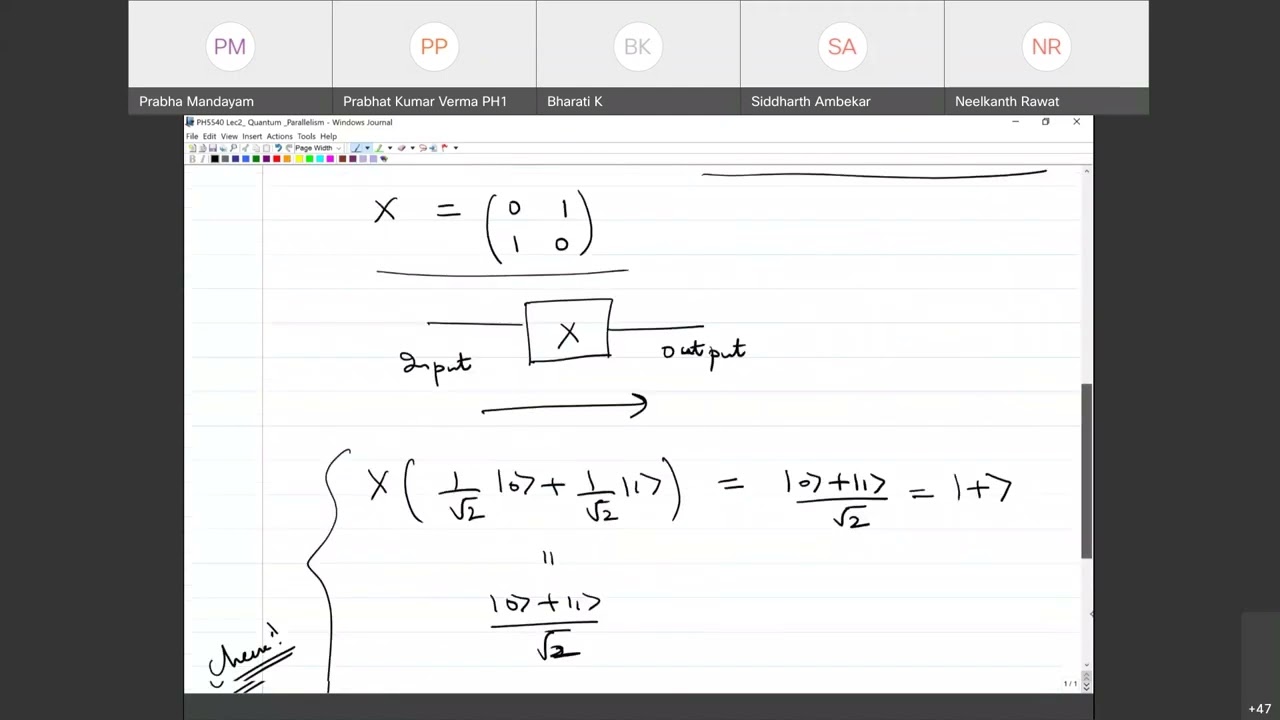
- Introduction to quantum gates and X gate representation
- Discussion of phase gate and relative phase
- Explanation of global vs relative phases with polarization analogy
- Transition to two-qubit gates and need for 4x4 matrices
- Definition and action of CNOT gate
- Connection between CNOT and XOR, highlighting reversibility
Contribution & Novelties
This lecture contributes to the course by systematically introducing quantum gates, emphasizing the role of unitary transformations and the physical meaning of phase. It clarifies misconceptions about global vs relative phases and demonstrates the construction of two-qubit gates. The interactive format enhances understanding of abstract concepts.
Pour aller plus loin :
- Unitary matrix — Fundamental concept for quantum gates.
- CNOT gate — Key two-qubit gate for entanglement and quantum computation.
- Quantum superposition — Basis of qubit behavior and parallelism.
79 words
Radar Profile
The radar profile shows a balanced strength across quantitative and qualitative dimensions, with slightly lower quantity due to the lecture's focus on depth rather than breadth of topics. High technical level and reliability reflect a solid academic presentation.