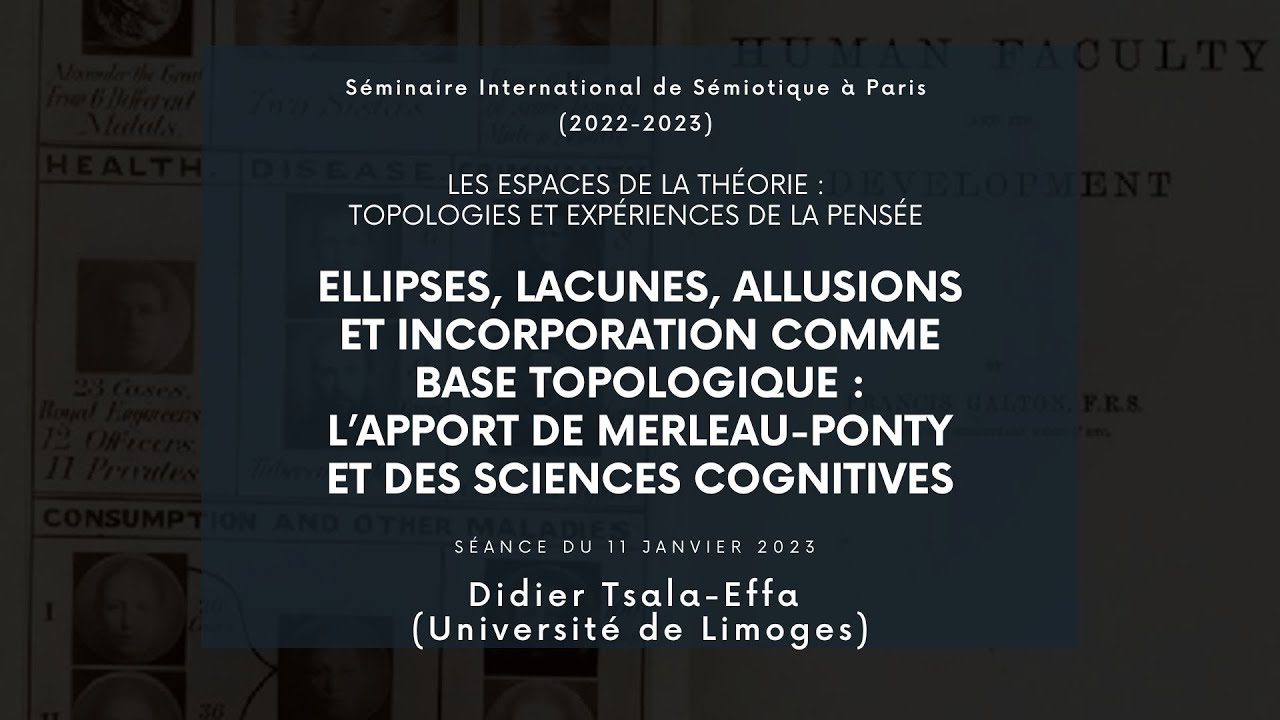
Didier Tsala-Effa (Univ. de Limoges) — Séminaire International de Sémiotique à Paris (11/01/2023)
Didier Tsala-Effa (Univ. of Limoges) — International Seminar of Semiotics in Paris (11/01/2023)
Keywords
Summary
108 words
Critical Evaluation
Value of the Information & Strength of the Argument
The talk offers a coherent and original synthesis of phenomenological and cognitive theories, proposing spatialization as a heuristic tool for understanding interpretive processes. The argumentation is systematic, building from abstract principles to concrete examples from narrative texts. The use of archaeological analogy effectively illustrates the iterative nature of interpretation. The presentation, however, is highly abstract and may leave some claims undersupported without detailed empirical evidence.
Scientific Rigor, Source Quality, Title Accuracy
The talk demonstrates solid scholarly rigor, referencing key works by Merleau-Ponty and cognitive scientists, and particularly engaging with Per Aage Brandt’s cognitively oriented narratology. The sources are mentioned directly in the lecture, though specific citations are not always provided. The title is well aligned with the content, as the discussion indeed revolves around ’ellipses, lacunes, allusions et incorporation’ as topological bases, drawing on the named thinkers. No comments are available for analysis.
152 words
Title / Content Match
The title accurately reflects the content, which discusses ellipses, gaps, allusions, and incorporation as a topological basis, drawing on Merleau-Ponty and cognitive science.
Quality & Reliability
8/10
The talk is a scholarly presentation from an academic expert, drawing on established theories in semiotics and cognitive science. The reasoning is rigorous and well-structured, though it represents a single perspective without extensive peer-reviewed backing in the video.
Key Moments
Markers derived by PSI from the transcript: the creator did not define chapters.
- Introduction of speaker and session context.
- Recapitulation of previous work on spatialization and saillance.
- Definition of saillance and its role in perception.
- Introduction of three guides: list, tableau, diagramme.
- Archaeologist analogy for iterative interpretation.
- Application to narrative analysis via Brandt's cognitive narratology.
- Conclusion and outlook on spatialization as a topological base.
Cited Sources
- Force et espace : Maupassant, Borges, Hemingway. Éléments de narratologie cognitive — Mentioned as a cognitive narratology approach to narrative dynamics, used to illustrate spatialized analysis.
Contribution & Novelties
The talk’s original contribution lies in proposing spatialization as a minimal and necessary condition for interpretive acts, drawing from Merleau-Ponty’s phenomenology and cognitive science. It extends the concept to narrative analysis, suggesting that narrative genres can be modeled as topologically motivated variations of force dynamics. This offers a new heuristic for semiotic and literary analysis.
Pour aller plus loin :
- Enactivism — Relevant to the enactive approach mentioned in the talk.
- Maurice Merleau-Ponty — Key philosophical foundation.
- Cognitive narratology — The field of Brandt’s work.
- Per Aage Brandt — The cognitive semiotician cited.
93 words
Radar Profile
The radar profile shows very high technical level (9) and strong information quality (8), with slightly lower quantity (8) and reliability (8). This indicates a deeply specialized, theoretically dense lecture that is intellectually robust but may have limited accessibility.