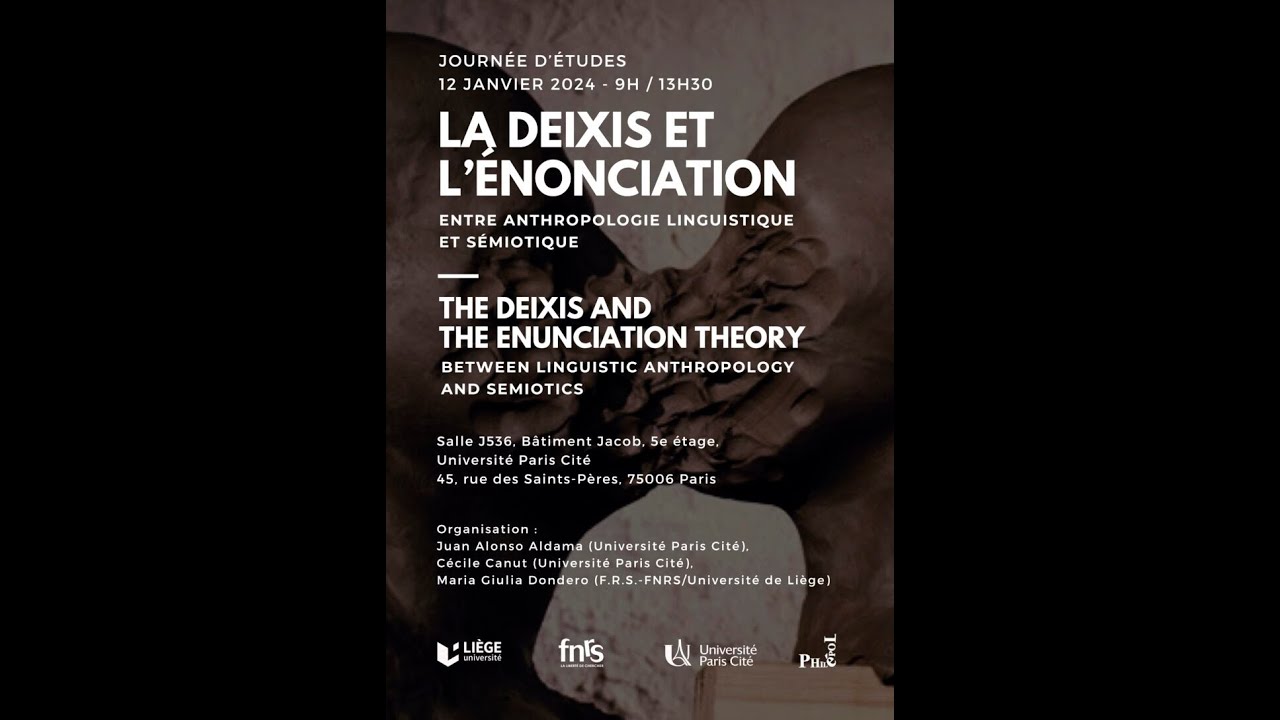
La déixis et l'énonciation (M. Leone, C. Nakassis; Paris Cité, 12/01/2024)
Deixis and enunciation (M. Leone, C. Nakassis; Paris Cité, 12/01/2024)
Keywords
Summary
168 words
Critical Evaluation
Value of the Information & Strength of the Argument
The value of the information lies in its theoretical sophistication and synthesis of linguistic anthropology and semiotics. Nakassis’s argument that most indexicality is not deictically bounded but distributed and emergent challenges traditional views and offers a fresh framework for understanding enunciation. He builds a nuanced case for distinguishing persona-indexing from person-indexing registers, illustrating with concrete examples such as ‘method’ vs. ‘Cannabis sativa’ and Pittsburgh dialect forms. The reasoning is meticulous, systematically defining terms like ‘register’, ’enregisterment’, and ‘intentionality’, and then linking them to broader semiotic processes. The argumentation is coherent and evidenced by theoretical references, though the transcript is partial, limiting full evaluation. The introduction by Canut also frames the stakes clearly, aligning with anti-positivist and practice-based approaches.
Scientific Rigor, Source Quality, Title Accuracy
The video demonstrates high scientific rigor through explicit engagement with foundational theorists (Benveniste, Peirce, Jakobson, Goffman) and current anthropological linguistics. The speakers are recognized experts, and the content is presented in a formal academic setting. Sources are not exhaustively listed but are woven into the discourse. The title accurately represents the scope and participants, and no discrepancies were detected. As no comments or external sources were provided, this analysis relies solely on the video content.
208 words
Title / Content Match
The title accurately reflects the content, which focuses on deixis and enunciation from linguistic anthropological and semiotic perspectives, with specified speakers and context.
Quality & Reliability
8/10
The video is an academic conference recording featuring renowned scholars in linguistic anthropology and semiotics. The content is theoretically grounded, referencing established theorists, and presented in a rigorous scholarly context. However, the transcript is partial and the lack of editorial oversight limits higher scoring.
Key Moments
Markers derived by PSI from the transcript: the creator did not define chapters.
- Cécile Canut introduces the conference, discussing the metapragmatic approach and historical context.
- Constantine Nakassis begins his talk on person-indexing registers, outlining the distinction from persona-indexing registers.
- Nakassis introduces the concept of enregisterment and discusses the nature of registers as metapragmatic models.
- Nakassis elaborates on intextualization and the three types of semiotic grounds (icon, index, symbol) in relation to textual coherence.
- Discussion of interactional texts and register coherence with examples like 'this method is loud'.
Cited Sources
- Émile Benveniste — Referenced as foundational for the theory of enunciation and deixis.
- Charles Sanders Peirce — His semiotic theory of indexes and icons underpins the discussion of indexicality.
- Roman Jakobson — His concept of the poetic function is extended to the notion of intxtualization.
- Erving Goffman — Mentioned regarding interaction rituals and the 'greasy parts' of interaction.
- Michael Silverstein — Referenced at the beginning as part of the work group and influential in linguistic anthropology.
Contribution & Novelties
The video contributes original theoretical perspectives by proposing a clear distinction between persona-indexing and person-indexing registers, and by emphasizing the distributed, emergent nature of most indexicality in discourse. It advocates for a shift from looking at decontextualized traces to examining indexical processes in their full range, integrating insights from linguistic anthropology and semiotics. The concept of ‘person-indexing registers’ expands traditional notions of idiolect and speech register, offering a dynamic model of how individuals and texts are semiotically constituted. The talk also refines the notion of enregisterment by linking it to intertextuality and metapragmatics.
Pour aller plus loin :
- Indexicality — Key semiotic concept underlying the talk.
- Enregisterment — The process by which forms become associated with social types, central to the argument.
- Metapragmatics — Reflexive dimension of language use that the lecture heavily employs.
- Speech register — Differentiates persona-indexing registers, though the talk extends beyond this.
146 words
Radar Profile
The radar profile shows balanced high scores across all dimensions, indicating a rigorous, information-dense, and technically advanced presentation. The slightly lower score in 'quantite_information' reflects the partial transcript, but the overall profile suggests a high-quality academic contribution.