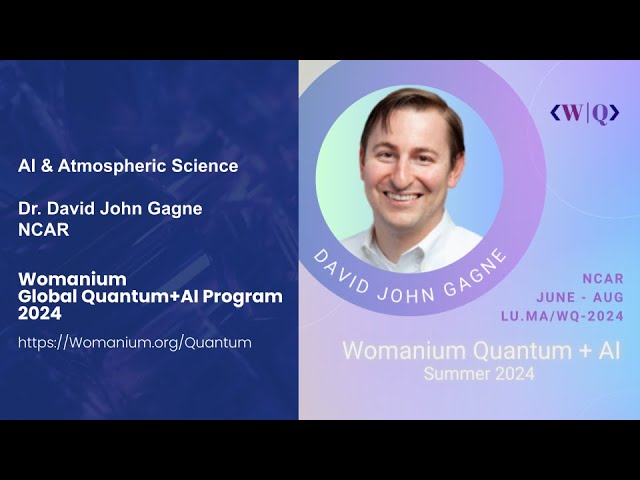
WOMANIUM QUANTUM + AI 2024: DAY 11 ❯ AI for Atmospheric Science (David John Gagne - NCAR)
Keywords
Summary
277 words
Critical Evaluation
Value of the Information & Strength of the Argument
The talk delivers substantial value as a structured, accessible introduction to AI applications in atmospheric science. It covers a wide range of methods—from classical decision trees and ensembles to deep neural networks—and grounds them in concrete meteorological use cases such as wildfire fuel moisture estimation, hail and tornado probability, hurricane intensity diagnosis, and full-atmosphere forecasting. The argumentation is solid and well-reasoned: Gagne consistently presents trade-offs (e.g., existing vs. custom vs. synthetic data; interpretability vs. performance; physics-based vs. hybrid vs. pure AI models) rather than advocating for a single approach. He acknowledges the slowing rate of improvement in traditional numerical weather prediction and the uneven global distribution of forecasting benefits, which motivates the need for AI. The interactive polls add an engaging dimension and reveal common misconceptions (e.g., many participants thought noisy/missing data is a poor match for decision trees, while the intended answer was smooth curves). The talk is not an original research presentation but a high-quality synthesis, and its value lies in its clarity, balance, and practical orientation. It avoids hype and clearly states that AI is not a silver bullet, noting challenges such as data quality, generalization, and maintenance of hybrid systems.
Scientific Rigor, Source Quality, Title Accuracy
Scientific rigor is high. The speaker is a domain expert from NCAR, and the content aligns with established knowledge in atmospheric science and machine learning. He does not make unsupported claims; instead, he explains algorithms at a conceptual level and cites examples from NCAR (e.g., fuel moisture estimation, hail/tornado probability). However, the talk does not include formal citations or references to specific papers during the presentation, and the description provides only the event website and schedule, not direct links to the research mentioned. The title accurately reflects the content: it is a keynote on AI for atmospheric science by David John Gagne at the WOMANIUM Quantum + AI 2024 event. No misleading framing. No comments were provided for analysis.
328 words
Title / Content Match
The title accurately reflects the content: a keynote on AI for atmospheric science delivered by David John Gagne at the WOMANIUM Quantum + AI 2024 event. The talk covers AI methods for weather and climate prediction as announced.
Quality & Reliability
8/10
The speaker is a recognized machine learning scientist at NCAR, a leading atmospheric research institution. The content is technically accurate, well-structured, and transparent about trade-offs and limitations. No unverified claims or exaggerated promises. The talk is a pedagogical overview rather than a presentation of new primary research, but it reflects current state-of-the-art methods in AI for weather and climate.
Key Moments
Markers derived by PSI from the transcript: the creator did not define chapters.
- Introduction of Dr. David John Gagne and his role at NCAR.
- Framing the problem: weather and climate disasters, slowing improvement in prediction, uneven global benefits, and climate change.
- Clarifying AI vs. machine learning vs. deep learning, and task types: classification, regression, generative AI.
- Applications: object segmentation (tropical cyclones, atmospheric rivers), hurricane intensity diagnosis, full-atmosphere AI forecasting, hybrid models, post-processing.
- Data sourcing strategies: existing archives, custom collection, synthetic data—trade-offs discussed.
- First audience poll: which aspect of AI offers greatest impact? Most choose D (finding unknown patterns).
- Explanation of decision trees, random forests, and gradient boosting, with examples like fuel moisture and hail/tornado probability.
- Second audience poll: poor data match for decision trees; intended answer B (smooth curves), many choose C (noisy/missing data).
- Transition to neural networks: artificial neurons, activation functions (ReLU), and training via mini-batch gradient descent.
Cited Sources
- WOMANIUM Quantum + AI 2024 event page — Official event website for the WOMANIUM Quantum + AI 2024 program, where this keynote was delivered.
- WOMANIUM Quantum + AI 2024 schedule — Schedule of the event, listing the keynote by Dr. David John Gagne.
Contribution & Novelties
This talk does not present new primary research; its originality lies in providing a comprehensive, balanced, and accessible synthesis of AI methods for atmospheric science, tailored to a general technical audience. It uniquely combines a high-level overview of AI paradigms (classification, regression, generative) with concrete meteorological applications and interactive audience engagement. The discussion of data sourcing trade-offs and the clear explanation of decision trees, random forests, gradient boosting, and neural networks—along with their strengths and weaknesses—makes it a valuable educational resource. The emphasis on predicting high-impact weather and climate disasters, and the acknowledgment of slowing improvements in traditional numerical weather prediction, offers a realistic perspective on where AI can contribute.
Pour aller plus loin :
- Machine learning in weather forecasting — Wikipedia overview of AI applications in meteorology.
- Random forest — Background on the ensemble decision tree method discussed.
- Gradient boosting — Explanation of the boosting technique mentioned.
- Numerical weather prediction — Context for traditional physics-based models contrasted with AI approaches.
- National Center for Atmospheric Research (NCAR) — Institution where the speaker works.
173 words
Radar Profile
The radar profile shows high reliability and information quality, with moderate technical depth and quantity of information. The talk is strong on credibility and clarity, but as a keynote overview it does not delve into advanced mathematical details or present novel research, which is reflected in the technical level score.