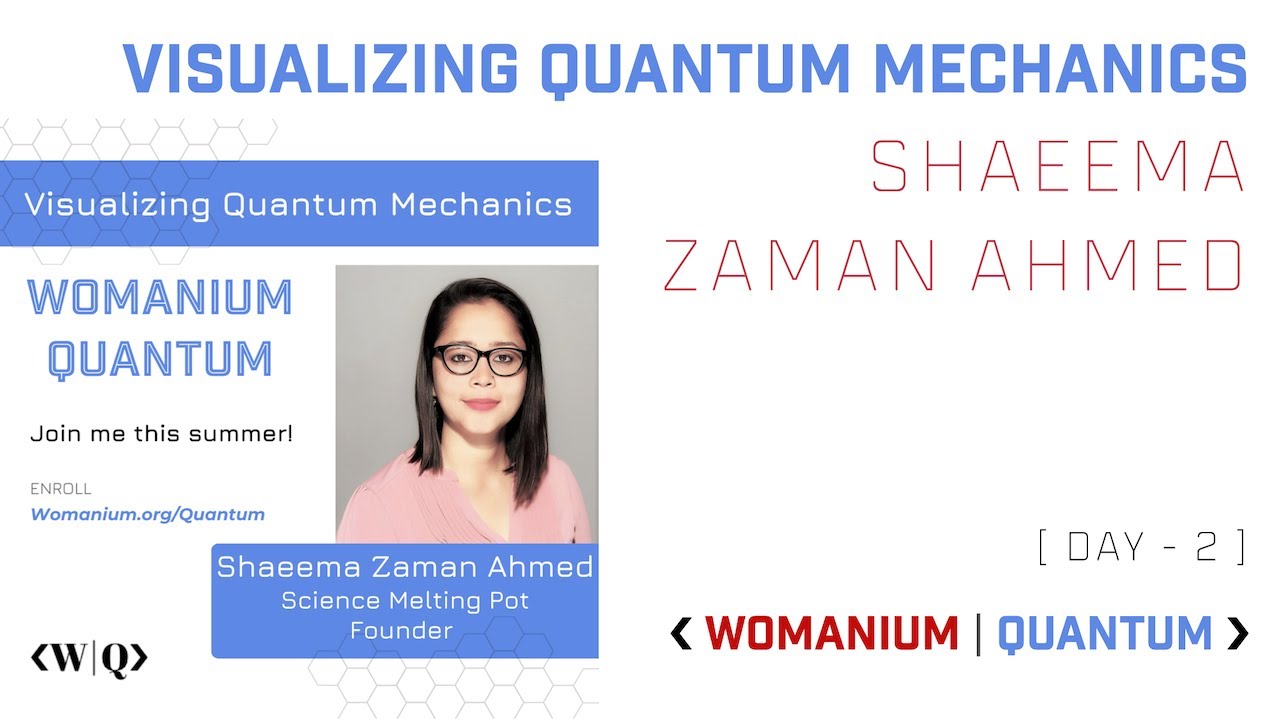
WOMANIUM QUANTUM : DAY 2 ❯ Shaeema: Visualizing Quantum Mechanics
Keywords
Summary
153 words
Critical Evaluation
Value of the Information & Strength of the Argument
The talk provides a solid, accessible overview of core quantum mechanics concepts, deliberately building from everyday analogies to mathematical formalism. The use of the double-slit experiment video and a simple book-shelf analogy makes abstract ideas more tangible. The argumentation is logical and progressive: she first establishes the special properties of quantum systems, then introduces the mathematical language (wave function, Schrödinger equation), and finally applies it to a concrete model. The pedagogical value is high, as she repeatedly checks understanding through polls and offers practical exercises. The speaker’s expertise is evident in the clarity of explanations, though some simplifications (e.g., state collapse) are presented without delving into interpretational debates, which is appropriate for an introductory audience but could be considered a limitation for advanced learners.
Scientific Rigor, Source Quality, Title Accuracy
The scientific content adheres to standard textbook quantum mechanics, with no apparent errors. The sources are indirect: she references interactive simulations hosted by the University of St Andrews (QuVis), which are recognized educational tools. She does not cite research papers, but the talk is a didactic exposition rather than a research presentation. The title accurately reflects the content, as visualisation is the central theme. No contradictory sources are mentioned. Public engagement appears positive, judging by the 99 likes relative to 4,164 views, but no comment analysis is possible due to absence of data.
232 words
Title / Content Match
The title accurately reflects the content: a session dedicated to visualising quantum mechanics through analogies, simulations, and concrete examples.
Quality & Reliability
8/10
The talk is delivered by a physicist with a PhD in quantum physics education, uses established concepts, and includes references to university-hosted simulations. The explanations are accurate and suitable for a mixed audience, though it is a popularized introduction.
Key Moments
Markers derived by PSI from the transcript: the creator did not define chapters.
- Introduction and personal background: Shaeema's journey from India to Denmark, her PhD on quantum games and simulations, and founding of Science Melting Pot.
- Explanation of the four key properties of quantum systems: wave-particle duality, superposition, uncertainty, and quantization, using the book-shelf analogy.
- Double-slit experiment video and debrief: the wave-like behaviour of particles, superposition, wave-particle duality, and the role of the observer.
- Discussion of quantization and discrete energy levels, recalling the Schrödinger equation and the historical development of atomic models.
- Introduction of the wave function and probability density, explaining how the square of the wave function gives the probability of finding a particle.
- Detailed presentation of the Schrödinger equation, its terms, and its analogy to Newton's second law.
- Example of the quantum harmonic oscillator, energy level spacing, and applications to diatomic molecules; final quiz on energy spectra.
Cited Sources
- 1D Particle in a Box simulation - QuVis — Exercise suggested to visualise the concepts of the 1D infinite well discussed in the talk.
- Superposition States simulation - QuVis — Interactive simulation to explore superposition of quantum states.
- Bloch Sphere representation simulation - QuVis — Visualisation of the Bloch sphere for a two-level quantum system.
- Time development 2-level system simulation - QuVis — Simulation illustrating the time evolution of a two-level system.
Concurring Sources
- QuVis - Quantum Visualisation Project — The simulations cited in the description are hosted here; they are designed to aid visualisation of quantum mechanics concepts.
Contribution & Novelties
The talk contributes to science communication by demonstrating how quantum mechanics can be taught through visual analogies and interactive simulations, making abstract concepts more accessible. The speaker’s focus on visualisation as a pedagogical tool is supported by her academic background in quantum physics education.
Pour aller plus loin :
- Double-slit experiment - Wikipedia — Relevant to the core demonstration of wave-particle duality.
- Schrödinger equation - Wikipedia — Foundation of the mathematical framework presented.
- Quantum harmonic oscillator - Wikipedia — Directly related to the final example of the talk.
- QuVis Quantum Visualisation Project — The source of the simulations recommended, highlighting the project’s mission.
103 words
Radar Profile
The radar profile shows a balanced performance across all dimensions, with slightly higher values in quantity and quality of information, consistent with a comprehensive introductory lecture that prioritises clarity and engagement over technical depth.