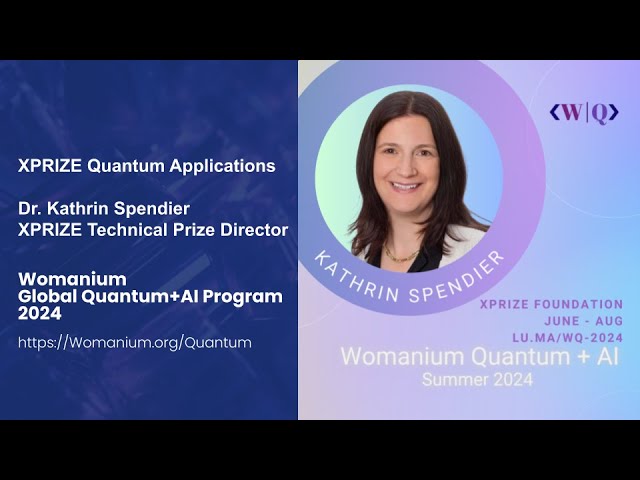
WOMANIUM QUANTUM + AI 2024: DAY 6 ❯ XPRIZE Quantum Applications (Kathrin Spendier - XPRIZE)
Keywords
Summary
200 words
Critical Evaluation
Value of the Information & Strength of the Argument
The presentation offers substantial value by clearly articulating the objectives, structure, and evaluation criteria of the XPRIZE Quantum Applications competition. It provides concrete examples of algorithm categories and cites specific research papers, giving viewers a tangible sense of what constitutes a competitive submission. The argumentation is coherent: the speaker argues that quantum computing can address global challenges, but current hardware limitations necessitate algorithmic advances, hence the competition’s focus on algorithms that can demonstrate quantum advantage with resource estimates. The reasoning is logical and well-supported by the competition’s design. However, the argumentation is largely promotional, aiming to attract participants rather than critically examine the feasibility or limitations of quantum computing. The speaker acknowledges hardware uncertainties but does not delve into potential pitfalls or alternative approaches. The value lies in the practical guidance for potential competitors and the clear mapping of quantum applications to SDGs.
Scientific Rigor, Source Quality, Title Accuracy
The talk maintains scientific rigor by referencing peer-reviewed papers as examples of algorithm categories, such as Hastings’ work on tensor PCA and studies on quantum linear system solvers. These citations lend credibility to the technical claims. The sources are not exhaustively detailed, but the speaker directs viewers to the competition website for further information. The title accurately reflects the content, as the video is indeed a session on XPRIZE Quantum Applications. The presentation is transparent about the competition’s sponsors and partners, and the speaker’s role as prize director is clearly stated. However, the talk does not critically evaluate the cited papers or provide independent verification; it relies on the competition’s framework. The Q&A session adds some depth by addressing practical concerns, but the overall rigor is that of a well-structured informational session rather than a scientific review.
295 words
Title / Content Match
The title accurately reflects the content: a session on the XPRIZE Quantum Applications competition, presented by Kathrin Spendier. The talk matches the title's promise.
Quality & Reliability
8/10
The presentation is delivered by the XPRIZE technical prize director, an authoritative source on the competition's rules, timeline, and judging criteria. The information is factual and verifiable through the official XPRIZE website. However, the talk is promotional in nature and does not present independent scientific evidence; it relies on the competition's own framework and cited papers without deep critical analysis.
Key Moments
Markers derived by PSI from the transcript: the creator did not define chapters.
- Introduction and welcome to Day 6 of the WOMANIUM Quantum + AI program.
- Introduction of Dr. Kathrin Spendier and overview of the XPRIZE Quantum Applications competition.
- Background on XPRIZE history, including the Orteig Prize and Ansari XPRIZE.
- Announcement of the $5 million XPRIZE Quantum Applications, supported by Google Quantum AI and GESDA.
- Explanation of the competition's alignment with UN Sustainable Development Goals and the need for quantum algorithms.
- Overview of the competition timeline: registration, interim reports, Phase 1 and Phase 2 submissions, and awards.
- Judging criteria: impact, scale of quantum computer, evidence, and novelty.
- Examples of algorithm categories with cited papers (Hastings, quantum linear system solvers, etc.).
- Q&A session covering hardware maturity, quantum-AI interface, team formation, and IP ownership.
- Closing remarks and encouragement to register for the competition.
Cited Sources
- WOMANIUM Quantum Program — Official website for the WOMANIUM Quantum + AI program, providing schedule and details.
- WOMANIUM Quantum Schedule — Schedule of the WOMANIUM Quantum + AI program, referenced for further sessions.
Concurring Sources
- XPRIZE Quantum Applications Official Page — Confirms the competition details, sponsors, and timeline as presented in the video.
Contribution & Novelties
The video provides an up-to-date overview of the XPRIZE Quantum Applications competition, including its structure, timeline, and judging criteria, which may not be widely known outside quantum computing circles. It highlights the competition’s unique focus on real-world applications and resource estimation, bridging the gap between theoretical algorithms and practical implementation. The emphasis on aligning quantum computing with UN SDGs is a novel angle that positions the technology as a tool for global benefit. The Q&A session offers insights into team dynamics, IP rights, and resource availability, which are practical considerations for participants.
Pour aller plus loin :
- XPRIZE Quantum Applications — Official competition page with detailed rules and registration.
- Quantum computing — Wikipedia article providing background on quantum computing principles.
- Sustainable Development Goals — United Nations page outlining the SDGs referenced in the talk.
134 words
Radar Profile
The radar profile shows high scores in information quantity and quality, reflecting the comprehensive coverage of the competition's details. Technical level is moderate, as the talk is accessible to a broad audience without deep quantum expertise. Reliability is high due to the authoritative speaker and alignment with official sources.