Transition role of entangled data in quantum machine learning
Keywords
Summary
180 words
Critical Evaluation
Value of the Information & Strength of the Argument
The value of the information is high, as the talk addresses a key open question in quantum machine learning with a rigorous theoretical framework. The argumentation is solid, progressing from a clear problem statement to a formal theorem and proof sketch, supported by numerical examples. The speaker carefully contrasts the new results with previous work, showing both continuity and novelty. The dual effect of entanglement is a significant insight with practical implications for algorithm design. The reasoning is methodical and clearly presented, although the dense mathematical content may require careful attention.
Scientific Rigor, Source Quality, Title Accuracy
The scientific rigor is strong, with the presentation based on a specific arXiv paper (2306.03481) and referencing established results in quantum tomography and learning theory. The speaker explicitly mentions the optimal bounds for quantum state tomography and compares them with his derived limits. The quality of sources is high, as the primary source is a preprint from the authors, and the talk appears to be a seminar presentation. The title ‘Transition role of entangled data in quantum machine learning’ is precisely aligned with the content, capturing the nuanced and sometimes counterintuitive findings. The talk does not embed a sponsor segment; no public comments are available for analysis.
213 words
Title / Content Match
The title accurately reflects the core contribution: analyzing how the entanglement degree in training data transitions between beneficial and harmful effects in quantum machine learning, depending on the number of measurements.
Quality & Reliability
8/10
The talk presents original theoretical results from a peer-reviewed arXiv paper, with a clear mathematical framework and numerical validations. The speaker is a researcher at Wuhan University and JD Explore Academy. The content is rigorous, though the transcript is auto-generated and contains imperfections.
Key Moments
Markers derived by PSI from the transcript: the creator did not define chapters.
- Introduction and review of quantum machine learning framework, including the hybrid quantum-classical paradigm.
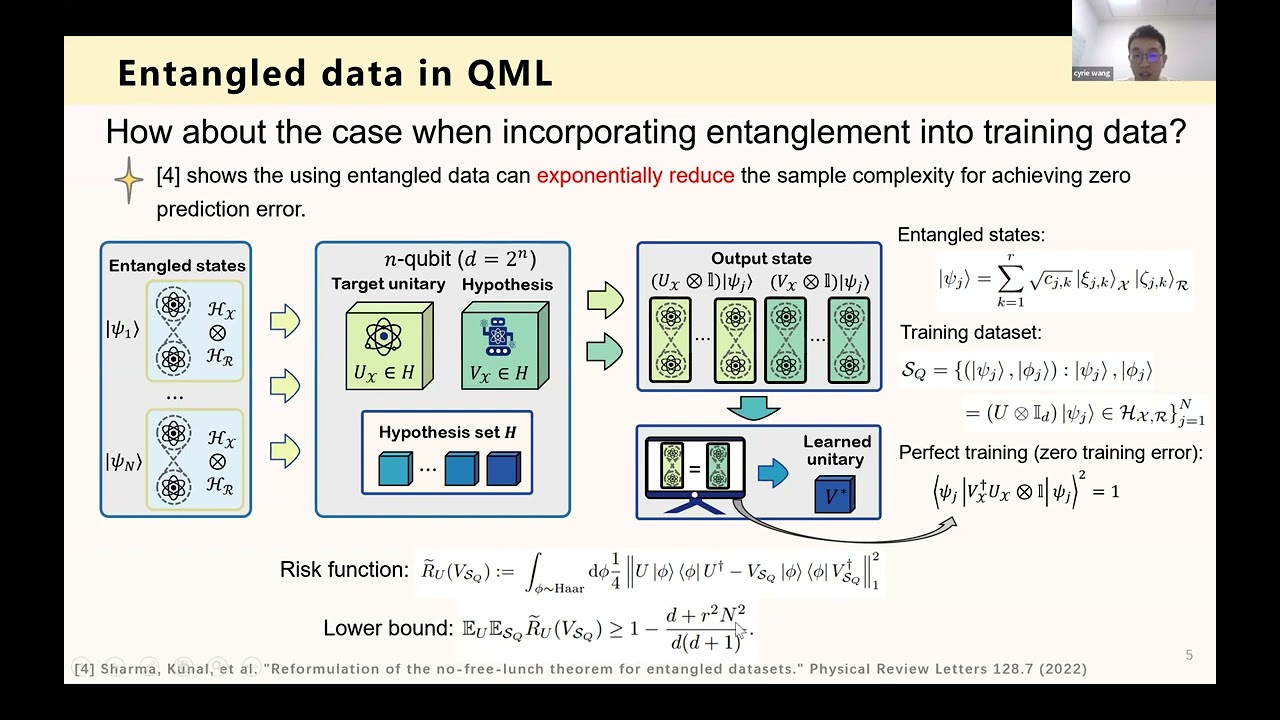
- Discussion of previous work showing entanglement in operations or measurements reduces training data size, and the specific result by Sharma et al. on entangled data.
- Presentation of the main result: the no-free-lunch theorem for entangled data, with a dual effect depending on the number of measurements M.
- Proof sketch using epsilon-packing and information-theoretic bounds, explaining the transition in prediction error via mutual information.
- Numerical simulations with a specific class of target unitaries, confirming the theoretical predictions.
Cited Sources
- Transition role of entangled data in quantum machine learning (arXiv:2306.03481) — The paper presenting the results discussed in the talk, co-authored by Xinbiao Wang and collaborators.
Concurring Sources
- Transition role of entangled data in quantum machine learning (arXiv:2306.03481) — The primary source containing the full proofs and additional numerical experiments, which the talk draws upon directly.
Contribution & Novelties
The main contribution is the establishment of a quantum no-free-lunch theorem specifically for entangled data, revealing a non-monotonic relationship between entanglement degree and prediction error. This goes beyond previous findings that only showed benefits of entanglement. The work also provides a practical guideline: the number of measurements must scale at least as R^2 n to unlock the advantage of high-rank entangled data. The proof introduces a reduction to hypothesis testing with epsilon-packings and tight mutual information bounds, which may inspire further research in quantum learning theory.
Pour aller plus loin :
- Quantum machine learning — Overview of the field and common algorithms.
- No-free-lunch theorem — General statistical learning principle underlying the analysis.
- Quantum entanglement — The resource central to the data considered in the talk.
125 words
Radar Profile
The radar profile shows high scores in technical level and reliability, with slightly lower but solid scores in information quantity and quality. This indicates a technically deep presentation backed by rigorous theoretical work, with ample content but not overly broad coverage. The balanced profile reflects a focused seminar talk suitable for a specialized audience.